 Historical Figure MBTI
#1304 · 9-28-26 · Heian Japan
Fujiwara no Teishi
Empress · Patron · Center of a Literary Salon
977–1001
5 min read
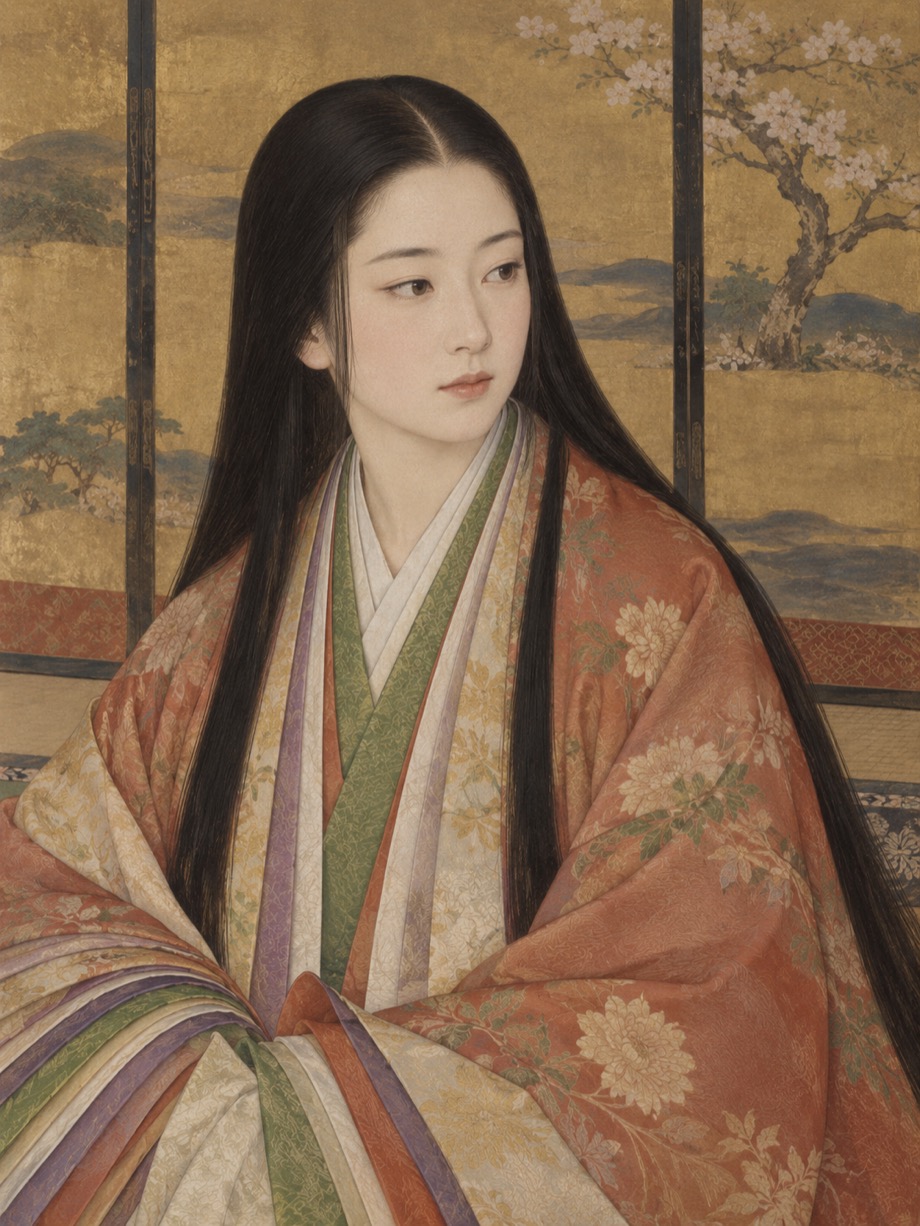
AI-assisted Portrait of Fujiwara no Teishi
The patron who makes an answer possible
In The Pillow Book, Fujiwara no Teishi often begins the exchange that makes Sei Shōnagon memorable. A question about snow becomes an invitation to recognize a Chinese poem. A gift of paper becomes a discussion about what kind of writing might fill it. The empress is not simply a beautiful presence beside a clever attendant. She helps establish the occasion, recognizes the response, and gives learning a social destination.
Teishi’s literary household belonged to the imperial court of her husband, Emperor Ichijō. Her father Michitaka’s position supported its early security; his death and the subsequent political collapse of her brothers weakened it. Much of what makes Teishi individually vivid survives through a writer devoted to her. The tentative ENFJ reading therefore has low confidence: it names the socially responsive patron represented in these scenes, while acknowledging that affectionate commemoration is an interested form of evidence.
Teishi’s tentative ENFJ reading centers on dominant extraverted feeling: the loyal account presents a patron who gives other people’s learning an audience, an occasion, and a place to belong.
An invitation rather than an examination
The snow scene works because Teishi’s prompt is understood. In Fukumori’s discussion, shared Chinese learning becomes something enacted through a gesture. The empress does not need a recitation to establish the attendant’s competence; lifting the blind makes that competence perceptible to the room. Teishi’s participation matters because the exchange is reciprocal. She provides a situation in which knowledge can be recognized without turning every recognition into a formal test.
The arrival scene offers another register. In Waley’s selected translation, the new attendant is embarrassed to show herself and Teishi tries to ease that discomfort. The remembered patron can attend to a person’s difficulty entering the household, not only to the brilliance displayed after entry. This makes the proposed feeling interpretation more specific than the claim that a woman with attendants must have been socially skilled. It concerns the depicted adjustment to another person’s immediate vulnerability.
The limitation is considerable. Shōnagon selects the scene and supplies its emotional emphasis. An attentive gesture may be characteristic, exceptional, or especially valuable to a writer who wants to explain why this patron deserved loyalty. The evidence supports a responsive literary portrait; it cannot establish equal warmth toward every dependent person. Rank makes this household possible, and hospitality within its circle need not imply an expansive ethic beyond it.
A household given coherence through culture
The paper episode presents patronage as more than payment. Teishi asks what the material should become, and an attendant’s wordplay suggests a project. Fukumori treats the account as an origin narrative whose apparently casual conversation may conceal a more collective cultural purpose. Teishi’s salon offers resources and recognition that make writing possible. We should not assert that she planned every feature of The Pillow Book, but neither should its declaration of privacy make the household disappear.
The tentative auxiliary introverted intuition reading rests on the coherence of this represented patronage. Learning, conversation, and literary creation appear to reinforce a particular household identity. The patron helps sustain a circle that understands what kinds of response count as excellent. This could indicate an ability to hold a shared cultural direction in view. It could also be the effect of the author’s arrangement: a coherent empress emerges because a coherent memorial needs her at its center.
For that reason, the inference is weaker than the evidence of responsiveness. A remembered conversation supplies no independent account of long-range intentions. Teishi’s institutional position and family interests already explain why cultivating a distinguished household was useful. Personality enters only as a possible account of how she participated in that work. The model should illuminate the difference between an inviting question and a command, without inventing a hidden master plan behind either.
Grace remembered while security disappears
Michitaka died in 995. Korechika’s reversal and exile in the following year damaged the family’s position, while Michinaga’s rise eventually placed his daughter Shōshi alongside Teishi as an empress. These changes make the book’s gracious scenes historically charged. Remembered exchanges can preserve the value of a household that no longer possesses the same political leverage. Their brightness does not prove that Teishi was indifferent to danger, or that she possessed an invulnerably optimistic temperament.
Teishi died following childbirth in 1001 by Western calendar reckoning. Accounts using the Japanese lunar year may describe the death as occurring in 1000; those datings should not be treated as evidence for two separate events. The loss gives the literary portrait a powerful afterlife. It is tempting to let tragedy certify all the qualities the attendant loved, but sympathy is not corroboration. A person can deserve remembrance while the sources remain insufficient to recover the full range of her conduct.
Why this tentative reading?
Why not ESFJ?
Both readings could explain the patron’s sensitivity to household relationships. ENFJ is only a tentative preference because the scenes connect responsiveness with a cultivated shared identity and the encouragement of new literary expression. The surviving account does not securely distinguish that pattern from careful stewardship of established courtly expectations.
The distinction remains subordinate to the source problem. A patron’s ability to recognize wit is not automatically a dominant function, and successful hospitality is not a psychological measurement. Low confidence preserves the possibility that Shōnagon’s affectionate composition, rather than Teishi’s stable personal preferences, accounts for much of the pattern.
Connected Figures
Further Reading
- The Pillow Book — Sei Shōnagon; translated by Meredith McKinneyRead the lists alongside the court narratives, attending to the difference between remembered occasions and the narrator’s presentation of them.
- Sei Shōnagon the Essay / Ese-ist: Delineating Differences in Makura no sōshi — Naomi FukumoriExamines the book’s origin story, its ordering of differences, and the possible collective purposes behind its apparently private miscellany.
- Chinese Learning as Performative Power in Makura no sōshi and Murasaki Shikibu nikki — Naomi FukumoriExplains how classical knowledge could become a social performance within women’s court households, rather than a simple measure of solitary scholarship.
