 Historical Figure MBTI
#1303 · 9-28-26 · Heian Japan
Sei Shōnagon
Court Writer · Author of The Pillow Book
c. 966–after 1017; death date uncertain
10 min read
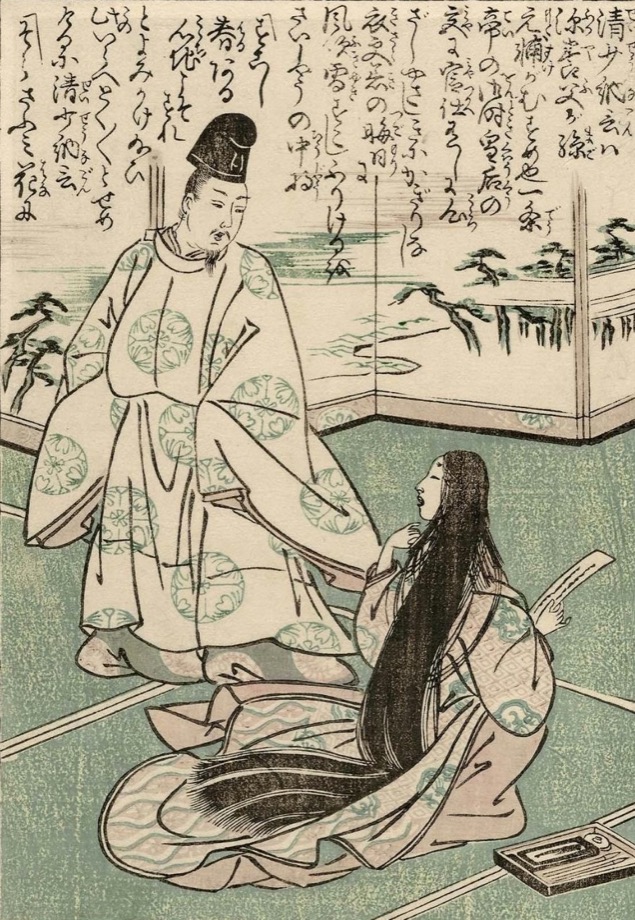
Portrait of Sei Shōnagon — 18th century (later depiction)
The answer is to lift the blind
An empress asks about the snow on a Chinese mountain. Her attendant does not recite an explanation. She lifts the blind. The winter landscape outside supplies the answer, and recognition becomes a shared pleasure. In The Pillow Book, Sei Shōnagon makes a learned allusion happen in a room: remembered poetry changes the meaning of a gesture, and the gesture gives the poem another life. The scene is small enough to fit in a few lines, yet it contains the attraction of her writing. Thought arrives through an unexpected connection and becomes visible before it becomes an argument.
Shōnagon served Fujiwara no Teishi, a consort of Emperor Ichijō, in the literary court of late tenth-century Japan. Her book gathers lists, irritations, recollections, descriptions, and encounters that refuse to settle into a single continuous life story. Its narrator can be dazzling, snobbish, embarrassed, tender, or impatient within a short span. The temptation is to turn that voice into a complete personality. A better reading keeps the historical woman, the remembered speaker, and the author arranging those memories distinguishable even when they overlap.
The tentative ENTP interpretation rests on recurring habits of presentation: an appetite for connections, pleasure in testing distinctions, and an ability to make an exchange move in an unforeseen direction. It does not rest on treating every clever reply as spontaneous or every list as a transcript of her mind. The surviving work offers a sustained intellectual manner, but it also offers a carefully managed public self. Medium confidence concerns that repeated manner, with substantially less confidence about the whole person behind it.
The tentative ENTP reading begins with dominant extraverted intuition: Shōnagon repeatedly turns an occasion into an unexpected connection, then lets an audience discover why it works.
A world that keeps suggesting another world
The snow episode gains its force from the distance it crosses. An imperial room in Japan and a Chinese poetic landscape become momentarily continuous. Shōnagon’s response is neither a literal report on the weather nor a display of the entire source poem. It selects the part of the occasion that can become another thing. Naomi Fukumori’s analysis emphasizes the social performance of Chinese learning here: the empress supplies a recognizable cue, and her attendant makes recognition pleasurable. The exchange belongs to a cultivated circle rather than to an isolated prodigy surrounded by people incapable of understanding her.
That movement offers a useful analogy for extraverted intuition. A present detail opens a possibility beyond its immediate use. Learning supplies material for fresh combinations rather than only a store of correct answers. Across The Pillow Book, the narrator can make a room, a message, a season, or a visitor disclose an unexpected relation. Her energy lies in finding the turn that other people have not yet made. This is an interpretation of a repeated literary habit; the book cannot establish how often the historical Shōnagon thought this way when no memorable exchange was available.
The lists pursue a similar freedom. Their categories bring unlike objects together under a temporary heading, inviting the reader to experience the pleasure or absurdity of the connection. A grounded boat and a fallen tree can belong beside a socially diminished person because each supplies an image of lost effectiveness. The category creates a new neighborhood for familiar things. It is less a final inventory of the world than an experiment in what can be seen together. Readers can dispute an entry, extend the grouping, or notice that its principle shifts as the sequence unfolds.
Calling this imaginative does not mean that it is detached from material life. The possibilities begin in exact situations: a screen, an expected visitor, a piece of paper, the arrangement of people who can and cannot see one another. Her writing often changes the conceptual frame while keeping the occasion sharply present. The inference toward intuition comes from the movement between frames, not from overlooking sensory description. Indeed, the detail makes the unexpected connection land. Without the visible blind and actual snow, the learned answer would be merely another quotation.
The pleasure of making a distinction hold
Shōnagon’s categories are not all harmonious. A heading can promise that two things cannot be compared, then place them side by side so that the reader has to consider the terms of comparison. That tension is part of the pleasure. The narrator draws lines and makes the drawing of lines available for scrutiny. Her judgments frequently depend on the exact relationship between an expectation and its fulfillment: not simply whether a visitor arrives, but whether the visitor is the one whose arrival would transform the waiting.
This supports a tentative auxiliary introverted thinking reading. The evidence is not that she practices formal logic or is incapable of feeling. It is her recurring interest in the internal terms of a situation: what makes an action apt, what makes a classification convincing, and why a seemingly similar case fails. The chosen example must satisfy the distinction she has established. When it does not, she often exposes the mismatch instead of smoothing it over for the sake of agreement. Her prose turns taste into something the reader can inspect, even when the judgment remains personal.
The book’s origin story makes a comparable move with language. In Fukumori’s discussion, Korechika brings paper, Teishi asks what use it should have, and Shōnagon supplies the pillow suggestion through a play on words. A possible writing project emerges from a verbal relation. The story need not be accepted as a documentary record of an instantaneous invention to show what the author values in her self-presentation. She gives the consequential answer a compact intelligibility: a turn of language can account for the title and make an apparently casual exchange feel formative.
The same distinction-making can become narrow or cruel. Confidence in one’s criterion does not guarantee that the criterion is fair. A narrator who notices exactly how a performance misses its mark can expose pretension, but can also humiliate someone who lacks the resources to perform correctly. Typology should not convert those judgments into evidence of superior intelligence. The important pattern is the insistence that a particular assessment can be made and defended. Its ethical quality must be evaluated separately from the mental style proposed to explain it.
Wit needs someone to receive it
The voice that later readers remember as fearless also remembers entering service in embarrassment. In Arthur Waley’s selected translation, the new attendant hides herself while the empress tries to put her at ease. This is useful resistance to a flattened portrait of the permanently confident conversational victor. The author chooses to preserve dependence, hesitation, and the difficulty of becoming visible in a highly ranked household. Her assured literary persona does not erase the social conditions that made assurance possible.
The tentative tertiary extraverted feeling reading concerns her attention to reception. A reply matters partly because someone recognizes it, laughs, approves, or remembers. Teishi’s responsiveness gives many scenes their emotional center. The household’s shared standards enable the exchange, and the narrator records who understands how to participate. Yet social attentiveness is not identical to generosity. It can enforce the circle’s exclusions as readily as it creates intimacy. Rank, education, clothing, and the ability to answer appropriately all shape whose presence the narrator finds welcome.
The beggar scenes in Waley’s translation make the discomfort concrete. The women can treat an old woman’s performance as entertainment and reproduce it for amusement. Another appeal can elicit the narrator’s sympathy and a gift of clothing. These are not convenient proof of either universal compassion or universal heartlessness. They reveal how judgment changes with presentation and circumstance inside an unequal social world. An account of her personality that omits the contempt is too comfortable; one that reduces her to contempt misses the variation she herself records.
Her loyalty to Teishi also affects selection. Remembering the salon’s grace preserves a household whose political security deteriorated. The literary achievement is not therefore politically innocent, even when an individual scene seems to concern only manners or weather. A successful exchange can become evidence that this was a world worth remembering. The author’s responsiveness to a shared audience thus has two levels: the immediate listeners within the scene and later readers invited to recognize the value of the lost circle.
Memory is an art of arrangement
The Pillow Book survives in differing textual traditions. Its order and boundaries should not be imagined as a single untouched notebook pulled from beneath a pillow. Fukumori questions easy assumptions about privacy and draws attention to the courtly resources behind its composition. Paper, patronage, literary knowledge, and eventual circulation complicate the narrator’s declaration that she wrote for herself. A claim of accidental exposure can be part of a work’s account of its own legitimacy, rather than sufficient proof that no audience was anticipated.
This matters especially for the proposed function stack. Vivid recollection does not by itself establish introverted sensing, and a work arranged around remembered occasions cannot measure an inferior function. The stack names the model attached to the editorial type, not four independently demonstrated historical mechanisms. The stronger evidence concerns the repeated movement from occasion to possibility, followed by the scrutiny of fit. The weaker evidence concerns how that intellectual manner related to her habits of continuity, security, and everyday obligation.
Later images of Shōnagon add another layer. The sharp-tongued rival, the liberated wit, the vulgar show-off, and the modern essayist each select features that different readers find useful. Ivanova’s reception study follows these changing appropriations. The history of interpretation warns against congratulating ourselves for having finally recovered a transparent person. Even the favorable ENTP label could become another costume if it makes the book answer only the questions that a modern personality scheme has taught us to ask.
Why this tentative reading?
Why not INTP?
The competing reading has real strength: Shōnagon tests categories and enjoys precision. ENTP fits the presented voice somewhat better because the distinctions repeatedly emerge through outward encounters, verbal invitations, and possibilities made available to an audience, rather than through a sustained withdrawal into an autonomous explanatory system.
The difference is modest and provisional. A literary miscellany naturally highlights striking exchanges, while editing can conceal the quiet thought that prepared them. Extraversion here concerns the direction of the proposed cognitive pattern; it does not mean that Shōnagon was always sociable or free from embarrassment. The case remains open to an introverted reading, and the narrator’s confidence is no substitute for independent biographical evidence. What makes ENTP useful is the combination of inventive association and discriminating argument, not the familiar stereotype of a person who likes to win debates.
Connected Figures
Further Reading
- The Pillow Book — Sei Shōnagon; translated by Meredith McKinneyRead the lists alongside the court narratives, attending to the difference between remembered occasions and the narrator’s presentation of them.
- Sei Shōnagon the Essay / Ese-ist: Delineating Differences in Makura no sōshi — Naomi FukumoriExamines the book’s origin story, its ordering of differences, and the possible collective purposes behind its apparently private miscellany.
- Chinese Learning as Performative Power in Makura no sōshi and Murasaki Shikibu nikki — Naomi FukumoriExplains how classical knowledge could become a social performance within women’s court households, rather than a simple measure of solitary scholarship.
- Unbinding The Pillow Book: The Many Lives of a Japanese Classic — Gergana IvanovaTraces changing interpretations of the book and its author, reminding readers how much their familiar portrait owes to later reception.
