 Historical Figure MBTI
#1309 · 9-29-26 · Heian Japan
Koshikibu no Naishi
Waka Poet · Court Attendant
birth unknown–1025; died in her twenties
5 min read
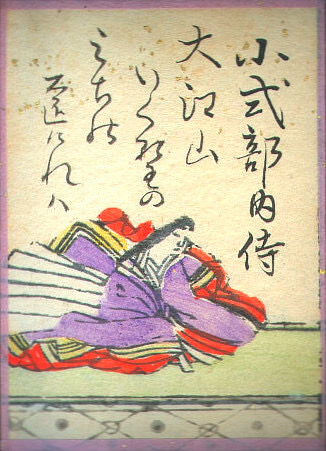
Portrait of Koshikibu no Naishi — Edo period (1603–1868) (later depiction)
A daughter answers under her own name
Koshikibu no Naishi’s most famous poem survives beside a challenge to her independence. In the familiar anecdote, Fujiwara no Sadayori teases her about obtaining help from her mother, Izumi Shikibu, then away in Tango. The response turns the route to Tango into a verbal demonstration of competence. The suggestion that she cannot compose alone is answered by a poem whose construction makes dependence difficult to maintain.
The scene is memorable, but its evidentiary status matters. It is transmitted in poetic headnotes and later anecdotal literature, including Toshiyori Zuinō, written long after her death. It tells us how her reputation was defended and remembered. It cannot supply an exact transcript of an encounter, still less a full psychological portrait assembled from one successful reply.
Koshikibu remains Untyped. Her birth date is uncertain, and she died in 1025 while still in her twenties. A small body of attributed verse, court service, family connections, and an unusually famous anecdote establish a historical poet. They do not establish sufficiently varied personal behavior to classify her responsibly. That restraint makes room for her achievement without requiring an invented temperament.
A route becomes the means of an answer
The poem chosen as number sixty of the Hyakunin Isshu names Ōeyama, Ikuno, and Amanohashidate. The distance to Tango provides its apparent subject. The word fumi allows the thought of traveling or stepping to coexist with the thought of a letter. On one level, the speaker has not crossed that long road. On another, she has not even received the written assistance implied by the accusation.
The arrangement does more than deny that a messenger has returned. It makes the denial perform the skill being doubted. An explanation that she had written the poem herself would still depend on being believed. An accomplished answer gives the audience something to judge directly. The anecdote understands authorship as a public contest in which the form of the reply can become evidence.
The place names are therefore working parts of the poem, not an itinerary from which every journey in her life can be reconstructed. Amanohashidate evokes a recognizable location and helps fix the geographical distance; Ikuno participates in the movement of the language. A translation often needs explanation to preserve these simultaneous effects. That difficulty marks an achievement in Japanese verbal craft, rather than a defect in the poem.
The story also exposes an unequal burden. A daughter of a celebrated poet can inherit access, reputation, and suspicion together. Her accomplishment may be understood as borrowed before it is examined. We cannot measure how often Koshikibu encountered such skepticism, but the remembered scene shows that literary tradition found the problem intelligible. Her mother’s fame becomes both a resource and an obstacle in the telling.
Court service was a setting for literary work
Koshikibu and her mother served Fujiwara no Shōshi around the beginning of the eleventh century. The imperial household brought women writers into a setting where poems accompanied communication, ceremony, and reputation. Being a court attendant was not simply proximity to a royal name. It involved participation in a social world whose expectations made accomplished language consequential.
The small surviving poetic corpus should not be taken as a reliable measure of everything she composed. Selection and preservation can produce an uneven record. A few poems in imperial anthologies may reflect what later compilers valued and what was available to them, rather than the complete extent of a working poet’s output. Conversely, missing work cannot be invented in order to enlarge her career.
Her distinction from Izumi matters here. The mother’s more extensive verse and relationship narrative have often drawn the daughter into a supporting role. Koshikibu had her own court position, attributed poems, and relationships. A portrait can acknowledge those facts without assuming that the two women had identical artistic priorities or that the daughter’s voice is merely a smaller version of the mother’s.
Court connections also carried personal and dynastic consequences. Encyclopedic accounts associate Koshikibu with children by Fujiwara no Norimichi and Fujiwara no Kinnari. Details vary across sources, and they should not be expanded into reconstructed conversations or a confident romantic itinerary. These connections place her within aristocratic society. They do not justify treating her short life as a list of lovers.
The death belongs to two different records
Koshikibu died in 1025 after bearing a child. The uncertainty surrounding her birth prevents an exact age from being asserted, though the sources place her in her twenties. The basic loss is more secure than the elaborated accounts of prayers, temporary recoveries, or final exchanges that entered later storytelling. Those accounts belong to the history of how maternal grief and poetic power were remembered.
Izumi’s mourning poems give the daughter’s death an enduring presence in literary memory. They document a voice of bereavement, but they are not a substitute for the daughter’s own work. Reading only the mother’s grief can make Koshikibu appear to exist principally as someone lost. Reading her attributed verse restores another relation: she was a maker of language before she became the subject of lament.
Later anthologies and images repeatedly returned to the Ōeyama answer. The repetition made one incident stand for a whole person. Its appeal is understandable: a young poet demonstrates competence in the very act of refusing a slight. The price of that clarity is compression. The remembered scene is a strong literary portrait and a thin behavioral record. Both facts should remain visible together.
Connected Figures
Further Reading
- Pictures of the Heart: The Hyakunin Isshu in Word and Image — Joshua S. MostowReads canonical poems alongside the commentary and images that shaped their reception.
- Toshiyori Zuinō — Minamoto no ToshiyoriA later poetic treatise transmitting the celebrated anecdote, to be distinguished from contemporary testimony.
- Traditional Japanese Literature: An Anthology, Beginnings to 1600 — Edited by Haruo ShiranePlaces court poetry and anecdotal literature within their different genres and historical settings.
