 Historical Figure MBTI
#1310 · 9-29-26 · Heian Japan
Ise no Taifu
Waka Poet · Imperial Attendant
fl. early–mid-11th century; exact dates unknown
5 min read
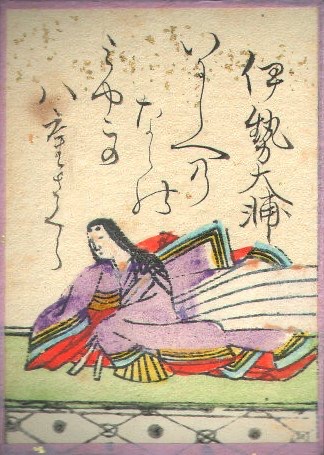
Portrait of Ise no Taifu — Edo period (1603–1868) (later depiction)
A new attendant receives the blossoms
Ise no Taifu’s best-known appearance begins with something handed over. Cherry blossoms from Nara arrive at the imperial household, and the new attendant is asked to receive them and compose an appropriate poem. In the traditional account, Murasaki Shikibu passes the task to her. The occasion tests an ability essential to court literary life: make words answer a particular gift, in front of people capable of judging the answer.
The resulting verse became number sixty-one of the Hyakunin Isshu. It draws the flowers’ old capital and their present destination into one compact compliment. The poem’s fame has often made that introductory scene seem like the whole career. In fact, Ise no Taifu continued to participate in court poetry across decades, leaving work associated with contests, celebrations, and a personal collection.
Her exact birth and death dates are unknown. She remains Untyped because the record does not supply sufficiently varied evidence of her everyday judgment or inward priorities. An accomplished occasional poem can establish professional skill without establishing a stable personality preference. Her service and later caregiving likewise deserve historical attention without being used as a shortcut to psychological classification.
Eightfold flowers at a ninefold palace
The poem places the double cherry blossoms of old Nara in the palace of the present capital. The numerical relation between eightfold blossoms and the ninefold palace helps the language move from one location to another. The reference to the palace is a conventional expression rather than an architectural inventory. The verse praises through an inherited vocabulary whose associations a court audience could recognize.
The movement is temporal as well as spatial. Nara is the old capital, but the flowers are not made obsolete by that history. Their beauty becomes present in Kyoto. The poem can acknowledge continuity while affirming the current court’s distinction. A gift from an earlier center becomes a means of honoring the household receiving it, so the compliment accomplishes more than a description of pretty blossoms.
This is a useful example of the practical work performed by court poetry. A response turns receipt into recognition. It marks attention to the giver’s offering while locating the recipient within a larger cultural landscape. The poem is aesthetically accomplished and socially useful at the same time. Separating those functions too sharply would make the occasion harder to understand.
The traditional account gives Murasaki a role in creating the opportunity. It should not automatically be retold as an act of jealousy, hazing, or deliberate rescue. Those motives require evidence beyond the transfer of a task. What the story makes visible is a setting in which a newcomer’s competence can become apparent through performance. Its dramatic economy should not become permission to invent what either woman thought.
A working poet over many years
Ise no Taifu was a daughter of Ōnakatomi no Sukechika, from a family connected with ritual office and poetry. Her court name reflects that institutional background. The name Ise must not cause her to be confused with the earlier poet known simply as Ise. Distinguishing them preserves two different careers and prevents poems or relationships from migrating between biographies.
She entered the service of Fujiwara no Shōshi around 1008. Her activity extended into the middle of the century, including formal poetic occasions in the 1030s, 1040s, and 1050s. The chronological range matters more than a falsely exact lifespan. It shows that a celebrated beginning did not exhaust her contribution and that her competence continued to be called upon in changing circumstances.
The personal collection called Ise no Taifu Shū and poems preserved in imperial anthologies provide a wider literary record than the one famous verse. Their transmission still needs to be considered. A collection may have different arrangements and textual forms, and an anthology selects for particular purposes. The surviving work is evidence of a career mediated by copying and editorial judgment, not a complete diary of professional life.
Scholarly descriptions emphasize her handling of associated words and pivot words. These techniques permit one expression to connect several meanings and give an occasional poem density without making it long. Familiarity with a shared poetic language was the condition of such invention. The discipline needed to produce it should not be flattened into either effortless inspiration or mechanical adherence to tradition.
Household relationships without a recovered temperament
Ise no Taifu married Takashina no Narinobu and had daughters who also became known through court service and verse. The family connections place literary practice within a household as well as an imperial institution. Skills, opportunities, and reputations could pass through those settings without making every family member artistically identical. Her descendants’ accomplishments do not supply missing details of her own personality.
Later she was entrusted with the care of Prince Sadahito, the future Emperor Shirakawa. That service is evidence of standing and responsibility. Descriptions of a gentle character occur in the biographical tradition, but the assignment alone cannot prove a particular inward disposition. A person may be chosen for experience, family connections, reliability, or several reasons that the record does not fully disentangle.
The same caution applies to religious withdrawal late in life. Where details are uncertain, the biography should not supply a dramatic conversion or final renunciation merely because such an ending would feel appropriate. Her known activity extends to around 1060, but exact death dates proposed in later reference works remain qualified. A long career can be recognized without pretending that its last scene survives.
Connected Figures
Further Reading
- Pictures of the Heart: The Hyakunin Isshu in Word and Image — Joshua S. MostowReads canonical poems alongside the commentary and images that shaped their reception.
- Traditional Japanese Literature: An Anthology, Beginnings to 1600 — Edited by Haruo ShiraneIntroduces the conventions and social occasions that made court verse a working art.
- Ise no Taifu — Osamu Ueno and Kiyoshi Inukai, in Japanese encyclopedias collected by KotobankBiographical entries identify her family, long poetic activity, and uncertain dates.
