 Historical Figure MBTI
#1311 · 9-30-26 · Heian Japan
Genshin
Tendai Monk · Author of the Ōjōyōshū
942–1017
6 min read
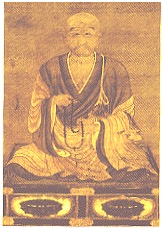
Portrait of Genshin — 14th century (later depiction)
A Path That Had to Be Practicable
Genshin did not present salvation as an attractive idea detached from the conditions of a practitioner's life. His Ōjōyōshū organized teachings about suffering, Amida's Pure Land, and the practices through which people might seek birth there. His religious activity also involved fellowships in which practitioners supported one another. A tentative INFJ reading concerns that connection between a sustained account of the spiritual path and guidance directed toward other people. It remains low confidence, because a doctrine is not a transparent description of its author's personality.
Born in 942, Genshin received training within the Tendai community of Mount Hiei and became associated with its Yokawa sector. Ryogen's leadership supplied part of his institutional setting. The Ōjōyōshū, completed in 985, assembled material from inherited scriptures and commentaries. Its achievement lay in selection, arrangement, and interpretation, rather than in inventing Amida devotion or replacing the entire Buddhist tradition with a new religion.
His later reputation must also be separated from the independent Pure Land schools that developed after his lifetime. Genshin remained a Tendai monk. His work could influence later teachers without expressing all of their positions in advance. Treating him only as a precursor obscures the religious community, doctrinal questions, and practical relationships in which he actually worked.
INFJ is a low-confidence interpretation of dominant Introverted Intuition: Genshin drew inherited teachings into a coherent account of the spiritual path and its implications for practice.
An Ordered Account of Suffering and Release
The Ōjōyōshū moves from the suffering of ordinary existence toward the advantages of the Pure Land and the means of seeking birth there. The sequence matters. Vivid descriptions of painful rebirth are not independent tales of cruelty supplied for entertainment. Within the work's religious argument, they help explain why an attachment to the present condition should give way to a different aspiration. The desired destination then makes sense within the account of what is being left behind.
Introverted Intuition is proposed cautiously for this sustained arrangement of material into an intelligible direction. Genshin makes many inherited passages participate in an account of what a practitioner should understand and do. It would be insufficient simply to call him visionary because he discusses another realm. The stronger evidence concerns the relation among the parts of his argument, while the limitation remains that systematic religious writing was also a scholarly task.
The work does not reduce nenbutsu to one uncomplicated action. Contemplative practices and recitation occupy different places in its discussion. Their presence shows attention to capacities and circumstances rather than a universal assumption that every practitioner can perform the same demanding exercise. The interpretation must preserve those distinctions instead of projecting the later exclusive emphasis of another teacher backward onto Genshin.
Practice in the Company of Others
The devotional groups around Yokawa make Genshin's career larger than the story of a solitary author. Practitioners gathered, recited, made commitments, and attended to one another near death. A person's final concentration could depend on the people present, the arrangement of the room, and the assistance available during illness. The aspiration toward another realm therefore required obligations enacted in this one.
The fellowship of twenty-five established in 986 is a useful example, but its chronology should not be simplified. Genshin was important in its subsequent life; the surviving evidence does not justify calling him its sole founder or assuming that it was created to implement every instruction in his book. Texts associated with the group have their own transmission and attribution problems. The relationship between author, fellowship, and handbook needs to be demonstrated rather than presumed.
Extraverted Feeling is a tentative description of his guidance within such relationships. The proposal concerns organized spiritual assistance and the recognition that another person's practice can require companionship. It does not claim that a religious office proves exceptional empathy or that every covenant was written by Genshin himself. The shared commitments belong to a community whose members also exercised initiative.
Learning within Tendai
Genshin's scholarship extended beyond the subjects for which he later became most famous. The Ichijō yōketsu, written in 1007, defended the possibility of Buddhahood for all beings through the Lotus Sutra's teaching of the One Vehicle. This concerns a doctrinal dispute within Buddhism, not a modern declaration that all religious differences are inconsequential. His Pure Land interests and his Tendai commitments should be understood together.
That wider learning changes how his reputation is read. A later biography organized around Pure Land birth can emphasize one set of writings and experiences, while a narrative praising the Lotus Sutra can emphasize another. Neither selection captures the whole person. Different accounts may preserve useful evidence while also teaching readers which devotional commitments deserve confidence.
Miraculous dreams and visions form part of these narratives. They are evidence for religious memory and the aims of the biographer, not independently verified encounters through which to reconstruct Genshin's temperament. Excluding them from the personality argument does not require dismissing their historical significance. The distinction is between what believers narrated about a holy teacher and what can support an inference about recurring personal conduct.
Influence Was Not Immediate Uniformity
The Ōjōyōshū became an important work, but its later prominence should not be mistaken for instant, universal reception in 985. Evidence for editions, quotations, images, and devotional use comes from different times. Sarah Horton's study of early eleventh-century sources cautions against making the book alone explain the spread of Pure Land practice. Fellowship activity can be historically consequential even where the text itself is rarely mentioned.
This distinction also guards the personality interpretation. The subsequent reach of a work cannot establish that its author possessed extraordinary interpersonal insight in every situation. Genshin's more defensible pattern lies in connecting a considered doctrinal account to specific communities and problems of practice. Its effectiveness depended on readers, collaborators, inherited traditions, and later interpreters as well as on the scholar who assembled it.
He died in 1017. Accounts of his final hours became part of the devotional record, while his writings continued to circulate. The historical teacher thus stands at the intersection of text and relationship. Neither the image of an isolated thinker nor that of an uncomplicated popular preacher is adequate to the combination of scholarship and communal religious work visible in his career.
Testing the INFJ Reading
Why not INTJ?
INTJ is plausible for the synthesis and precision of Genshin’s scholarship. INFJ is preferred tentatively because the proposed pattern connects the account of the path with guidance and reciprocal spiritual support. That distinction remains weak: religious institutions can require both systematic teaching and care regardless of the teacher’s everyday temperament.
The reading is low confidence and describes a limited public pattern. It cannot infer a complete private mind from a religious treatise, a fellowship’s rules, or later stories of holiness.
Connected Figures
Further Reading
- Genshin’s Ōjōyōshū and the Construction of Pure Land Discourse in Heian Japan — Robert F. RhodesA study of Genshin’s life and teachings that places his major work within earlier Tendai and Pure Land traditions.
- The Teachings Essential for Rebirth: A Study of Genshin’s Ōjōyōshū — Allan A. AndrewsA foundational English study with partial translation; later scholarship revises aspects of its account of early reception.
- The Influence of the Ōjōyōshū in Late Tenth- and Early Eleventh-Century Japan — Sarah HortonA reassessment of early reception that distinguishes the influence of a text from the activity of religious fellowships.
- Preparing for the Pure Land in Late Tenth-Century Japan — Richard BowringAn article translating and examining the vows and covenants of a fellowship organized around care at the approach of death.
- The Cambridge History of Japan, Volume 2: Heian Japan — Donald H. Shively and William H. McCullough, editorsHistorical studies of aristocratic government, religious institutions, and the social settings of Heian Buddhism.
