 Historical Figure MBTI
#1313 · 9-30-26 · Heian Japan
Kūya
Religious Teacher · Public Nenbutsu Practitioner
903–972
6 min read
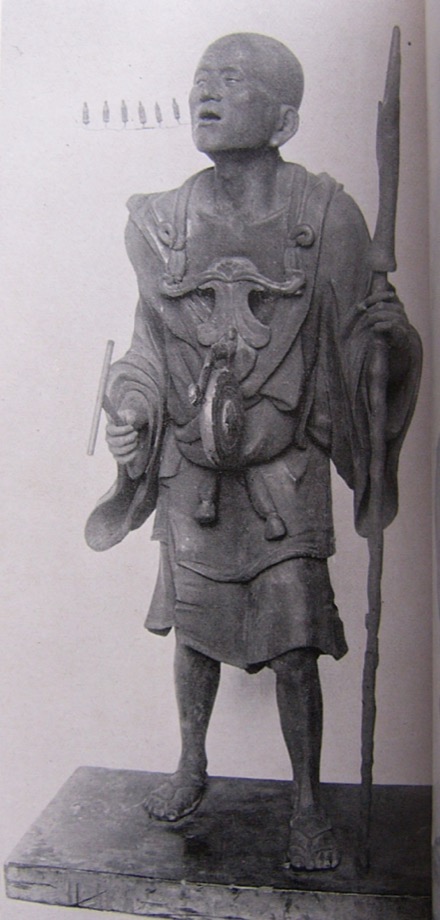
Kūya — early 13th-century statue by Kōshō, photographed 1933 (later depiction)
Practice Where People Lived
Kuya's remembered religious work repeatedly encounters ordinary needs: a difficult road, access to water, neglected remains, or a person in distress. Amida recitation belongs to those encounters, but does not exhaust their meaning. A tentative ESFJ interpretation concerns the association of teaching with practical attention to other people. Confidence is low because the earliest accounts praise a holy practitioner and combine plausible activity with sacred narrative.
Conventionally dated 903–972, Kuya became known as a holy man of the marketplace. His origins are uncertain. Claims of imperial descent appear in religious tradition, but should not become a securely identified parentage. The early eulogy by Minamoto no Tamenori explicitly acknowledges the lack of disclosed family information. That uncertainty is preferable to a dramatic story that the surviving evidence cannot establish.
Kuya's career also resists a simple opposition between popular religion and formal Buddhism. His public activity coexisted with learning, ordination, patronage, and major ceremonies. The different connections help explain how a mobile practitioner could also support substantial religious works. A later image of an isolated wanderer cannot stand for the whole range of his relationships.
ESFJ is a low-confidence reading of dominant Extraverted Feeling: the early representation of Kuya repeatedly joins religious instruction to care enacted among other people.
Care Made Available
The eulogy remembers Kuya relieving difficulty along routes and in inhabited places. It associates recitation with acts that could benefit travelers, residents, and the dead. These are claims made by a praising author, not a modern audit of every project. Even so, their recurrence establishes the kind of conduct through which an early witness wanted Kuya understood: religious practice directed outward into encounters with need.
Extraverted Feeling is proposed cautiously for that orientation. It does not follow automatically from calling someone compassionate. The specific pattern is that instruction and assistance occur together, rather than making the recipient's spiritual problem the only concern. The limitation is substantial: the eulogist may select examples because they embody a religious ideal, leaving less exemplary conduct outside the account.
Descriptions of compassion can also include miraculous recognition, dreams, or transformed beings. Those episodes should not be stripped of their religious form and then treated as ordinary psychological observations. They show how a sacred biography makes holiness convincing. Excluding supernatural events from the type argument leaves the representation's practical orientation available for discussion without claiming that every narrated encounter happened as written.
A Shared Practice Repeated in Daily Life
Amida recitation supplied a practice that could be repeated and shared. Kuya's remembered presence in the capital from 938 connected it to everyday spaces rather than reserving it for learned exposition. The familiar designation as a marketplace holy man reflects that association. It is a historical reputation, however, not proof that every social group responded to him in the same way.
Introverted Sensing is proposed for the continuity of a recognizable practice across changing encounters. The inference concerns repeated conduct rather than a private preference for routine that no source independently observes. Recitation itself was part of a religious tradition; other practitioners could perform it for different reasons. Its value here comes from its continuing connection to public service in the accounts of this particular career.
Nor should he be made the uncomplicated inventor of all later dancing nenbutsu. Subsequent traditions connected themselves to his name and image. Such claims can establish a lineage of memory while leaving the exact relation between tenth-century practice and later performance uncertain. A history of attribution is more accurate than a story in which one recognizable modern form began complete with one teacher.
Public Work Needed Resources
Kuya's religious activity extended to the production of images and the copying of scriptures. His efforts culminated in a substantial dedication ceremony in 963, remembered through early written evidence as well as temple tradition. Soliciting resources connected a devotional undertaking to donors and skilled makers. Public religious practice did not mean an absence of organization or of relationships with people who possessed wealth. The early account remembers solicitation among rich and poor for images and the production of a large scripture copy. Its emphasis makes participation wider than a single donor’s generosity. The precise distribution of resources is less recoverable than the fact that Kuya’s remembered work drew people together around objects and observances they could help support. The practitioner therefore belonged to networks of giving as well as to encounters with immediate need.
The institution later known as Rokuharamitsuji traces its beginnings to Kuya's Saikoji. Traditional accounts commonly associate its foundation with 951, while the ceremony of 963 records another important stage. These dates describe developments rather than a requirement to select one isolated founding instant. Temples acquire buildings, objects, personnel, and names over time.
The practical scale of such work qualifies a sentimental image of someone whose contribution consisted only in spontaneous kindness. A ceremony required preparation; a copied scripture required materials and labor; a lasting institution required people who continued after its founder. The evidence supports a religious practitioner with varied connections, not a purely informal figure acting without the conditions that made his work possible.
The Holy Man in Text and Sculpture
Yoshishige no Yasutane included Kuya in a collection of accounts of people believed to have attained Pure Land birth. The entry draws on earlier representation rather than providing a second wholly independent observation of his life. The texts therefore need to be compared as related works, not counted as separate witnesses whenever they repeat the same detail. Their purposes include encouraging religious confidence.
The famous standing statue associated with Kosho belongs to the Kamakura period, long after Kuya's death. Its figures emerging from the mouth make recitation visible in sculptural form. It is a powerful interpretation of a remembered practice. Its apparent immediacy should not make it a lifetime likeness or a record of how Kuya behaved while being observed by a contemporary artist.
The difference between early account and later image matters for the personality assessment. A public ideal of service can remain important without yielding secure access to ordinary temperament. The proposed reading concerns the conduct recurrently associated with Kuya in the earlier evidence. It cannot infer sociability from a statue, determine private motives from a miracle story, or explain a thousand years of worship through a four-letter code.
Testing the ESFJ Reading
Why not ENFJ?
ENFJ is plausible for a religious teacher with public influence. ESFJ is preferred tentatively where the accounts emphasize repeated practice and assistance in particular encounters rather than a personally articulated comprehensive program. The distinction is weak because the texts preserve an exemplary representation and relatively little of Kuya’s own explanation of his decisions.
The interpretation stays low confidence. The historical significance of the public practitioner is firmer than a reconstruction of the private person behind the eulogy.
Connected Figures
Further Reading
- Eulogizing Kūya as More than a Nenbutsu Practitioner: A Study and Translation of the Kūyarui — Clark ChilsonAn article with a complete translation of the early eulogy and an analysis of how it constructs a holy life.
- The Cambridge History of Japan, Volume 2: Heian Japan — Donald H. Shively and William H. McCullough, editorsHistorical studies of aristocratic government, religious institutions, and the social settings of Heian Buddhism.
- Genshin’s Ōjōyōshū and the Construction of Pure Land Discourse in Heian Japan — Robert F. RhodesA study of Genshin’s life and teachings that places his major work within earlier Tendai and Pure Land traditions.
- The Three Treasures: A Revised and Illustrated Study and Translation of Minamoto no Tamenori’s Sanbōe — Edward KamensA study and translation of another work by Kuya’s eulogist, useful for its religious and literary setting.
