 Historical Figure MBTI
#1314 · 9-30-26 · Heian Japan
Yoshishige no Yasutane
Court Scholar · Devotional Writer · Monk
c. 931–1002
5 min read
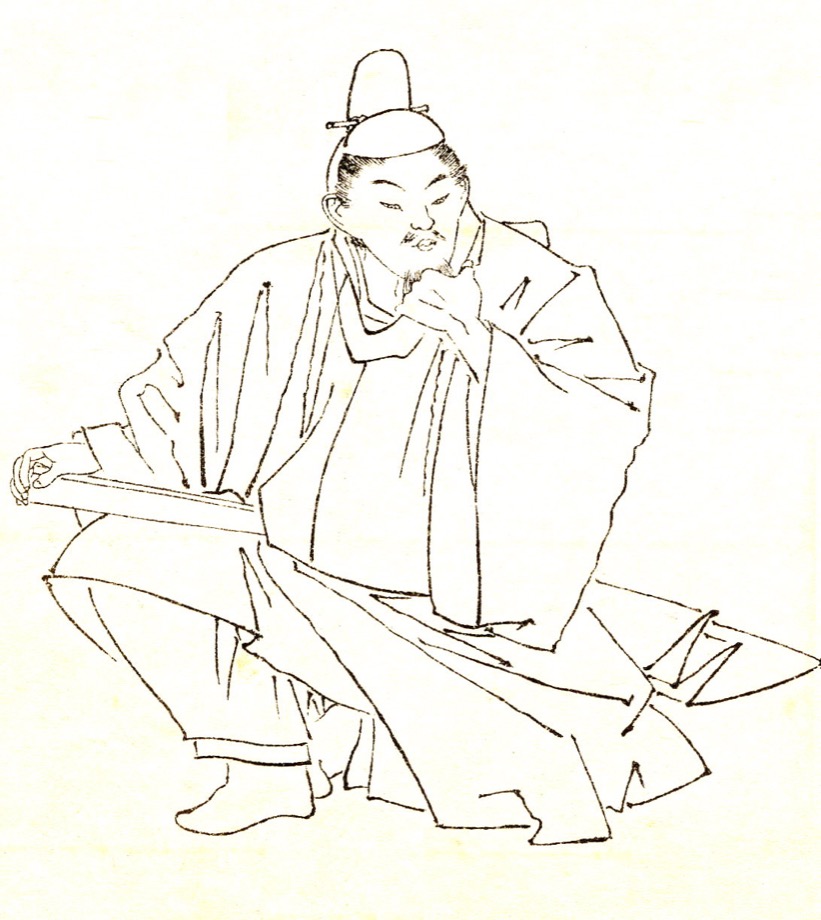
Portrait of Yoshishige no Yasutane — 19th century (later depiction)
An Ideal Given a Place to Live
Yoshishige no Yasutane did not move from court scholarship to religious life in one unexplained gesture. His writing describes an effort to give learning and devotion a fitting place within ordinary existence, followed by eventual ordination. A tentative INFP reading concerns that continuing alignment of conduct with an inward religious ideal. It remains low confidence, because a literary account can shape the self it claims to reveal.
Conventionally born around 931, Yasutane served in the court's learned bureaucracy. Chinese literary and ethical traditions provided resources for his prose, while Buddhist commitments developed alongside official work. His Chiteiki, or Record of the Pond Pavilion, was written in 982. The later monk took the name Jakushin; his career ended in 1002 according to the dating followed here.
INFP is a low-confidence reading of dominant Introverted Feeling: Yasutane’s surviving writing repeatedly considers how a life might become congruent with a personally embraced religious ideal.
Choosing the Terms of a Sufficient Life
The Chiteiki presents a dwelling as a setting in which different obligations can be arranged. Learning, family, and Buddhist practice remain present rather than vanishing into an ideal of total isolation. The account belongs to a Chinese literary tradition of reflective retirement and must be read as a crafted work. It nevertheless makes the question of an appropriately lived life more important than the display of unrestricted advancement.
Introverted Feeling is proposed for that emphasis on the fit between action and an accepted ideal. The evidence is not simply that he preferred a small residence or later became a monk. It is the recurrence of an effort to assess the meaning of his own way of living. Other motives, including status, resources, and literary convention, also shape the account; the proposed vocabulary cannot replace them.
Ordination in 986 changed his formal position, but devotion had preceded it. That continuity prevents the attractive story of an ambitious official suddenly discovering an authentic self untouched by the past. Yasutane's religious life used the learning and relationships cultivated earlier. A change of status could reorganize those resources without making his previous experience meaningless.
Learning and Faith in More Than One Form
Yasutane participated in the Kangakue, a fellowship joining students and monks in literary and devotional activity. Poems composed on Buddhist topics connected cultivated language with religious aspiration. The group provides evidence that learning and faith could reinforce one another through shared work, rather than forming two separate worlds between which a person had to choose absolutely.
Extraverted Intuition is suggested cautiously by the willingness to make different forms serve a religious purpose: literary reflection, devotional gatherings, and exemplary narrative. The inference concerns connections among those activities. It does not follow merely from versatility, and the historical setting offered these forms to other learned practitioners as well.
The Nihon ojo gokurakuki assembled biographies of people believed to have attained birth in the Pure Land. Its preface explains the value of concrete examples for readers who could not grasp or trust the promise through doctrinal statements alone. Yasutane's aim was to encourage aspiration through narrated lives. The collection is therefore an argument in narrative form, not an impartial register of supernatural events.
Other Lives Used as Examples
The collection includes clergy and laypeople, women as well as men. That range broadens the field of religious exemplarity beyond one clerical career. It does not eliminate the social ordering of the text: rank and location can affect arrangement, while women are often identified through relatives or residence rather than personal names. Religious inclusion should not be confused with the disappearance of hierarchy.
Kuya appears among these figures, linking Yasutane's writing to an earlier public practitioner. The account depends in part on existing representation. Its use tells us about what Yasutane wished his readers to consider possible, while its miraculous elements belong to that religious persuasion. They cannot establish the personality of either the subject or the compiler.
His association with the devotional world around Genshin likewise shows that inward aspiration did not require indifference to other people. Religious preparation could involve fellowship, assistance during illness, and concern for another practitioner's final concentration. The precise authorship of particular covenants remains uncertain, so collective commitments should not all be credited to Yasutane personally. The firmer pattern is participation in a learned and devotional network.
Testing the INFP Reading
Why not INFJ?
INFJ is plausible for a writer connecting religious understanding with examples meant to guide others. INFP is preferred tentatively because the proposed pattern begins with his recurring assessment of how his own life should conform to an embraced ideal. The distinction remains weak: the texts serve literary and religious purposes rather than documenting every ordinary decision.
The type stays low confidence. Literary reflection and ordination support an interpretation of recurring commitment, while the private balance of motives remains incompletely recoverable.
Connected Figures
Further Reading
- Japanese Literature in Chinese, Volume I: Poetry and Prose in Chinese by Japanese Writers of the Early Period — Burton Watson, translatorIncludes a translation of the Record of the Pond Pavilion within the tradition of Japanese writing in Chinese.
- Chiteiki — Yoshishige no Yasutane; translated by Donald D. DongA translation with introduction in Monumenta Nipponica, useful for reading the literary construction of a chosen dwelling.
- Ōjōyōshū, Nihon Ōjō Gokuraku-ki, and the Construction of Pure Land Discourse in Heian Japan — Robert F. RhodesAn article comparing systematic doctrine and exemplary biography as different forms of religious persuasion.
- Preparing for the Pure Land in Late Tenth-Century Japan — Richard BowringAn article translating and examining the vows and covenants of a fellowship organized around care at the approach of death.
- The Cambridge History of Japan, Volume 2: Heian Japan — Donald H. Shively and William H. McCullough, editorsHistorical studies of aristocratic government, religious institutions, and the social settings of Heian Buddhism.
