 Historical Figure MBTI
#1315 · 10-1-26 · The Heian–Kamakura Transition
Saigyō
Poet · Buddhist Monk · Traveler
1118–1190
7 min read
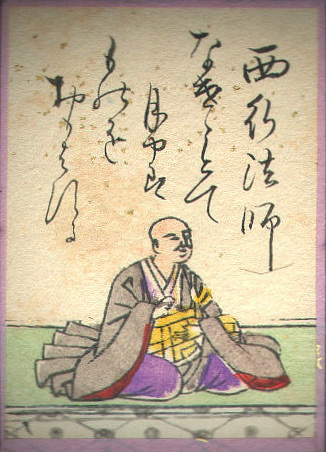
Portrait of Saigyō — Edo period (1603–1868) (later depiction)
Renunciation Did Not End Attachment
Saigyo's entry into Buddhist life did not make poetry, memory, or other people disappear. His work returns to the difficulty of relinquishing attachment while remaining moved by a place, a season, or a relationship. A tentative INFP reading concerns this continuing examination of a chosen vocation. It does not treat every poetic speaker as the author's private voice or infer a personality simply because he left worldly service.
Born in 1118 as Sato Norikiyo, he served in the guard attached to retired Emperor Toba before becoming a monk around 1140. The precise motives for that decision are not securely recoverable. Later stories supply vivid explanations, but religious change need not be attributed to one romantic disappointment or one dramatic encounter. His subsequent career included residence at religious sites, travel, and enduring participation in poetic life.
He lived through conflicts that changed the balance among court and warrior households, dying in 1190 after the Taira defeat. Those events belong to the setting of his journeys and relationships. They should not become a claim that he renounced service because he foresaw the whole political transition or rejected every institution of the society in which he continued to act.
INFP is a low-confidence interpretation of dominant Introverted Feeling: Saigyo repeatedly considers the relation between a chosen religious vocation and the attachments that remain meaningful within it.
A Vocation Reconsidered Through Poetry
Saigyo's poems often place withdrawal beside a feeling that has not conveniently vanished. The tension matters more than an uncomplicated image of serenity. A mountain dwelling can be a setting of religious practice and still contain loneliness, memory, or an unsettled response to the world. These are poetic constructions whose recurrence permits interpretation without turning each verse into a dated entry in a private diary.
Introverted Feeling is proposed cautiously for the sustained question of how an embraced vocation should relate to what remains personally compelling. The inference concerns a pattern across his literary work and the documented change of life. It does not mean that sincerity eliminates convention. A poet can use inherited language precisely because it provides a recognized way to examine a commitment that has not become simple.
Love poems require particular care. Poetry gatherings supplied topics on which a monk could compose, and a speaker longing for an absent lover does not establish a corresponding affair. The religious significance of attachment can be discussed without reconstructing a secret biography. Saigyo's work is most intelligible when literary roles and the historical poet remain connected but distinguishable.
Places Opened Different Questions
Travel brought Saigyo into landscapes already inhabited by poetic and religious associations. A named place could evoke earlier verse, sacred history, remembered figures, and current circumstances. The experience was not merely observation of an untouched natural scene. His writing belongs to a tradition in which recognition and expectation shaped what a poet could make of an encounter.
Extraverted Intuition offers a tentative account of the connections through which a place could become more than one thing at once. Physical surroundings, inherited language, and religious aspiration can meet without resolving into a single explanation. The claim is modest: a repeated literary method may suggest a way of attending, but skill with allusion does not independently establish the author's everyday temperament.
The poems include responses to inhabited places and social life as well as flowers and moons. It would be misleading to assign him a timeless national intimacy with nature. Modern accounts of such a quality can impose later aesthetic and philosophical categories on medieval writing. Saigyo's particular language and religious situation deserve attention before the image of a universally representative Japanese nature poet.
A Monk among Other People
Saigyo did not cease to participate in literary exchange. Shunzei included his work in the Senzaishu, giving the monk's poems a place within an imperial anthology. Such inclusion connected a life outside ordinary court service with institutions of courtly judgment and preservation. The relationship is more specific than the claim that a recluse's genius was eventually recognized by an otherwise separate society.
He also asked the much younger Teika to judge a contest composed from his own poems in 1187. The act complicates an image of complete independence from other people's standards. Saigyo could pursue a distinctive vocation while still requesting learned assessment. The exchange gives evidence of a literary relationship, but not of a modern mentoring arrangement in which every subsequent choice by Teika reflected Saigyo's instruction.
Religious journeys could likewise have practical purposes. Accounts associate his later travel north with seeking support for the rebuilding of Todaiji. Pilgrimage, patronage, and literary encounter could overlap. That setting prevents the reduction of every journey to spontaneous wandering undertaken only to satisfy personal feeling. Religious institutions and the needs of other people remained part of the vocation.
The Journey and Its Retelling
The Azuma kagami records an encounter with Yoritomo at Kamakura during a northern journey. The chronicle is a later account whose political setting and narrative choices need to be kept in view. Its scene is useful evidence for how Saigyo was remembered in relation to military authority. It cannot supply an exact transcript of his tone, establish everything he felt about Yoritomo, or prove a type from a reported refusal or gift.
Later narratives and illustrated accounts gave his renunciation and travels further dramatic shape. Those works are part of his cultural afterlife. They may preserve earlier material, but their vividness does not make them contemporary observation. The monk-poet of historical evidence must remain distinguishable from the exemplary traveler required by a later story.
The same caution applies to his celebrated wish to die beneath blossoms. Its poetic form brings season, religious memory, and aspiration together. The poem can be discussed without claiming that the writer predicted his death or that fulfillment of a literary wish demonstrates supernatural insight. A meaningful coincidence in later narration is not an additional observation of the historical person's mind.
Poetry after the Political Boundary
Saigyo's work acquired renewed authority after his death, including a substantial presence in the Shinkokinshu. The anthology belonged to a later configuration of patronage and criticism. Its use of his poems shows their continuing possibilities for readers and editors, rather than proving that he had composed them as a program for that future collection.
His career therefore crosses the conventional divide between Heian and Kamakura without becoming a symbol of one world simply surrendering to another. Courtly poetry continued, religious communities adapted, and military leaders sought the resources of existing culture. The historical monk acted among those overlapping conditions. His literary achievement does not require him to have stood outside them all.
Testing the INFP Reading
Why not INFJ?
INFJ is plausible for the religious interpretation and recurrent connections among experience, attachment, and impermanence. INFP is preferred tentatively because the proposed pattern centers on a personally chosen vocation repeatedly tested against what remains meaningful. The difference is uncertain: literary and religious conventions shape the surviving evidence for both possibilities.
The reading stays low confidence. A body of poetry allows a sustained interpretation, but does not make a constructed speaker interchangeable with an author observed across ordinary life.
Connected Figures
Further Reading
- Awesome Nightfall: The Life, Times, and Poetry of Saigyō — William R. LaFleurTranslations and historical interpretation; read its account of religious experience alongside later critiques of the nature-poet image.
- Saigyō: Poems of a Mountain Home — Burton Watson, translatorA translated selection useful for attending to individual poems and their different topics.
- Saigyō: A Search for Religion — Takagi KiyokoA scholarly article examining the relationship between priesthood, poetry, travel, and continuing attachment.
- How a Medieval Monk-Poet (Saigyô) and Japan Became Identified with Nature — Mike SugimotoA critique of modern interpretive frameworks that turn the poet into an emblem of a national relation to nature.
- Teika: The Life and Works of a Medieval Japanese Poet — Paul S. AtkinsA modern study drawing on diary entries, poems, criticism, and textual work while distinguishing secure writings from later attributions.
