 Historical Figure MBTI
#1322 · 10-3-26 · The Heian–Kamakura Transition
Minamoto no Yoritomo
Military Leader · Founder of the Kamakura Government
1147–1199
10 min read
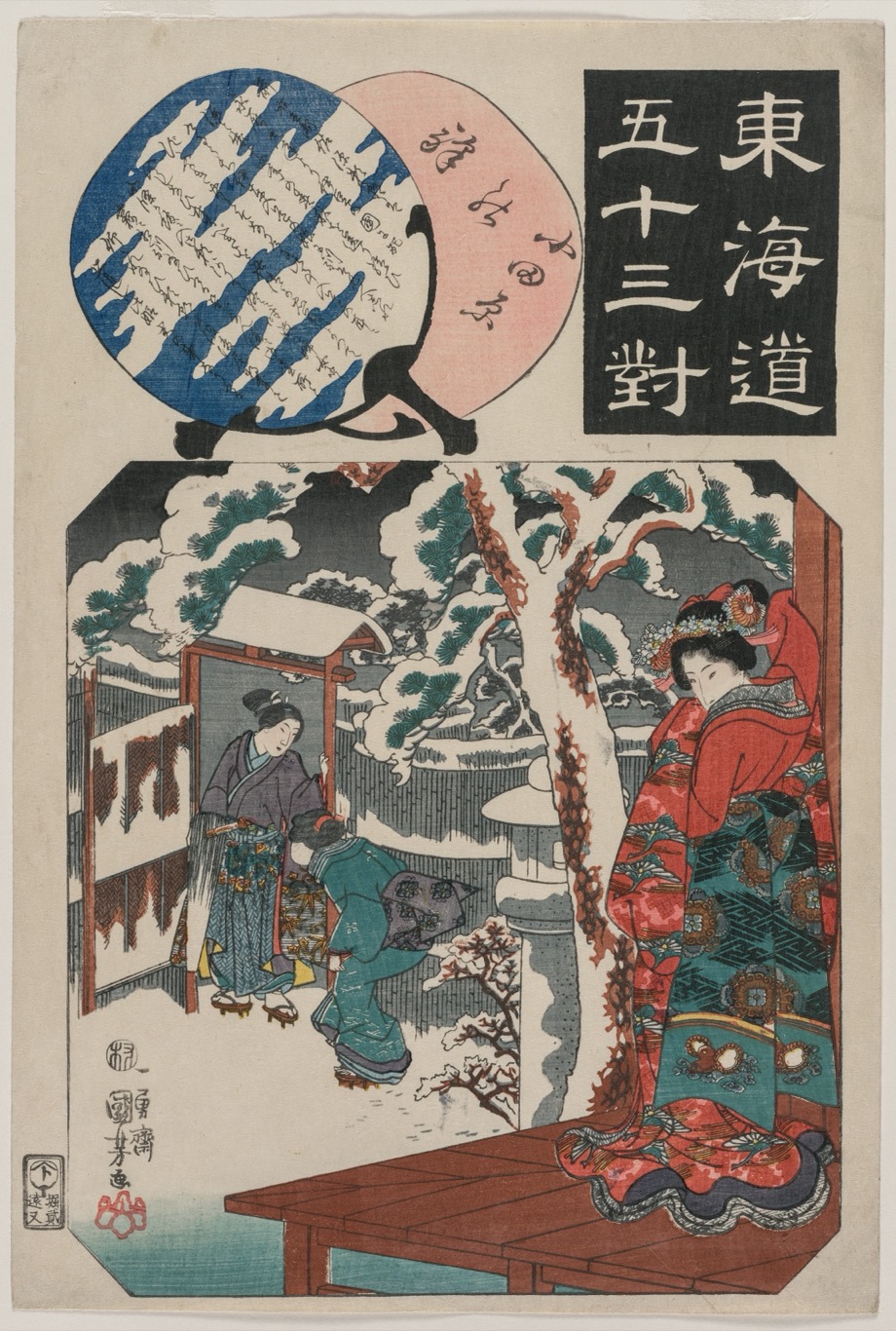
Minamoto no Yoritomo visiting the daughter of Itō Nyūdō — mid-1840s (later narrative depiction)
The center that stayed behind
The great battles belong to other names. Yoshinaka entered the capital; Yoshitsune became the dazzling figure of the later war tales. Minamoto no Yoritomo built his authority at Kamakura, away from the theater in which those reputations were made. The distance matters. He could send an army toward Kyoto while keeping the source of its patronage, its obligations, and its political direction in the east. His achievement was to make that center matter after a particular battle had ended.
Yoritomo lived from 1147 to 1199, across the collapse of Taira supremacy and the emergence of a new form of military government. His story is often compressed into the establishment of the first shogunate. That description can hide the process: a regional following became a government through many claims, bargains, and confrontations. The imperial court did not disappear. Court offices, estate rights, religious institutions, and provincial relationships continued to shape what the new government could do.
The tentative INTJ reading concerns this sustained organization of a political future, rather than the popular image of a cold mastermind. Yoritomo repeatedly worked to make separate sources of military power answerable to a common center. That is compatible with a strategic, convergent outlook supported by practical administration. It does not prove that he anticipated every consequence, lacked affection, or possessed the private habits associated with a modern personality category.
The tentative INTJ reading rests on dominant Ni: making a durable center of authority the organizing purpose behind separate military and political decisions.
A future larger than a campaign
A victorious army can disperse. Its leaders can seek rewards from different patrons, turn their followers toward separate ambitions, or become rivals once the common enemy weakens. Yoritomo’s political problem was therefore larger than winning against the Taira. If military allegiance remained temporary, another commander’s success could unravel his position. Kamakura needed to become the place from which authority was recognized and obligations were sustained.
Jeffrey P. Mass’s account emphasizes the consolidation of an eastern base during the early war years. Yoritomo gathered existing officials and local warrior interests around his own patronage. The significant pattern is the connection between those activities: a headquarters, a following, and administrative claims reinforced one another. He was accumulating an ability to determine what other people’s victories would mean.
Within the proposed type, introverted intuition names the tendency to bring dispersed developments into one guiding political conception. The evidence is stronger for a recurring direction than for a single prophetic plan. Yoritomo did not need to foresee later centuries of warrior government to understand that a permanent base could outlast a temporary coalition. Strategic consistency and omniscience are very different claims.
The account also resists a simple celebration of innovation. Much of the work depended on existing offices and recognized claims. A leader can pursue a new distribution of power through conservative instruments. For Yoritomo, continuity offered a usable language of legitimacy. The question was often who would guarantee an arrangement and command the people within it, rather than whether every arrangement should be destroyed.
Authority made administratively real
A political vision acquires substance when people know where to seek recognition, whose decision settles a dispute, and what follows a refusal. This was the practical dimension of Yoritomo’s leadership. Orders concerning local conduct and land claims made the eastern center more than a military gathering place. Administration translated personal superiority into relationships that could be repeated and enforced.
Extraverted thinking is a plausible secondary lens for that translation. The relevant evidence is the effort to connect responsibilities, appointments, and rewards to a central source. It is not simply that Yoritomo had a government. Every ruler works through institutions. His distinctive pattern lies in treating the organization of allegiance as a continuing task, even while warfare elsewhere appeared to supply the decisive action.
These relationships were neither a modern bureaucracy nor a uniform national system. Local families had histories, interests, and resources of their own. Court and estate authorities retained claims that military power could not casually erase. Yoritomo’s strength lay partly in recognizing that practical control required accommodation. The government had to function among other authorities, not merely pronounce itself above them.
The familiar date of 1192, when he received the shogunal title, is therefore useful without being a complete explanation. His organization was already developing before that appointment. A title could confirm a position; it could not by itself create the following and administrative practices that made the position effective. The history is a sequence of construction, not a single ceremony that suddenly changed every relation in Japan.
The brother who became a political problem
Yoshitsune’s victories created a different kind of authority: the prestige of the commander who had acted at the decisive moment. His connections with the court raised a question that the brothers could not settle through military achievement alone. Could an outstanding commander receive recognition on terms outside the hierarchy that Yoritomo was building? Their conflict turned that question into a struggle over survival.
It is tempting to explain the rupture as jealousy. Later narratives make the contrast almost irresistible: the brilliant younger brother and the suspicious older founder. Such a motive may feel intelligible, but it exceeds what the political record can securely establish. Rival patronage, control of appointments, and the danger of an independently recognized military leader provide a firmer explanation of the conflict’s setting.
That setting does not absolve Yoritomo. Insistence on centralized authority had consequences for people whose service had helped make the center powerful. Yoshitsune became an outlaw and died in 1189. A profile that praises institutional discipline without facing that destruction would turn a historical person into a diagram. The same determination that made allegiance coherent could make an exceptional ally unacceptable.
Nor should the conflict become proof of an inferior emotional function. We do not have access to the brothers’ private deliberations. Political decisions made under danger are poor evidence for an individual’s entire emotional life. The safer inference concerns Yoritomo’s public priority: military achievement did not entitle its author to stand outside the structure of authority he sought to maintain.
Power beside the court
The emergence of Kamakura is sometimes narrated as the moment warriors replaced an ornamental court. That picture is too clean. The new military government operated within a world still shaped by imperial authorization, aristocratic rights, and religious landholding. It could benefit from the court’s need for order while the court benefited from an eastern power capable of restraining competing warriors.
Go-Shirakawa was therefore more than a remnant of an obsolete system. The retired emperor represented a source of legitimacy and an active political interest. Yoritomo’s dealings with the capital required negotiation as well as coercion. A military leader who ignored those relationships would have faced resistance from institutions that controlled resources and recognition well beyond a battlefield.
This coexistence makes Yoritomo’s strategy more interesting. He did not have to abolish an older order to shift the balance inside it. The political construction could be substantial while remaining incomplete, uneven, and dependent on arrangements it had inherited. That combination of ambition and limitation is closer to the evidence than a story of one man inventing a fully formed future.
The war also imposed a discipline on resources. An eastern base could offer distance from a struggle without offering immunity from it. Followers expected protection and reward, and rival leaders could attract them if those expectations failed. Building an organization was therefore an answer to dependence, not an escape from dependence. Yoritomo needed others to accept his authority as useful to their own lives.
That reciprocal dimension complicates the image of an isolated strategist. His decisions mattered because they operated through people who retained the capacity to cooperate, bargain, or resist. A central purpose had to become a shared practical arrangement. The founder's persistence deserves attention precisely because a political structure cannot be held together by private intention alone. It must produce enough recognizable order for other people to continue using it.
The distinction also keeps personality analysis proportionate. A resulting institution is a collective achievement. Advisers, local families, rivals, and circumstances all shaped it. Yoritomo’s repeated decisions help identify a leadership pattern, but the government’s later durability cannot be assigned entirely to his cognition. History supplied pressures and opportunities that no type label explains.
Reading the founder through the record
The surviving materials differ in purpose. Administrative evidence can show a claim, an appointment, or an obligation. A chronicle can arrange those acts into a narrative of legitimate rule. A war tale can make the founder the dark counterpart to a beloved warrior. Each preserves something valuable, but their portraits should not be combined as if they were independent eyewitness descriptions of the same personality.
The later Azuma Kagami is especially important to Kamakura history and especially deserving of caution. Its account was compiled within the political world that benefited from the government’s survival. Its picture of earlier events belongs to that retrospective setting. A statement presented as a revealing exchange may also serve to explain why a later institution or ruling family deserved obedience.
For this reason, medium confidence in the editorial reading means a recognizable pattern of public organization, not certainty about a private psychological stack. Yoritomo’s sustained centralization is better documented than his interior experience. The historical description should remain firm where evidence supports it and modest where the typological interpretation begins.
Why this tentative reading?
Why not ENTJ?
Yoritomo’s forceful direction and concern with enforceable authority can support an ENTJ interpretation. The preference for INTJ rests on the prolonged construction of a relatively stable center from which separate operations were directed. Organization appears to serve a converging political design, rather than continual expansion through immediate command. That distinction is interpretive and cannot be established by his residence or title alone.
An ISTJ reading also has substance because his government worked through inherited obligations and recognized rights. The proposed INTJ emphasis does not deny that conservatism. It places more weight on his reconfiguration of those elements around Kamakura. Where the record shows familiar instruments serving a changed distribution of authority, preservation and strategic transformation can coexist.
Neither alternative would make him kinder, more legitimate, or more successful. The label is useful only if it draws attention to a specific pattern without rewriting the history around it. Yoritomo’s achievement and the suffering bound up with it remain the same under any plausible interpretation.
Connected Figures
Further Reading
- The Kamakura Bakufu, in Warrior Rule in Japan — Jeffrey P. Mass; edited by Marius B. JansenAn institutional history that complicates the familiar story of a sudden military replacement of the imperial court.
- The Tale of the Heike — Translated by Helen Craig McCulloughA major literary account of the wars, to be read as a shaped narrative rather than a transcript of the participants’ minds.
- Yoritomo and the Founding of the First Bakufu — Jeffrey P. MassExamines the origins and limits of Yoritomo’s government, including its dependence on existing arrangements.
