 Historical Figure MBTI
3 min read
#61 · 2-20-26 · The Tang Dynasty
An Lushan
Frontier General · Court Performer · Kinetic Force That Broke an Empire
ca. 703 — 757
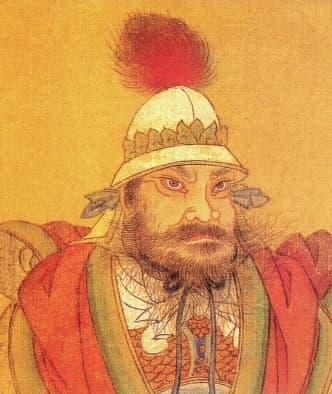
Portrait of An Lushan.
The Man Who Moved First
An Lushan did not inherit power. He rose through it. Born of mixed Sogdian and Turkic background on the Tang frontier, he began as a translator and minor officer. He climbed by battlefield performance, personal charisma, and adaptive survival in volatile border regions. He eventually commanded three major frontier circuits — an unprecedented consolidation of military authority under one man.
That rise was not ideological. It was situational. The question when typing An Lushan is not whether he used force — but how he used it. He most plausibly aligns with ESTP (Se–Ti–Fe–Ni): kinetic force inside a fragile system.
When systems drift, force takes over. Until it burns itself out.
Se — Dominant
An Lushan's career is defined by immediacy. He excelled in frontier warfare — environments requiring real-time responsiveness, adaptive tactics, and physical command presence. At court, he was theatrical. He famously performed exaggerated, comedic displays to entertain Emperor Xuanzong of Tang and staged a ritual "adoption" by Yang Guifei — a spectacle that blurred politics and performance.
That's not restrained strategic positioning. That's bold social risk-taking. ESTPs read a room and weaponize presence. They don't play long institutional games — they dominate moments. An Lushan dominated moments.
Ti — Auxiliary
His rise wasn't chaotic. He understood military structure, managed logistics, and built soldier loyalty effectively. But his intelligence appears tactical rather than systemic. He did not publish ideological manifestos. He did not restructure administrative doctrine. His rebellion lacked ideological architecture — it was force-backed. Ti in ESTPs optimizes tactics and internal mechanics rather than building grand theory. An Lushan optimized leverage.
Ni — Inferior
In later years, An Lushan became increasingly paranoid. Historical records describe growing suspicion, erratic brutality, and violent distrust of subordinates. He was eventually assassinated by his own son. That pattern mirrors inferior Ni under stress: obsessive threat projection, pattern-fixation without clarity, increasing detachment from reality.
He seized power — but did not sustain it. His regime destabilized rapidly after conquest. He had no vision for what came next. That difference matters.
The Ecosystem
The An Lushan Rebellion was not born in isolation. It required:
- • Xuanzong's relational over-trust (INFJ)
- • Yang Guozhong's factional pressure (ESTJ)
- • Military decentralization on the frontier
- • A general comfortable acting decisively
When tension escalated and purge became possible, An Lushan moved first. Not because destiny called him. But because in the moment, action was survival.
Connected Figures
Further Reading
- The An Lushan Rebellion — Edwin G. PulleyblankThe foundational English-language scholarly study of the rebellion, its causes, and its aftermath.
- The Cambridge History of China, Vol. 3: Sui and T'ang China — Denis Twitchett (ed.)The standard reference for Tang political history, including detailed coverage of the frontier military system and An Lushan's rise.
- China's Golden Age: Everyday Life in the Tang Dynasty — Charles BennVivid portrait of the Kaiyuan court culture that An Lushan navigated and ultimately destroyed.
- The Age of Eternal Bliss: A History of the Tang Dynasty — Mark Edward LewisSituates An Lushan's rebellion within the broader arc of Tang state formation and collapse.
