 Historical Figure MBTI
3 min read
#62 · 2-20-26 · The Tang Dynasty
Yang Guozhong
Court Chancellor · Factional Enforcer · The Administrator Who Misjudged a Storm
? — 756
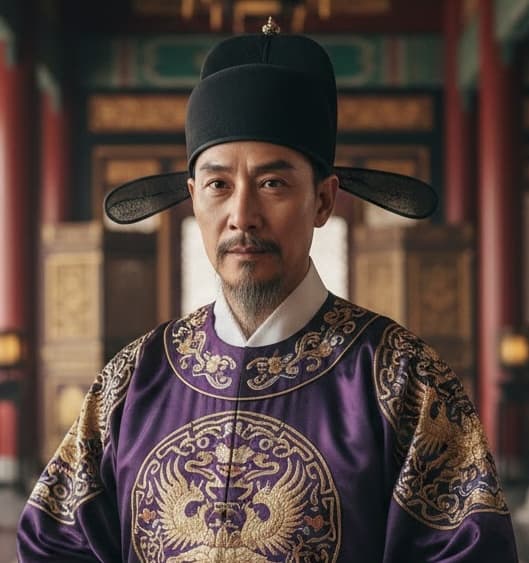
AI-assisted Portrait of Yang Guozhong.
The Man Behind the Throne — But Not the Vision
Yang Guozhong did not rise through battlefield brilliance. He did not craft civilizational philosophy. He rose through structure. A cousin of Yang Guifei, he leveraged proximity to power and eventually became chief chancellor under Emperor Xuanzong of Tang during the dynasty's most fragile transition.
Reading his historical behavior reveals one pattern clearly: executive structure first, relational harmony second. That aligns most coherently with ESTJ (Te–Si–Ne–Fi). He was not harmonizing people for unity's sake. He was enforcing order.
He had enforced power. He had not secured devotion.
Te — Dominant
Yang Guozhong's defining trait was administrative assertion. He centralized authority within his faction, actively opposed frontier military autonomy, attempted to weaken An Lushan politically, and leveraged bureaucratic tools rather than battlefield force. He believed in institutional control. His hostility toward An Lushan wasn't abstract jealousy alone — it reflected concern over military decentralization. On paper, he was not wrong.
But Te-dominance can overestimate enforcement and underestimate volatility. He treated An Lushan as a problem to be contained through pressure. He miscalculated the reaction.
Si — Auxiliary
Yang Guozhong was not a visionary reformer. He operated within existing Tang administrative structures and traditions. He enforced hierarchy. He maintained precedent. He did not attempt to redesign the empire. He attempted to control it. Si shows up here as commitment to established order — even when that order was already shifting beneath him. He interpreted the system as stable enough to enforce. It wasn't.
Ne — Tertiary
Yang Guozhong did recognize An Lushan as a threat. He was not blind. But his interpretation of risk appears rigid. Instead of recalibrating military structure more creatively, he escalated factional pressure. Ne in tertiary position often identifies danger but struggles to imagine multiple adaptive pathways. He saw the storm. He pushed against it directly.
Fi — Inferior
Historical accounts often paint Yang Guozhong as arrogant, dismissive, and politically abrasive. His downfall at Mawei Slope reveals something telling: when imperial guards mutinied, he had no emotional loyalty base strong enough to protect him. Te-dominant administrators often assume structural authority guarantees allegiance. Fi-inferior blind spots can neglect relational depth. When crisis erupted, the guards demanded his execution.
Why Not Fe-Dominant?
Why not Fe-dominant?
He is sometimes portrayed as manipulative or factional, which can lead to Fe assumptions. But his methods appear bureaucratic and coercive rather than harmonizing. He didn't unify court morale. He polarized it. His power was vertical, not relational. Fe-dominant administrators build cohesion; Yang Guozhong built hierarchy. The distinction matters in understanding why he died alone at Mawei Slope without defenders.
The Ecosystem
The Tang collapse was not a single failure. It was collision:
- • Xuanzong's over-trust (INFJ)
- • Yang Guifei's aesthetic immersion (ISFP)
- • Yang Guozhong's enforcement rigidity (ESTJ)
- • An Lushan's kinetic opportunism (ESTP)
Yang Guozhong correctly sensed danger in An Lushan's power. But he confronted force with pressure instead of systemic recalibration. When the rebellion broke, he became the symbol of court failure. At Mawei Slope in 756, imperial guards executed him before demanding Yang Guifei's death. He had represented structure. Structure had already fractured.
Connected Figures
Further Reading
- The Background of the Rebellion of An Lu-shan — Edwin G. PulleyblankThe definitive scholarly study of the court politics, factional struggles, and military conditions that produced the rebellion — Yang Guozhong's role is examined in detail.
- Sui and T'ang China, 589–906 (The Cambridge History of China, Vol. 3) — Denis Twitchett, ed.The authoritative English-language account of the Tang court and administration, including the late Xuanzong reign and the Mawei Incident.
- The Culture of Sex in Ancient China — Paul GoldinProvides broader context on court relationships and power dynamics in Tang-era China, relevant to understanding Yang Guifei's orbit and Yang Guozhong's leverage.
