 Historical Figure MBTI
#701 · 5-26-26 · The Age of Exploration
Anacaona
Cacica of Xaragua · Poet of the Areítos · Hanged by the Governor She Hosted
c. 1474 — 1503
6 min read
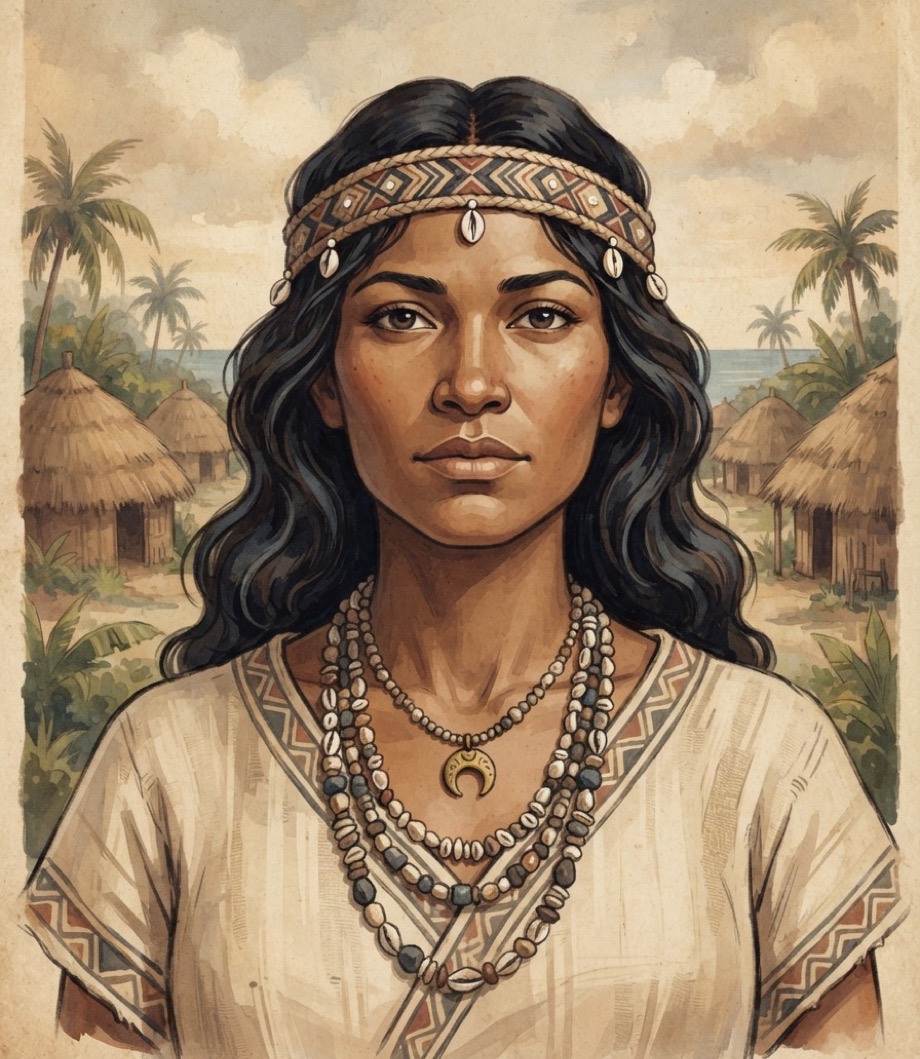
AI-assisted Portrait of Anacaona
The Poet Who Governed by Song
Before there were ships on the horizon, Anacaona was already a power in Xaragua — not because she commanded warriors, but because she composed. The areítos she wrote were archive, law, and liturgy at once, sung and danced by hundreds, carrying genealogies and treaties forward in memory. A woman who could write the songs a whole people repeated could, in the most literal sense, tell her community who it was.
That gift for shaping a room is the signature of dominant ENFJ Extraverted Feeling (Fe), and it is what Anacaona reached for again in 1492 when Spanish ships appeared off Hispaniola. She and her brother Bohechío met the newcomers not with spears but with feasts, gifts, and elaborate hospitality, betting that warmth could do work weapons could not. For a decade the wager very nearly worked. It is that same wager, offered one final time to a man who had come to betray it, that gives her story its unbearable shape.
Anacaona governed the way she composed — by drawing everyone into the circle. It was an ENFJ’s instinct, dominant Fe, trusting that a shared table could hold what treaties could not. Nicolás de Ovando understood this perfectly, and used it to kill her.
The Feast as Governance
Dominant Fe reads a room and reshapes it, and Anacaona did this at the scale of a chiefdom. Spanish chroniclers — men not inclined to flatter people they were dispossessing — nonetheless described her court as the most gracious they encountered on the island: elaborate welcomes, coordinated dancing, gifts calibrated to the guest’s status. This was diplomacy conducted in the register she trusted most: bring people into relationship, and the relationship becomes the treaty.
After Bohechío’s death made her cacica, and after her husband Caonabo died in Spanish captivity, she held to the same approach — kept hosting, kept composing. Fe-dominant leadership does not abandon warmth when it has been abused; it recommits, because governing by suspicion is not a language it speaks fluently.
That commitment reached its final expression in 1503, when Governor Nicolás de Ovando arrived announcing a visit of friendship. Anacaona did what she had always done: summoned the regional caciques, prepared the feast, opened her house. She read the occasion correctly by every standard she had ever had cause to trust. Ovando read it as an opportunity.
Reading the Long Arc of the Invasion
Auxiliary Ni is what let Anacaona see past the immediate encounter to the pattern underneath it. By most accounts she was the shrewder political mind of the two siblings who led Xaragua, credited with steering the chiefdom’s strategy across years, not single visits. She grasped early what many caciques were slower to accept: the Spanish presence was not a passing expedition but a permanent claim on the island, demanding a coherent long-term posture rather than an improvised response to each new ship.
Her chosen posture — accommodation through relationship rather than resistance through arms — was a strategic conclusion, not a default. Hatuey, a fellow Taíno leader, judged the same evidence and reached the opposite verdict, fleeing to Cuba to organize armed resistance. Anacaona’s wager was that Xaragua’s position and diplomatic skill could secure a durable peace where confrontation could not — grounded in a decade of survival while other chiefdoms fell to war and disease, right up until the pattern changed under her without warning.
Ceremony as a Living Art
Tertiary Se shows up in Anacaona not as impulsiveness but as physical command of the present moment — the choreography of the areíto itself. These were mass performances: dancers in coordinated lines, drums and rattles setting the pace, hundreds of bodies in the plaza responding to rhythms she had composed. Sustaining that kind of event requires a real feel for tempo and the physical energy of a crowd — the world in front of her, not an abstraction of it.
That same sensory command served her diplomatically. Spanish visitors reported being genuinely dazzled, describing feasts with a specificity suggesting Anacaona knew exactly how to stage an experience for an audience she wanted to win over. In 1503 that skill was, once again, entirely present, and entirely beside the point. She staged the welcome for Ovando as masterfully as every welcome before it. The room was perfect. The trap did not care.
The Blind Spot in the System
Inferior Ti is the least developed piece of the ENFJ stack — cold, detached, worst-case logical audit, asking whether a plan’s internal consistency holds apart from any relationship in the room. It is precisely the faculty needed to ask an unsentimental question of Ovando’s invitation: does a new governor’s sudden warmth, after years of Spanish violence elsewhere, actually follow logically, or does it only feel plausible because the ceremony is so familiar?
There is no evidence Anacaona asked that question. Her decade of success had never required it; the Fe-Ni-Se channel of reading people, patterns, and moments had, until then, been sufficient. The one time the situation demanded a colder reasoning that treats a friendly overture as a hypothesis to be tested rather than a relationship to be honored, it was catastrophically unavailable to her. Ovando appears to have understood exactly how to weaponize that gap, offering her precisely the ceremony she could not decline without abandoning the identity that had defined her leadership.
Why ENFJ Over ESFP
Why not ESFP?
ESFP was worth weighing, since Anacaona’s command of ceremony could pass, at a glance, for Se-dominant charisma. But the record shows multi-year strategy, not just brilliant performance in the moment — Fe leading and Ni supporting, not an ESFP’s Se-Fi stack turned toward personal authenticity. Her gift was holding an entire chiefdom’s trust across a decade: relational architecture, not a string of vivid performances.
The contrast sharpens against Hatuey, who read the same Spanish advance and reached the opposite conclusion — flee, resist, fight. Where Anacaona’s Fe sought accommodation, Hatuey’s more ESTP-shaped instinct sought confrontation. Neither reading was wrong; they were two coherent temperaments meeting the same catastrophe with the tools each trusted most.
Connected Figures
Further Reading
- The Tainos: Rise and Decline of the People Who Greeted Columbus — Irving RouseThe standard scholarly account of Taíno society, political structure, and the chiefdom system Anacaona led.
- Hispaniola: Caribbean Chiefdoms in the Age of Columbus — Samuel WilsonReconstructs the political and diplomatic world of Xaragua and the other Taíno cacicazgos before and during contact.
- A Short Account of the Destruction of the Indies — Bartolomé de las CasasEyewitness-era chronicle, written by a contemporary friar, that records the Xaragua massacre and Anacaona’s execution.
