 Historical Figure MBTI
#702 · 5-26-26 · The Age of Exploration
Nicolás de Ovando
Governor of Hispaniola · Architect of the Encomienda · Executioner of Xaragua
1460 — 1511
7 min read
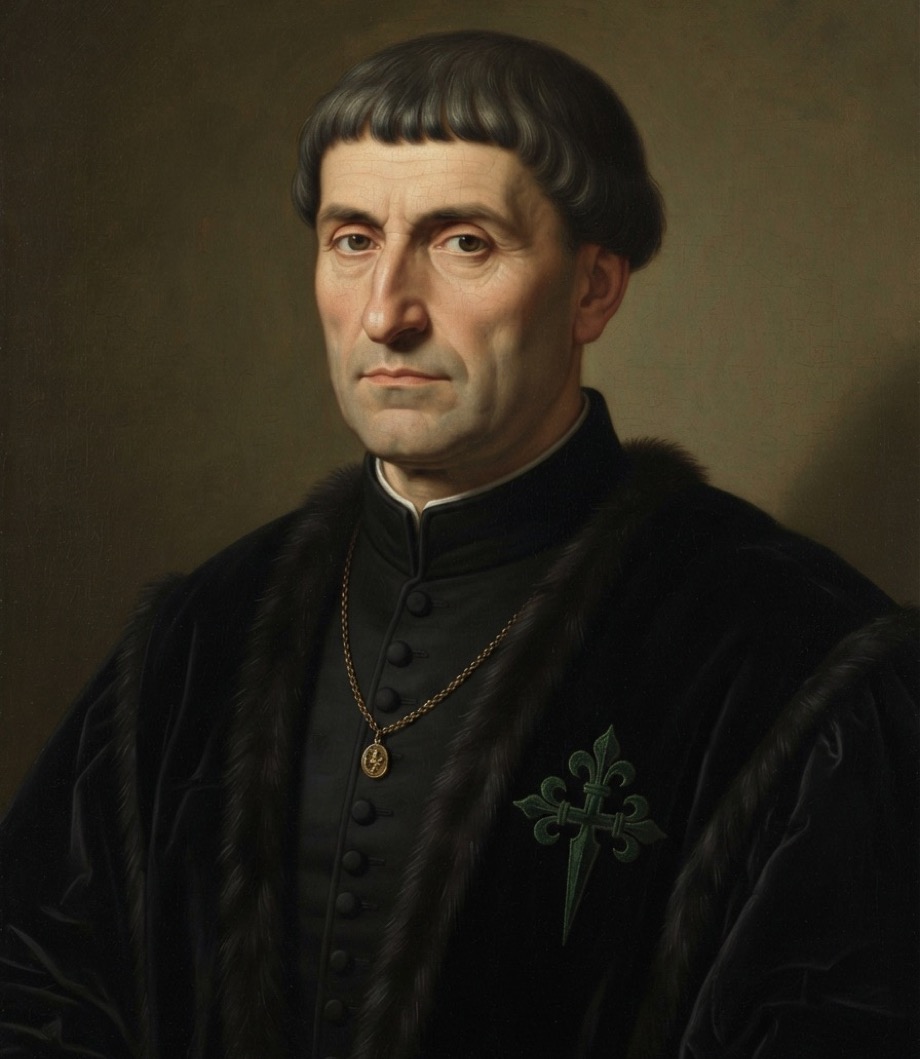
AI-assisted Portrait of Nicolás de Ovando
The Administrator the Crown Actually Wanted
Christopher Columbus had governed Hispaniola by improvisation and grievance, and by 1501 the colony was a rumor of gold, a string of unpaid mutinies, a paperwork disaster the crown could no longer ignore. So Ferdinand and Isabella sent someone whose character was a rebuke to Columbus's: a Knight of the Order of Alcántara, a career royal administrator, who arrived in April 1502 with thirty ships and twenty-five hundred settlers — the largest fleet the Americas had yet seen — with a mandate to fix, in bureaucratic terms, what a visionary had left in ruins.
Nicolás de Ovando is not a hard man to type. He is an ESTJ in the purest, least ambiguous sense the record offers: a man who looked at a disordered colonial project and saw not a moral emergency but an administrative one, and who solved it with grids, ledgers, statutes, and — when the ledger required it — fire.
That is the discomfort of writing about Ovando. He was, by every internal metric of Spanish colonial governance, a success — towns founded, taxation regularized, a functioning legal order imposed on a colony that had had none. He also walked into the province of Xaragua under a flag of friendship and left it a smoking house full of burned chiefs and a cacica hanging from a rope on invented charges. Both facts came from the same personality. Neither required the other to be an aberration.
Ovando was an ESTJ whose dominant Te did not distinguish between building a town and destroying a people — both were simply problems of order, solved by the same procedural hand.
The Institution-Builder
Where Columbus had governed by charisma and improvised threat, Ovando governed by instrument. His first acts as governor were clerical: audit the colony's finances, catalogue its settlements, convert the ad hoc labor arrangements Columbus had granted his favorites into a single codified system — the formalized encomienda, grants of indigenous labor written into law, standardized across the island, enforceable through royal administration rather than personal favor. This is dominant Te at its most consequential: not cruelty invented from nothing, but existing cruelty rationalized and made permanent through structure.
He founded new towns on a strict grid — Santo Domingo rebuilt, Concepción de la Vega, Puerto Real — each a small monument to external order imposed on unfamiliar terrain. Te does not need affection to organize, only a clear objective and the authority to enforce it. That same clarity makes Xaragua legible rather than inexplicable. Ovando did not experience Taíno resistance there as a wrong to be weighed; he experienced it as an obstacle to control — the last cacicazgo not yet subdued. A dominant Te mind facing an obstacle asks one question: what removes it most completely? The answer he arrived at was a massacre staged as diplomacy, carried out with the same procedural calm he brought to founding a town.
Precedent as Law
Ovando's auxiliary Si shows up not in nostalgia but in his instinct to formalize by reference to existing structure rather than invent something new. He did not dream up the encomienda — it already existed, informally, under Columbus. What he did was recognize it as a workable precedent and entrench it, tying it to the crown's existing feudal vocabulary of service and obligation. Si does not ask whether a precedent is just; it asks whether it is usable, and the encomienda was eminently usable.
This same orientation shaped how he treated his own authority. He was a Knight of Alcántara before he was a governor, and he ran Hispaniola with the procedural fidelity of a man who trusted institutions over instinct — royal instructions followed to the letter, reports filed, the colony's books kept in order. Where Columbus had treated the crown's directives as suggestions to be negotiated from a distance, Ovando treated them as the fixed architecture within which everything else had to fit — a colonial machine efficient enough to survive his own eventual recall in 1509 and outlast him by generations.
The Ruse at Xaragua
Tertiary Ne rarely governs an ESTJ's daily conduct, but it surfaces when a Te-dominant mind needs a lateral solution — a way around an obstacle brute administration cannot solve directly. Xaragua, under Anacaona, was the one center of Taíno authority Ovando had not brought under colonial control, and a direct assault risked a costly, protracted conflict. So he improvised an angle: a state visit, framed as friendship, timed to a gathering Anacaona would host with the elaborate hospitality customary to her position.
The plan itself is where the Ne shows — not in any expansive curiosity about possibility, but in a narrow, opportunistic cunning: stage an occasion, let the target's own generosity assemble the very chiefs he needed contained in one place, and convert their hospitality into a trap. This is Ne in service of Te, not Ne for its own sake — a single, ruthless application of "what possibility gets me what I need." What followed was not improvisation but execution: dozens of assembled Taíno chiefs burned alive in a house set alight around them, and Anacaona hanged publicly on conspiracy charges no contemporary evidence supports. Once the ruse succeeded, Ovando returned to dominant Te — founding towns, filing reports — as though the interlude had been just another administrative matter closed.
The Conscience That Never Surfaced
Inferior Fi in an ESTJ typically appears not as reflection but as sudden, unprocessed moral language — a flash of "loyalty" or "betrayal" deployed to justify what dominant Te has already decided to do. The fabricated conspiracy charge against Anacaona is exactly this pattern: rather than admit the massacre was a preemptive strike against Taíno authority, Ovando cloaked it in the vocabulary of personal wrong — she had conspired, she had broken faith. It is Fi's language used entirely in service of Te's convenience, never as an independent check on it.
What is conspicuously absent from the record is anything resembling private doubt — no letter of anguish, no later admission of excess, no sign that Ovando's inner values ever rose to interrogate what his outer function had accomplished. Bartolomé de las Casas, who chronicled the massacre from the era, records Ovando's conduct with a flatness that is itself instructive: this was not a man wrestling with guilt in secret, but one filing the episode away as resolved. That absence was not a failure of his personality but a predictable feature of it — an inferior Fi that never gets exercised does not restrain a dominant Te that has already decided what order requires; it simply supplies the justification after the fact, and moves on to the next town to be founded.
Why ESTJ Over ISTJ
Why not ISTJ?
An ISTJ governor would have enforced existing rules with dutiful consistency, but Ovando built the institutional architecture the colony lacked — the codified encomienda, a network of new grid towns. That is dominant Te reshaping a system, not auxiliary Te quietly maintaining one. The Xaragua ruse confirms it: an ISTJ's Si-Te stack favors caution over improvised deception, while Ovando's staged diplomatic fiction points to a Te-Si structure with tertiary Ne feeding it opportunistic angles ISTJ rarely reaches for.
The distinction matters because it changes what kind of danger Ovando represents. An ISTJ administrator who commits atrocity does so by rigidly following an order handed down from above. Ovando authored the order — he looked at a colony without institutions and built them, and when an entire cacicazgo resisted incorporation, he treated its destruction as simply another administrative task to be designed and closed out. ESTJ, not ISTJ: the horror is not obedience, but initiative.
Connected Figures
Further Reading
- Hispaniola: Caribbean Chiefdoms in the Age of Columbus — Samuel WilsonThe essential account of Taíno political structure and its destruction under Ovando's governorship.
- A Short Account of the Destruction of the Indies — Bartolomé de las CasasEyewitness-era chronicle documenting the Xaragua massacre and the encomienda's human cost.
- The Early Spanish Main — Carl Ortwin SauerA geographic and administrative history of Hispaniola's colonization, including Ovando's town-founding program.
