 Historical Figure MBTI
#706 · 5-26-26 · The Age of Exploration
Pedrarias Dávila
Furor Domini · Executioner of Balboa · Founder of Panama City
c. 1440 — 1531
11 min read
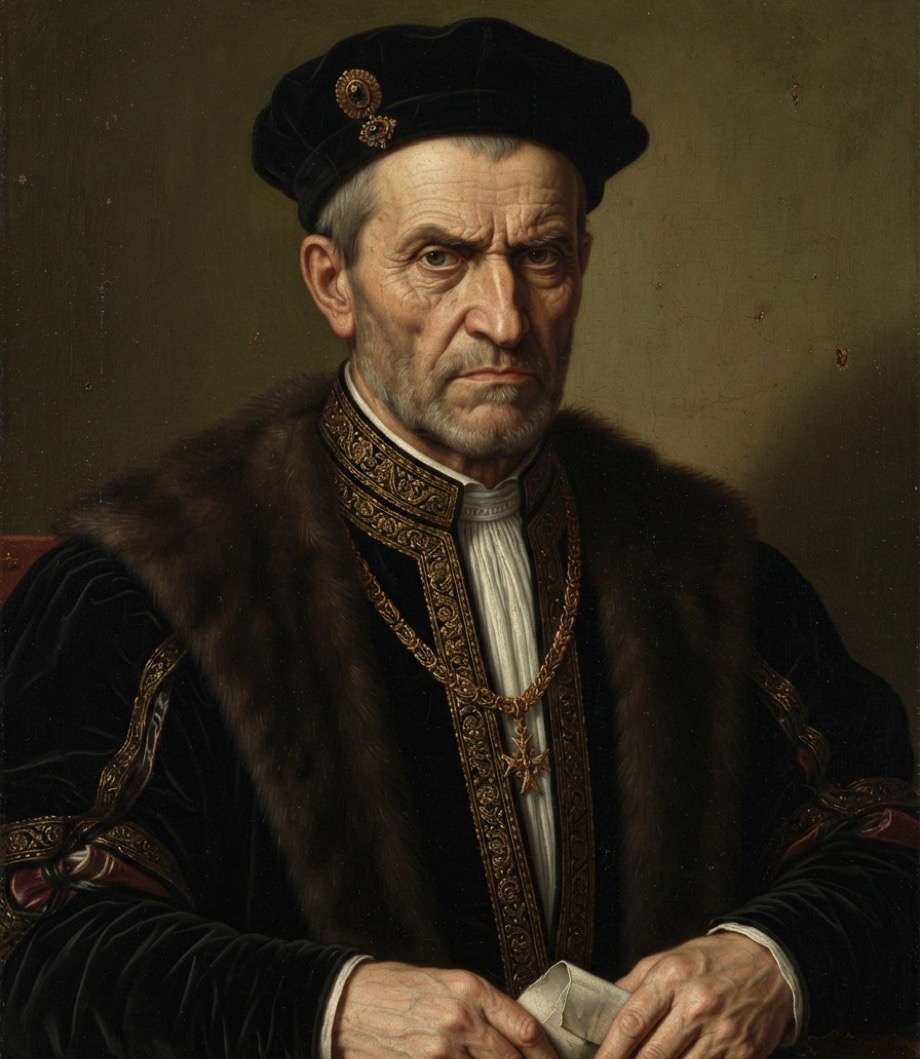
AI-assisted Portrait of Pedrarias Dávila
The Fury of God, Filed in Triplicate
He was already an old man when the Crown gave him a continent. Pedro Arias de Ávila — Pedrarias, as the chroniclers ran his name together, as though even his name were an abbreviation for administrative convenience — was somewhere around seventy in 1514 when he sailed from Sanlúcar with the largest expedition Spain had yet sent to the New World: some two thousand men, a royal commission, a notary, and a set of instructions. He had jousted in the Granada wars. He had a reputation, a wife of good family, and a nickname that would follow him into the histories: el Galán, the gallant, in his youth; Furor Domini, the Fury of God, by the time his own contemporaries were done with him. Both names were earned. Only the second one stuck.
What he did in the seventeen years that followed is not, on its surface, unusual for a conquistador. Indians died in enormous numbers. Rivals were removed. Cities were founded. What makes Pedrarias genuinely singular — what earns him a place beside Torquemada rather than beside the ordinary freebooters — is the texture of the violence. There is almost no rage in it. There is no recorded moment of him losing control. When he destroyed Vasco Núñez de Balboa, the man who had actually founded Darién and actually crossed to the Pacific, he did it through a marriage contract, a summons, an arrest warrant, a trial, and a signature. The beheading in Acla in January 1519 was the last line of a document, not the last act of a quarrel. Pedrarias sat behind a cane screen and listened to it happen.
That is the thing worth understanding about him. He was not a monster who happened to hold office. He was an officeholder whose monstrousness was entirely expressible in the language of office — a ESTJ in the fullest and worst sense of the pattern: hierarchy as reality, procedure as conscience, the written order as the final answer to any question about whether a thing should be done.
Pedrarias Dávila was an ESTJ whose dominant Extraverted Thinking found, in the machinery of Castilian colonial law, a form of violence that never once had to raise its voice.
Te — The Warrant as Weapon
Balboa was the problem Pedrarias was sent to solve, and the way he solved it is the cleanest portrait of dominant Extraverted Thinking in the archive. Balboa had done everything: overthrown the first governor, held the colony together, learned the local politics, crossed the isthmus in 1513 and waded into the South Sea in armour with a banner of the Virgin. He had done it all without authorization. Pedrarias arrived the next year holding the one thing Balboa lacked — a commission — and understood immediately that the commission was the only weapon that mattered. He opened his tenure not with a battle but with a residencia, the formal judicial audit of a predecessor's conduct, and set his officials to assembling a case.
When the case stalled and Balboa's stock rose in Spain — the Crown named him Adelantado of the South Sea, an inconveniently real title — Pedrarias did not escalate to violence. He restructured. He married his eldest daughter María, still in Spain, to Balboa by proxy, converting a rival into a son-in-law and the conflict into a family arrangement with defined lines of authority. It was, on paper, a settlement. Te does not want to win an argument; it wants the org chart amended so the argument cannot recur. For three years the amendment held while Balboa built brigantines on the Pacific coast at Pedrarias's pleasure.
Then came the summons. In late 1518 Pedrarias wrote to his son-in-law asking him to come to Acla for a conference. Balboa came. Francisco Pizarro, who had walked to the Pacific beside him, arrested him at the edge of town. The charge was treason — that Balboa had intended to sail off and found his own government beyond the Crown's reach. The evidence was thin to the point of transparency; the judge, Gaspar de Espinosa, reportedly urged mercy; Pedrarias declined and confirmed the sentence. Four men were beheaded in the plaza of Acla and their heads left on poles. The killing of Balboa was not a murder in any sense Pedrarias would have recognized. It was an execution, and executions have paperwork, and the paperwork was in order.
Si — Castile, Reproduced Exactly
Introverted Thinking builds systems from principle; Introverted Sensing reproduces the system it already knows. Pedrarias never invented a form of government. He imported one. Everywhere he went he laid down the same furniture: a cabildo of magistrates, a treasury with its royal fifth, a notary to record proceedings, an official reading of the Requerimiento before hostilities, an encomienda distribution assigning villages of Indians to Spaniards as labor grants. This was the template Nicolás de Ovando had stamped onto Hispaniola a decade earlier, and Pedrarias applied it to Darién, then to Panama, then to Nicaragua, with the fidelity of a man copying a document he has copied many times before.
The founding of Panama City on 15 August 1519 is the auxiliary at its most competent. Darién had been a mistake of geography — a swamp on the wrong ocean, chosen by men without instructions. Pedrarias, who had watched hundreds of his own colonists die there of fever and hunger in the first months after landing, made the coldly correct call: abandon the settlement his predecessor had built and re-found the capital on the Pacific shore, where the future of the enterprise plainly lay. He walked the town grid out himself, gave it a charter, and gave it the machinery. The city he planted became the staging ground from which Pizarro — his own former captain — would sail to Peru.
Si also explains the long memory that made him so dangerous to work under. Pedrarias forgot nothing and forgave nothing on a schedule. Gil González Dávila's unauthorized entry into Nicaragua in 1522 was remembered and answered; Francisco Hernández de Córdoba, Pedrarias's own lieutenant, drifted toward González's patronage and was beheaded in León in 1526 on the same charge, by the same method, through the same procedure that had killed Balboa seven years earlier. The precedent had worked once. It was filed. It was used again.
Ne — The Governor Who Kept Reaching
A purely rigid man would have sat in Darién until the Crown replaced him. Pedrarias did not sit. From the moment he landed he threw entradas outward in every direction — Ayora, Morales, Espinosa, Hernández de Córdoba — fanning armed parties across the isthmus and up the Pacific coast, each with orders to find gold, take slaves, and report. Tertiary Extraverted Intuition in a Te-dominant rarely looks like imagination; it looks like restless opportunism, an unwillingness to let a possible source of advantage go unexamined. He was in his eighties and still commissioning expeditions.
It is also why he kept surviving politically when he should not have. Twice the Crown moved to remove him — after the Balboa execution and again in the 1520s — and twice he improvised his way out: writing over the heads of his accusers, cultivating patrons at court, offering to resign in language calculated to make resignation unnecessary, and finally, when Panama was taken from him in 1526, simply relocating to Nicaragua and having himself confirmed as governor there instead. He was investigated, audited, denounced by Las Casas and by his own officials, and died in office at ninety-one.
But the tertiary is a supporting function, not a governing one, and its limits show in the thing Pedrarias could not see. He funded Pizarro's Peru voyages, then sold his share out of the partnership at Panama for a modest sum because the early returns looked poor. The greatest prize of the entire Spanish enterprise passed through his hands and he liquidated the position. Te evaluated the ledger; Ne could gesture at what might be out there, but never with enough conviction to overrule the numbers on the page.
Fi — The Conscience That Never Arrived
The death toll under Pedrarias is not knowable with precision and is, by every serious estimate, enormous. Between the Darién slave raids, the wars of the isthmus, the Nicaraguan encomiendas, the export of tens of thousands of enslaved Nicaraguans to Panama and Peru, and the epidemics that followed the columns everywhere, the indigenous population of the territories he governed collapsed within a generation. Las Casas, who despised him, called him a scourge. Oviedo, who served under him, wrote that he had heard him say the Indians were better off dead than alive since they would go straight to heaven.
And yet nothing in the record suggests he enjoyed any of it. That is the disturbing part. Cruelty as appetite leaves traces — boasting, ritual, excess — and Pedrarias leaves instead reports, musters, assessments, and correspondence with the Council of the Indies. He read the Requerimiento. He observed the forms. When his officers exceeded their instructions he prosecuted them, not out of pity but because unauthorized violence is disorder and disorder is the actual sin. Inferior Introverted Feeling here is not weak sentiment; it is a value function so undeveloped that it never generates an independent objection at all. Whatever the law and the Church jointly permitted, he permitted, and stopped thinking.
The one place the inferior surfaces is in the shape of his hatreds. The pursuit of Balboa was disproportionate and everyone around him knew it — the case was weak, the judge balked, and Pedrarias pushed it through anyway. Beneath the procedural language sits something the procedure cannot account for: an old man's raw, unexamined resentment of a young one who had done the thing he was sent to be famous for. Fi in the inferior does not disappear. It waits, unprocessed, and then comes out wearing the dominant's clothes — as a legal finding, signed and dated, with a scaffold at the end of it.
Why ESTJ Over ISTJ
Why not ISTJ?
The paperwork, the precedent, the Castilian template reproduced across three colonies — all of that would sit comfortably with an ISTJ, and the temptation is real. But an ISTJ leads with an internal archive and applies force outward second; Pedrarias led with the force. He did not wait in Darién for the situation to clarify. He landed with two thousand men and immediately pushed armed columns in every direction, restructured the colony's command, deposed and re-founded its capital, and spent seventeen years actively seizing jurisdiction — over Balboa, over Gil González, over Nicaragua when Panama was taken from him. The Si is unmistakable but it is in service: it supplies the forms that the Te is already out in the world imposing. An ISTJ administers a territory he has been given. Pedrarias went and took more of them, at eighty.
The other near-miss is ENTJ, and it fails for the opposite reason. An ENTJ would have had a vision of what the isthmus could become — a theory of empire, a new design. Pedrarias had no design. He had a commission and a manual. He sold his stake in Peru because the ledger said to, founded Panama because the geography said to, and killed his son-in-law because a legal finding said he could. Everything genuinely new that came out of his governorship was made by other men on the ground he had prepared and paid for. That combination — enormous outward drive, zero originality, total procedural fidelity, and no internal voice capable of saying stop — is the ESTJ signature, and in a colonial governorship with no oversight, it produced one of the deadliest administrations of the sixteenth century.
Connected Figures
Further Reading
- Balboa of Darién: Discoverer of the Pacific — Kathleen RomoliThe fullest narrative of the Pedrarias–Balboa conflict, from the 1514 landing to the scaffold at Acla.
- The Early Spanish Main — Carl Ortwin SauerGeographer's account of the Darién colony and the demographic collapse of the isthmus under the first governors.
- Forced Native Labor in Sixteenth-Century Central America — William L. ShermanThe documentary record of encomienda and the Nicaraguan slave trade during and after Pedrarias's governorship.
- Historia general y natural de las Indias — Gonzalo Fernández de OviedoEyewitness chronicle by a royal official who served under Pedrarias and knew both men personally.
- A Short Account of the Destruction of the Indies — Bartolomé de las CasasThe contemporary indictment; hostile, polemical, and the source of much of the case against Pedrarias.
