 Historical Figure MBTI
#705 · 5-26-26 · The Age of Exploration
Vasco Núñez de Balboa
Founder of Darién · First European to the Pacific · Beheaded by His Own Father-in-Law
1475 — 1519
9 min read
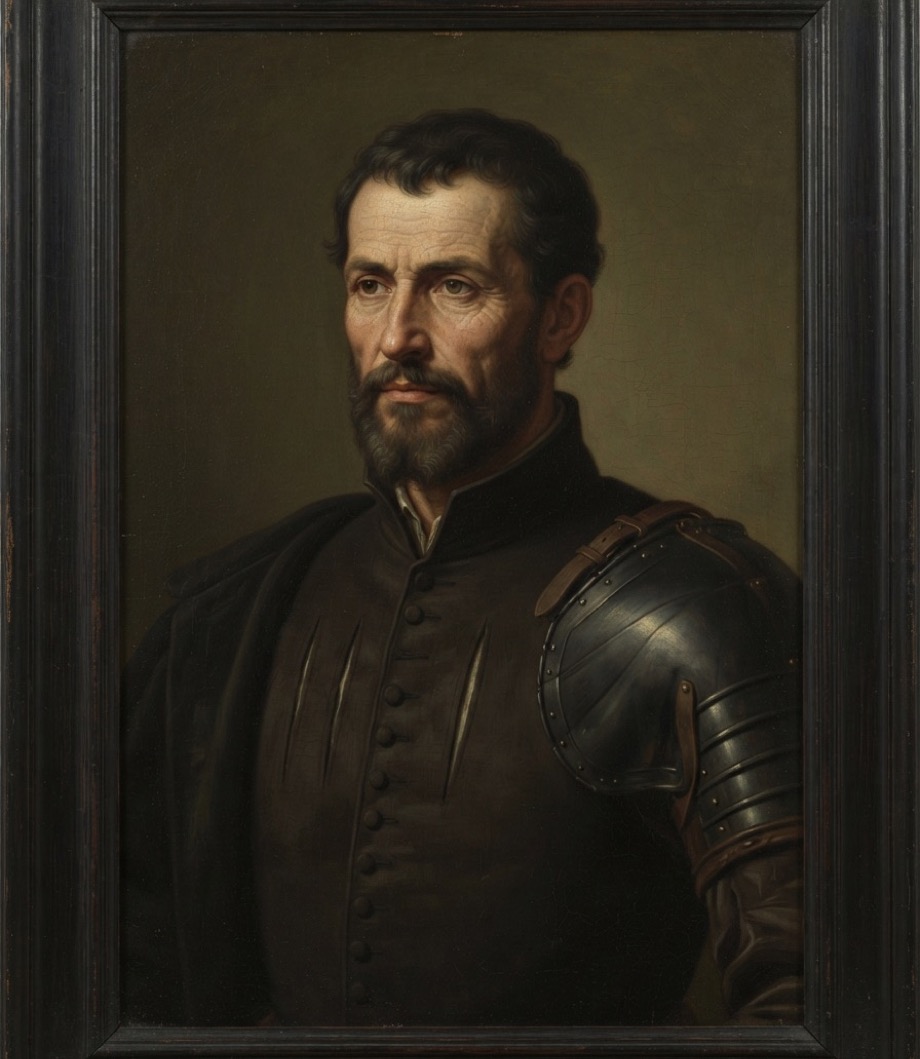
AI-assisted Portrait of Vasco Núñez de Balboa
The Man Who Arrived in a Barrel
In 1510 a supply ship left Santo Domingo for the failing colony of San Sebastián on the Gulf of Urabá. Folded into a cask in its hold, alongside the provisions, was a bankrupt farmer named Vasco Núñez de Balboa, hiding from creditors he could not pay and from a governor who had forbidden debtors to leave the island. Discovered at sea, he was threatened with marooning by the expedition's commander, Martín Fernández de Enciso. Within months he was running the expedition; within two years he was master of the first stable Spanish town on the American mainland.
He managed this without money, without a title, and without a patron at court — the three things that ordinarily decided everything in the Indies. What he had instead was an exact memory of a coastline he had sailed with Rodrigo de Bastidas a decade earlier, a body that outlasted everyone else's in the swamp, and a gift for reading a room of desperate armed men. When Enciso's colony was starving on a poisoned-arrow coast, Balboa said he knew a better river across the gulf, where the natives did not tip their arrows. He was right. The men deposed Enciso by vote and founded Santa María la Antigua del Darién on the site he had picked out of memory.
Nothing in his rise looks like scheming. It looks like a man who is simply better than everyone around him at the thing immediately in front of him — terrain, weather, negotiation, a fight — and who converts that competence into authority faster than the paperwork can catch up.
Balboa is the archive's clearest ESTP conquistador: dominant Se made him unbeatable in the present tense, and blind to the trap being assembled a year out.
Se — Waist-Deep, Sword Raised
On 1 September 1513 Balboa left Darién with roughly 190 Spaniards and several hundred Indigenous porters and guides, heading south across an isthmus nobody had mapped. It took twenty-five days to cover sixty miles. On 25 September he climbed a ridge in the territory of the cacique Quarequá, went up the last stretch alone, and saw open water to the south. Four days later, at the Gulf of San Miguel, he walked into the surf in armor with a banner in one hand and his sword in the other and claimed the Mar del Sur — and every shore it touched — for Castile.
Notice what that gesture is not. It is not a strategy — nobody had told him the ocean existed until Comogre's son described it, and he had no idea he stood on the near edge of Peru. It is not symbolism performed at a safe distance, the way a cartographer or a monarch claims territory. It is a man putting his actual body into the water because that is what taking a thing means to him. Dominant Se does not annex an abstraction; it touches the object.
The same function ran the whole march. He traveled light where better-equipped commanders bogged down, and negotiated or fought as the next village required — no fixed plan, because the plan was the terrain. Later governors arrived in Darién with royal instructions and a thousand men and lost most of them to fever within a year. Balboa crossed the continent with fewer than two hundred and brought them back.
Ti — The Arithmetic of a Small Force
Behind the daring sat a cold, specific logic. Balboa grasped earlier than most of his contemporaries that a Spanish force in Darién was tiny, sick, and dependent, and that its only durable asset was local politics. So he inventoried the isthmus like a machine: which cacique feuded with which, who could supply maize, what a baptism was worth in men and food.
He allied with Careta, took his daughter as his companion, and stood godfather at his baptism — an alliance that fed the colony through seasons that would otherwise have killed it. He backed Comogre, whose son gave him both the news of the southern sea and the warning that Spaniards fought each other over gold. Where a chief would not deal, he moved with the same detachment, and here the logic turns ugly: the campaigns against Quarequá and others were massacres, and the war dogs set on prisoners were part of his method, not an excess he happened to permit.
That is auxiliary Ti in its least flattering register — an internally consistent system for producing a result, indifferent to whether the pieces are people. It also explains his letters to Ferdinand, startlingly analytical documents in which he tells the king what Darién actually costs and why shipping unseasoned colonists in bulk will kill them. He was right, and the crown sent Pedrarias with fifteen hundred men anyway.
Fe — Loyalty Bought in the Field
Balboa commanded by presence. He shared the marches, took the front of the column, and divided loot in a way his men considered fair — one of the few points on which hostile and friendly sources agree. Men who had already voted out one commander followed him across an unmapped continent. That is not the authority of a commission; it is tertiary Fe in a leader who knows what frightened men need to see from the person in front of them, and who supplies it by doing rather than speaking.
The limit of the function shows in scale. Face to face, Balboa could win almost anyone — caciques, mutineers, even the officials sent to investigate him. At a distance he was helpless. The rivals he had shoved aside, Enciso above all, went home and told their version in Spain, where Balboa had no voice and no one to speak for him. The reputation that made him unbeatable within a hundred miles of Antigua counted for nothing in a chamber where the only evidence was paper.
Ni — The Summons He Answered
Pedrarias Dávila reached Darién in June 1514 with a royal commission, a lawyer, and a settled conviction that the discoverer of the South Sea was a problem to be managed. Balboa's response was to keep doing what had always worked: build ships on the Pacific coast, mount another expedition, produce results too undeniable to ignore. Made adelantado of the South Sea, he accepted a betrothal to Pedrarias's daughter María de Peñalosa — a girl he had never met, still in Spain — as if a family tie were a settlement rather than a leash.
It was the exact wrong read. Pedrarias did not want to be appeased; he wanted the rival gone, and now he had one who was formally his son-in-law and therefore easier to summon. In early 1519 a message called Balboa from the Pacific coast back to Acla. He came. Francisco Pizarro, who had marched with him to the ocean, arrested him on the road. The charge was treason — that he meant to break away and rule the South Sea independently — assembled from rumor and prosecuted by Gaspar de Espinosa in a proceeding whose outcome was decided before it opened. He was beheaded with four of his companions, and his head was set on a pole in the plaza.
The inferior Ni is legible in that whole final year: a man who could read a ridge line and a river system with perfect clarity, and who could not see, twelve months out, a trap being built out of a marriage contract. He walked toward the summons the way he had waded into the Pacific — because the thing in front of him was the thing that was real.
Why ESTP Over ISTP
Why not ISTP?
The ISTP case is real: Balboa was a superb field technician, ran on situational logic, and had no patience for procedure. But an ISTP leads Ti and uses Se in service of it — the competence comes first, the audience is incidental. Balboa reverses that order. He took Enciso's colony by working a crowd of armed men in the open, and once he had authority he kept putting himself at the visible front of every march. Compare Juan Ponce de León, a genuine ISTP of the same generation, who built his position on Puerto Rico through offices, contracts, and quiet consolidation. Balboa had no interest in that machinery.
The ESTP reading holds because every decisive moment of his life resolves the same way: he improvises in public, at speed, with his person as the argument. Stowing away in a cask, deposing a commander by acclamation, wading armored into an unknown ocean, walking back to Acla when called — these are not four different strategies. They are one function running without a brake, spectacular while the world stays physical, fatal the moment it turns into paperwork and patience.
Connected Figures
Further Reading
- Balboa of Darién: Discoverer of the Pacific — Kathleen RomoliThe standard English biography — still the fullest reconstruction of the Darién years and the trial at Acla.
- Life and Letters of Vasco Núñez de Balboa — Charles L. G. AndersonOlder and more admiring, but valuable for translating Balboa's own letters to Ferdinand at length.
- Pillaging the Empire: Piracy in the Americas — Kris LaneContext on how disorderly and improvised the early isthmus colonies actually were.
- The Spanish Seaborne Empire — J. H. ParryPlaces Darién inside the wider machinery of conquest, patronage, and royal appointment that Balboa never mastered.
