 Historical Figure MBTI
#704 · 5-26-26 · The Age of Exploration
Hatuey
Taíno Cacique · The Man Who Warned Cuba · Martyr at the Stake
c. 1470s — 1512
7 min read
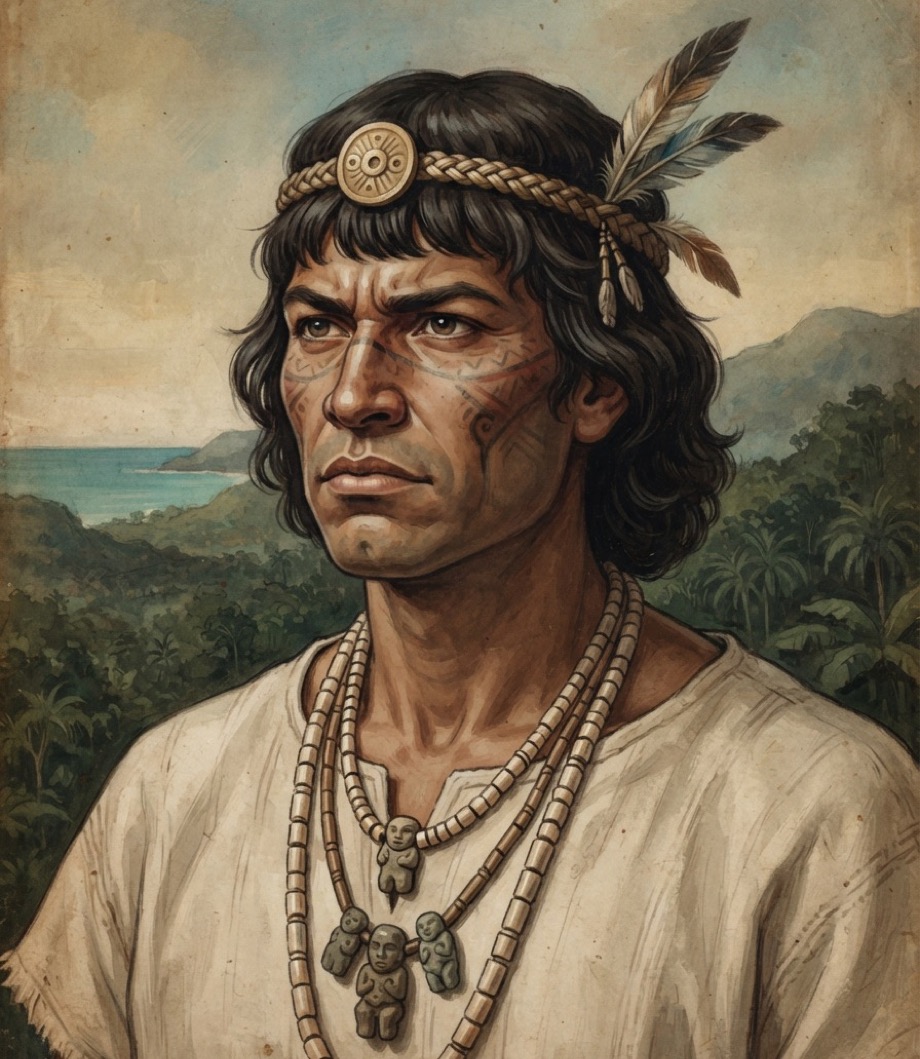
AI-assisted Portrait of Hatuey
The Man Who Crossed the Water to Warn Them
Around 1511, Hatuey did something almost no one in his position did: he acted on information before it cost him everything. Already a cacique on Hispaniola, already watching what the Spanish had done to his own people, he did not wait to see whether Cuba would be spared. He loaded canoes with followers and crossed the strait to tell an entire island what was coming — urgent, physical, and undertaken while there was still time to matter.
What he did once he arrived is the clearest window into his mind. He did not write a warning or send an emissary. He gathered the Cuban Taíno in person, produced a basket of gold, and staged a demonstration: this, he told them, holding the metal up, is the god the Spanish actually worship, the thing they will burn a continent to obtain. Throw it in the river, he said, and remove the reason they come. No theology, no abstraction — an object in his hands and a river nearby. He is the type — ESTP — that thinks by acting in the moment, and it shows even in a speech.
Hatuey led with a demonstration, not a doctrine — gold in his hands, a river at his feet, and Se doing the arguing.
He followed the warning with a war, running a guerrilla campaign against Diego Velázquez's columns rather than meeting Spanish steel and horses in open battle — ambush, retreat, terrain, vanish before it could respond. It held for roughly three months, an eternity by the standard of first contact elsewhere in the Caribbean. And the gold-basket speech is worth a second look: an ESTP rarely gets credit for moving a whole population to a costly act of self-denial, yet Hatuey did — which is why he reads as something close to a foil to the ENFJ cacique Anacaona, his appeal running through demonstration rather than her relational charisma, but moving people all the same.
A Basket of Gold, Held Up in Front of Everyone — Se, dominant
Dominant Se is often described as living in the present tense, but with Hatuey it is more specific: he thinks by staging something for people to look at. He did not lecture the Cuban Taíno about Spanish greed as an abstract vice — he put the actual gold in the actual room and let its weight and shine make the argument, a demonstration a crowd could see and touch and act on immediately.
The same function drove the war. Hatuey did not draft a campaign plan or reason his way to a theory of resistance; he read the terrain of Cuba the way a fluent speaker reads a sentence and used it — ambush points, retreat routes, the advantage of striking where Spanish formations couldn't hold. Guerrilla war rewards exactly the sensory, in-the-moment responsiveness that defines the function: decide fast, act on what is in front of you, vanish before the enemy can respond.
The Question He Asked at the Stake
Auxiliary Ti shows up not as elaborate theorizing but as a habit of testing claims for internal consistency before accepting them. The gold-basket speech is the clearest evidence: not an emotional appeal to loyalty or fear, but a piece of reasoning — here is what they actually value, here is why they came, here is the lever that removes their reason to come. Causal, stripped down, correct.
The same instinct governs the guerrilla strategy. Open battle against Spanish arms and horses was a losing proposition by any honest accounting, and Hatuey worked that out and refused to fight the war his enemy wanted — hit, withdraw, use ground the Spanish didn't know, a coherent logic of asymmetric resistance built without any European model to copy.
It surfaces most famously in his last exchange with the Franciscan friar. Offered baptism and the promise of heaven, Hatuey didn't refuse out of stubborn pride — he asked first: do Christians go there too? Told yes, he followed the logic to its plain conclusion and declined, reasoning that a paradise admitting men capable of what he had witnessed wasn't worth entering. A syllogism delivered under torment, and exactly how Ti behaves when everything else has been stripped away.
Crossing the Water for People He Had Never Met
Tertiary Fe is what turns Hatuey from a fighter defending his own territory into someone who left safety to warn strangers. The Cuban Taíno were not his people in any immediate sense — he owed them nothing beyond a shared fate he could see coming. He crossed the water anyway, gathered them, and organized them, because the alternative was letting an entire population walk into what he had already watched happen to his own.
It shows again in how he built the resistance — not as a lone raider but as a leader who could pull a foreign population into a coordinated campaign on short notice, with no inherited authority to fall back on. He had to earn trust fast, on the strength of what he showed them rather than who he already was to them.
The Warning He Could Not Fully Believe Would Be Heeded
Inferior Ni appears less as foresight than as a grim, unpolished flash of it — a conviction he could act on but never really theorize. He understood, correctly and early, where the Spanish arrival on Hispaniola was heading, and projected that trajectory forward onto Cuba before a single ship had landed there — long-range pattern recognition rare for a function this low in the stack, which is why it surfaces as one dramatic act rather than sustained planning.
It shows its limits, too. The gold-in-the-river plan assumed a narrow model of Spanish motive — remove the metal, remove the incentive — and didn't anticipate that greed for gold would simply be replaced by other appetites: land, labor, conversion, control. An inferior function reaches for the big picture and grabs part of it, not all of it.
It never abandoned him, even facing the fire. The question he put to the friar — whether Christians, too, went to the heaven being offered him — was itself a kind of Ni move: a refusal to accept the present framing of paradise without projecting forward to what it would actually contain, and finding it wanting.
Why ESTP Over ISTP
Why not ISTP?
An ISTP leads with introverted thinking turned inward and stays quiet until a problem needs solving directly in front of them — it does not, as a rule, cross open water to organize strangers around a public act of collective defiance. The gold-basket speech is an extraverted performance aimed at an audience, not a private insight applied alone. The guerrilla campaign that followed required sustained authority over other fighters, something ISTP's more solitary, low-Fe orientation rarely produces.
What tips it to ESTP is the order of operations: act first, in public, on what is directly present, and let the reasoning catch up after. That is the opposite sequence from a dominant-Ti type, and it is the sequence Hatuey followed from the crossing to the river to the war to the stake.
Connected Figures
Further Reading
- A Short Account of the Destruction of the Indies — Bartolomé de las Casas (1552)The primary source for the gold-basket speech and Hatuey's execution, written by a missionary who campaigned against the abuses he describes.
- El Cacique Hatuey: Ídolo o mito? — Jalil Sued BadilloA close historiographical study weighing the documentary record against the legend Hatuey later became.
- The Tainos: Rise and Decline of the People Who Greeted Columbus — Irving RouseBroader context on Taíno society, leadership structures, and the demographic collapse following contact.
