 Historical Figure MBTI
#703 · 5-26-26 · The Age of Exploration
Juan Ponce de León
Conquistador of Puerto Rico · Seeker of Florida · Soldier to the End
c. 1474 — 1521
7 min read
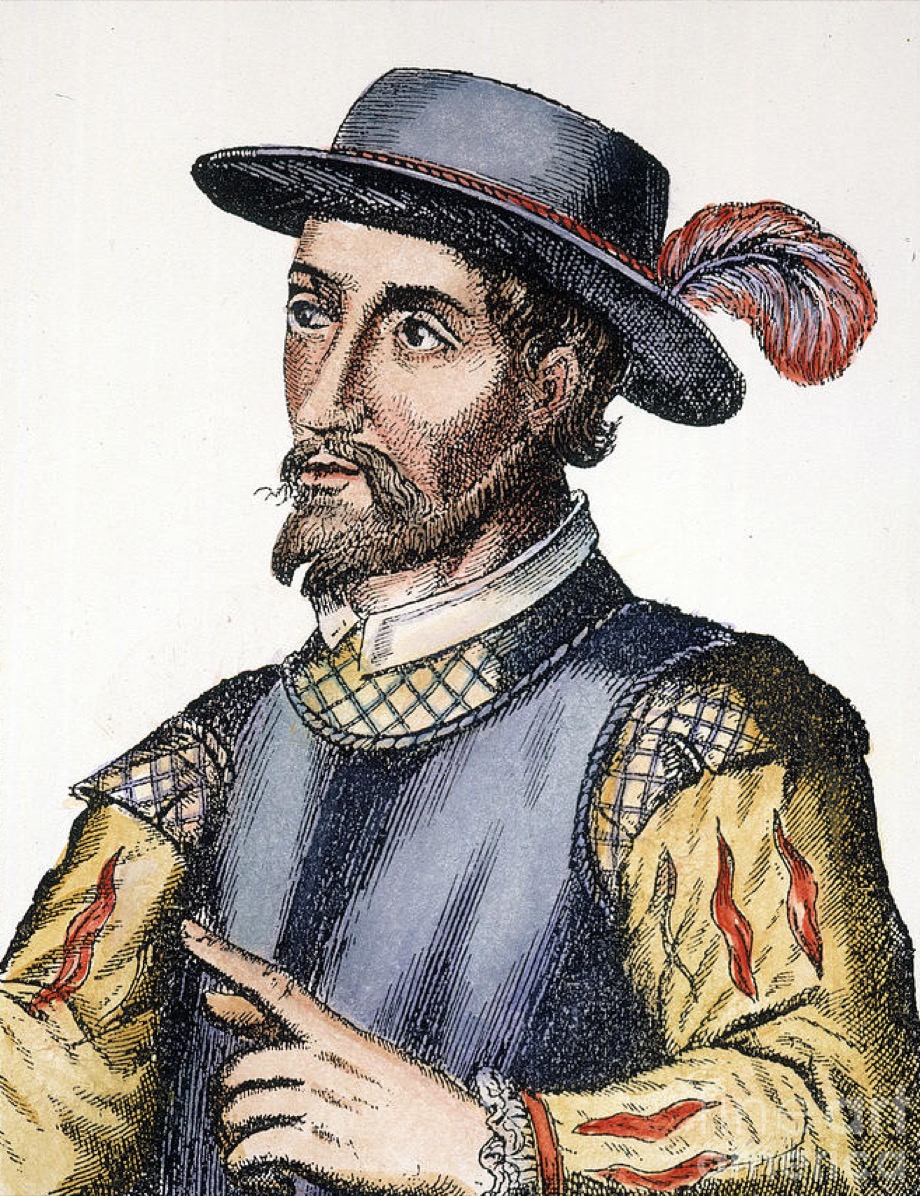
Portrait of Juan Ponce de León
The Soldier Who Never Learned to Wait
Juan Ponce de León did not accumulate power. He took ground. He fought in the last campaigns against Granada as a young man, crossed the Atlantic on Columbus's second voyage in 1493 as an unremarkable soldier among hundreds, and over the next fifteen years turned himself, through nothing but repeated, competent, physical action, into the first governor of Puerto Rico. There was no patron who made him. There was no court intrigue he mastered. There was a series of campaigns he fought and won, an island he pacified with a small force and a direct approach, and a gold-mining operation he organized with his own hands on the ground. When Spain wanted to know what was north of Cuba, in 1513, it was Ponce de León who went and looked — and found Florida, named it, and mapped its coast before turning back.
He is, in the popular imagination, the old man chasing a magic spring. The documented man is almost the opposite: someone who moved toward whatever was directly in front of him — territory, gold, an arrow in the leg — and dealt with it with his hands, not his imagination. That is the signature of ISTP, a type built around solving the problem immediately at hand, and Ponce de León solved problems that way for nearly thirty years, right up until the one that killed him.
He was not a visionary who happened to fight. He was a fighter who occasionally had visions, and only trusted the fighting — the mark of dominant Ti wired to Se, an ISTP who reasoned with his hands.
A Private Logic of Conquest
Ponce de León never wrote a treatise, never courted a chronicler, never seems to have explained himself to anyone beyond what a campaign or a report required. What survives instead is a record of decisions that worked — a mining operation organized efficiently enough to make him wealthy within a few years of taking Puerto Rico, a conquest plotted with a small force against a larger indigenous population and executed with minimal waste. This is dominant Ti: a private, internally consistent system for figuring out how things actually function, tested silently against results rather than argued out loud.
It shows most clearly in how he handled being stripped of the Puerto Rico governorship. Diego Columbus, asserting inherited privilege, maneuvered him out of the post around 1511–1512. A man driven by status or by relationships might have fought the decision in the courts of Spain, or nursed the grievance. Ponce de León instead reasoned his way to the next problem: if the island he had built was no longer his to govern, there was still unclaimed land to the north, and a royal patent to be had for finding it. He converted a political defeat into a logistical question and answered it with an expedition.
Even the famous story of the Fountain of Youth reads, on the documentary evidence, less like romantic longing and more like Ti doing what Ti does with an unverified rumor — filing it away as one hypothesis among several, worth investigating only insofar as it could be tested by going and looking, alongside the more mundane and better-attested goals of land, gold, and labor.
Leading From the Front, Always
Every major turn in Ponce de León's career happened in the field, in person, at close range. He did not send lieutenants to pacify Puerto Rico while he administered from a distance — he led the campaigning himself, moving through terrain, engaging directly, reading the immediate physical situation and acting on it without deliberation. This is auxiliary Se: an appetite for the concrete present, a trust in what the senses report right now over what a plan predicted yesterday.
It is also, unmistakably, what killed him. At sixty-something, on a second Florida expedition meant to plant a permanent colony rather than just survey a coastline, he was still in the front rank when the Calusa attacked — not directing the colony's founding from a ship offshore, but present enough to take a poisoned arrow. He retreated to Cuba and died of the wound within weeks. A more cautious commander, or one whose strength lay in strategic foresight rather than immediate engagement, might have stayed back and lived. Ponce de León never operated that way, not once in three decades, and there is no evidence he considered it.
The same appetite explains his restlessness after losing Puerto Rico. He did not sit in Santo Domingo working the political angles; he outfitted ships and went looking for the next physical frontier, because sitting still and lobbying was never where his competence — or his interest — lived.
A Flicker of the Long View
Tertiary Ni surfaces in Ponce de León not as prophecy but as occasional, well-timed foresight — moments where he seemed to sense which direction held the future before the evidence fully justified it. Petitioning the Crown for the right to explore and settle whatever lay north of Cuba, before anyone had confirmed there was a mainland there at all, was such a bet: a hunch about unclaimed opportunity, acted on early enough to secure the patent before a rival could.
It never became a dominant trait. He did not theorize about what Florida's discovery might mean for Spain's empire, did not angle to become a strategist or a court advisor on colonial policy. The long view flickered in just enough to point him toward a good bet, and then Se and Ti took over to execute it — which is exactly the pattern of a tertiary function: present, occasionally decisive, never running the show.
Governing Without a Gift for It
Inferior Fe is where Ponce de León's record turns uncomfortable, and not only by the moral standards of his own century. He held authority over Puerto Rico's indigenous population and over enslaved people taken from Florida and neighboring islands, and nothing in the sources suggests he managed those relationships with any particular attunement to the people under his command — only with the same blunt, results-oriented competence he brought to mining and campaigning. Where a dominant Fe leader builds consensus and reads a room to hold people together, Ponce de León held Puerto Rico together through direct force and practical administration, not through cultivated loyalty.
It shows too in his loss of the governorship itself. He seems to have been outmaneuvered less by superior political skill on Diego Columbus's part than by his own indifference to the social game of court favor — he had built a functioning colony with his hands and assumed the results would speak for themselves. They did not, in a system that ran as much on lineage and connection as on demonstrated competence, and the gap between what he was good at and what the situation actually required is the clearest mark of inferior Fe: a blind spot for the very terrain where his rivals thrived.
Why ISTP Over ESTP
Why not ESTP?
ESTP is the extraverted mirror of the same field-competence profile, and it is tempting to reach for it given how much of Ponce de León's life played out in direct physical action. But ESTPs lead with Se and use Ti in support — they read and work a room, negotiate, perform for an audience. Ponce de León did none of that. He built no network of political allies, gave no evidence of charm deployed strategically, and lost his governorship in part because he would not or could not play that game. His decisions read as privately reasoned first, acted on second, and explained to no one — dominant Ti, not dominant Se.
The distinction is not academic. An ESTP contemporary like Vasco Núñez de Balboa built and held power partly through charisma and force of personality among his men. Ponce de León held Puerto Rico through administration and results, and lost his position to a rival move he seems never to have seen coming — the outcome of a man who solved problems in isolation, trusting that competence alone would carry him, and finding, too late, that it did not.
Connected Figures
Further Reading
- Juan Ponce de León and the Spanish Discovery of Puerto Rico and Florida — Robert FusonThe standard scholarly biography, reconstructing his campaigns and expeditions from primary Spanish sources.
- Finding Florida: The True History of the Sunshine State — T.D. AllmanOpens with a clear-eyed account of Ponce de León's real motives, stripped of the Fountain of Youth mythology.
- History of the Indies — Bartolomé de las CasasA contemporary chronicle covering the Spanish conquest of the Caribbean, including the pacification of Puerto Rico.
