 Historical Figure MBTI
4 min read
#291 · 3-25-26 · Catherinian Russia
Baroness von Wrede
Baroness · Baltic Noblewoman · Peripheral Figure of the Court
dates uncertain
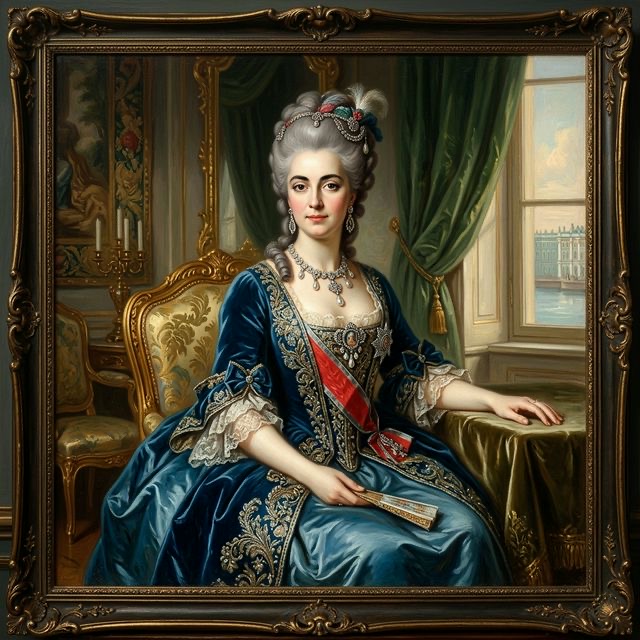
AI-assisted Portrait of Baroness von Wrede
A Baltic Name in a Russian World
The Baltic German nobility occupied a peculiar position in Imperial Russia. They were not Russians — they were the old Protestant elite of the Livonian and Estonian provinces, speaking German at home, maintaining Lutheran churches and Baltic estate cultures, yet serving the Romanov empire with conspicuous loyalty. From Peter the Great onward, Baltic German families supplied Russia with generals, administrators, diplomats, and courtiers at a rate far out of proportion to their numbers. The von Wrede family was among these families — a baronial house of the Baltic German service elite, present in the imperial orbit through generations of court and military placement.
Baroness von Wrede appears in the Catherinian Russia cluster as one of the peripheral figures of this world. The specific details of her life — her birth year, her husband, her particular role at court — are not well documented in the historical record that has come down to us. What we can reconstruct is the milieu: a Baltic German baroness in Catherine II's Russia would have inhabited the ceremonial world of St. Petersburg court life, would have participated in the religious and social institutions of the German-speaking community within the Russian capital, and would have navigated the double identity of her class — loyal imperial servants who remained culturally distinct from the Russian nobility around them.
The historical record does not support confident psychological typing for Baroness von Wrede. Too little is known about the particular texture of her life — her letters, her relationships, her decisions — to identify the cognitive patterns that MBTI typing requires. She is included here not as a typed figure but as a presence in this world, a marker of the Baltic German layer of Catherinian society that shaped the court's character without fully merging into it.
Between Two Worlds
The position of a Baltic German noblewoman in Catherine II's Russia was one of structured ambiguity. She was a subject of the empress, expected to participate in the rituals and obligations of court life, yet she belonged to a community defined by its German language, Lutheran faith, and attachment to Baltic provincial traditions. This was not a marginal position — Baltic Germans were deeply integrated into imperial administration — but it was a doubled one, requiring constant code-switching between Russian imperial expectations and the dense social world of the German-speaking community in St. Petersburg.
Catherine herself, of course, was German-born — Princess Sophie of Anhalt-Zerbst, who arrived in Russia in 1745, converted to Orthodoxy, and remade herself as the most thoroughly Russian of empresses. Her relationship to the Baltic German community was therefore complex: she understood it from the inside but had conspicuously transcended it, choosing Russian identity with the deliberateness of someone who had chosen rather than inherited it. Baronesses like von Wrede, who had not made that transcendent choice, remained in the intermediate space — useful to the empire, integrated into court life, but still identifiably Baltic in the way that mattered to the Russian aristocracy around them.
Psychological Verdict
The historical sources do not give us enough to type Baroness von Wrede with any confidence. The von Wrede baronial context suggests someone navigating the obligations of service nobility — disciplined, protocol-aware, attuned to the social hierarchies of a court world — but these are characteristics of the milieu rather than of any particular psychological type. Whether she was an Fe-dominant social adapter or an Si-dominant custodian of tradition or something else entirely, the record doesn't say. This entry marks her presence in the Catherinian orbit without claiming more than the evidence permits.
What is clear is that women of her class and background formed a distinct layer of Catherine's court: educated, multilingual, tied to the German Protestant world that had given Russia so many of its most capable administrators, yet always slightly external to the inner circle of Russian Orthodox aristocracy that Catherine cultivated. They were necessary figures — and largely invisible ones. Baroness von Wrede belongs to that invisible necessary world, a face in the background of an era that is otherwise well-documented from the vantage point of its most prominent actors.
Connected Figures
Further Reading
- Russia in the Age of Catherine the Great — Isabel de MadariagaThe standard account of Catherinian Russia, including the Baltic German elite the Baroness's family belonged to.
- The Romanovs: Autocrats of All the Russias — W. Bruce LincolnTraces the Romanov reliance on Baltic German nobility, the world the Baroness inhabited without fully merging into.
- Catherine the Great: Portrait of a Woman — Robert K. MassieSketches the ceremonial court world a Baltic German baroness like von Wrede would have navigated in St. Petersburg.
