 Historical Figure MBTI
#1150 · 8-24-26 · The Fall of the Han
Cai Wenji
Poet · Twelve Years a Captive · Ransomed by the Man Who Killed Her Father's Enemies
c. 177 – c. 249 CE
10 min read
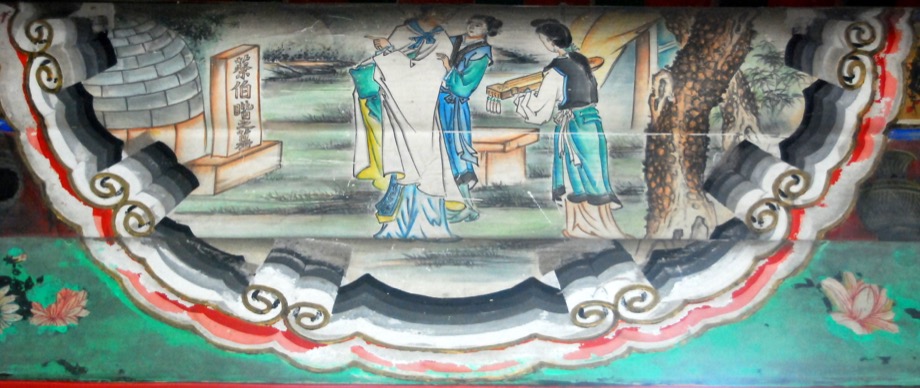
Portrait of Cai Wenji
A Poem That Refused to Choose a Side
Cai Wenji was born into a household where texts were furniture. Her father, Cai Yong, was one of the most eminent scholar-officials of the late Han, and she grew up surrounded by his library and, tradition insists, by an ear so trained that at six she could name a broken lute string in another room by its sound alone. That inheritance — precision of feeling, trained early and privately — would outlast every institution that raised her. The Han collapsed around her in pieces: a warlord's coup, a capital burned, a father dead in prison for the wrong political sympathy. Sometime in the chaos of the mid-190s, a Xiongnu raiding party took her north, and for roughly twelve years she lived a second, unchosen life — the wife of a chieftain, the mother of two children — before Cao Cao, an old family friend of her father's, ransomed her back to Han territory for gold and silk she never asked to be worth.
Nothing about that return was simple, and Cai Wenji never pretended it was. She did not come home and write a grateful chronicle of rescue. She wrote "Eighteen Songs of a Nomad Flute," a first-person cycle that holds captivity and homecoming in the same unresolved breath — grief for the father's country lost, and grief, just as raw, for the children's country she was made to abandon in exchange for it. No public office, no military campaign, no diplomatic settlement earned her the record she has. A poem did. That fact alone tells most of the story of her type.
Cai Wenji is an INFP, and dominant Fi is the whole architecture of her one surviving act: turning an unresolvable private grief into art rather than into a moral that anyone could use.
A Grief With No Correct AnswerFi — dominant
"Eighteen Songs" does not read like a document written to persuade anyone of anything. It reads like a woman working out, verse by verse, what she actually felt — and what she felt did not sort cleanly into the categories her own culture offered her. She was supposed to feel only relief at deliverance from the "barbarian" north and only duty toward the ancestral home reclaiming her. Instead the poems dwell, at length and without apology, on the children she left screaming after her cart as it pulled away, on a decade of a life that had become genuinely her own even though it began in violence. That refusal to file her feeling under the label her society had ready for it is Fi in its most unmistakable form: an internal standard of truth that outranks the external one, even when the external one is offering her a hero's welcome.
It shows again in the choice of form. A woman of her class and moment, wanting to record what had happened to her, had a respectable model available — the sober autobiographical memorial, third person, dignified, built for the historical record her own father would have recognized. She wrote a flute-song cycle instead, first person, unguarded, closer to lament than to chronicle. The gap between the genre she was handed and the genre she used is the gap between Fe's instinct to speak in the register the audience expects and Fi's insistence on the register the feeling actually requires.
Even her ransom, described by everyone else as an unambiguous rescue, gets no unambiguous treatment from her. She never argues that Cao Cao was wrong to buy her back, or that the Xiongnu chieftain was right to have taken her. She simply refuses to let either truth cancel the other. Holding two genuinely incompatible loyalties open at once, without smoothing them into a single verdict for anyone else's comfort, is exactly the kind of moral stubbornness that marks a dominant, not an auxiliary, feeling function.
Reading a Second Life From the InsideNe — auxiliary
Ne is what let a Han scholar's daughter, dropped without consent into a Xiongnu camp, come to understand that life as a life rather than only as a captivity. The poems don't render her years on the steppe as a single flat sentence of suffering; they notice weather, sound, the particular textures of a world she'd had no reason to expect she'd ever inhabit, let alone find bearable within. That capacity to keep generating a felt, multi-angled picture of an unfamiliar situation — rather than collapsing it immediately into "enemy territory" — is the auxiliary function doing its quiet work underneath the Fi that ultimately judges it.
It surfaces again, differently, in the tradition that she helped reconstruct several hundred lost texts from her father's ruined library by memory after her return. Recitation from memory sounds like a Si task, and its raw material was — but reassembling scattered, partial, damaged fragments into working texts again is an associative act, following half-remembered threads outward until they cohere, which is Ne's native terrain even when it's being spent in service of the past rather than the future.
What Ne does not give her is detachment. She never treats her own captivity as one interesting case study among many, the way a more Ne-led type might turn even personal catastrophe into material for wider reflection. Every possibility she entertains about her situation still gets pulled back through Fi and asked whether it's true to what she actually feels — which is precisely the ordering a dominant-Fi, auxiliary-Ne profile predicts.
Everything Lost, Held ExactlySi — tertiary
Tertiary Si is why the details in "Eighteen Songs" are so exact rather than merely atmospheric — the specific cry of the flute the cycle takes its form from, the specific weight of the children's hands, the specific road out of the camp. She is not painting an impression of loss in general; she is preserving, almost archivally, the sensory particulars of a life she knows she will never get to inhabit again. That instinct to hold the past in precise, retrievable detail — rather than let it blur into a general mood — is the tertiary function, present and useful, but serving Fi's emotional accuracy rather than running the show on its own.
The library reconstruction shows the same instinct pointed at a different loss. Rebuilding several hundred texts from memory required exactly the kind of granular, faithful recall Si is built for — not reinventing her father's scholarship in her own image, but restoring it as closely as she could to what it had actually been. A dominant-Si figure might have made that project their life's center; for her it reads as a debt paid, a discrete act of fidelity to the dead, subordinate to the larger emotional reckoning the poems carry out.
And it explains why home, once regained, never fully satisfies her on the page. Si keeps producing an exact, aching comparison between the household she returns to and the household — imperfect, imposed, but real — she left behind. A weaker sense of what was lost would have made the return easier to write as simple relief. Hers isn't, because she remembers too precisely what "left behind" actually cost.
A Life She Never Tried to RunTe — inferior
Nothing about Cai Wenji's recorded life involves organizing other people, negotiating outcomes, or building the kind of durable external structure Te specializes in. The ransom itself is the clearest evidence: it happens to her. Cao Cao decides, Cao Cao pays, Cao Cao arranges the terms of her return — and she is transported by the outcome rather than the author of it. That is not a moral failing; it is simply where an inferior Te sits in the psyche, present enough to accept a negotiated deal but nowhere near capable of, or interested in, initiating one herself.
Her second marriage after returning to Han territory reads the same way in the sources: arranged, accepted, undocumented in any detail that suggests she shaped it. Where a Te-dominant or even strong-auxiliary figure would have used her restored status and her father's name to build something — a school, a faction, a position — she used it to finish a private, backward-looking task: recovering her father's books, word by remembered word. That is Fi and Si working in concert, with Te never rising to claim the driver's seat.
Even at its most functional, her inferior Te shows up defensively rather than assertively — the discipline needed to sit down and actually complete the reconstruction of several hundred texts, a real feat of sustained execution, but one aimed entirely at honoring a private debt rather than building any public machinery. It is Te in service of Fi's verdict, never Te setting the terms.
Why INFP Over ISFJ
Why not ISFJ?
It is tempting to read her as a dutiful daughter and wife who simply endured captivity and returned home because return was owed — a reading that would make her ISFJ, Si and Fe working together to honor obligation and keep the record tidy. But "Eighteen Songs" refuses tidiness. It lingers, unresolved and unashamed, on love and grief for the children and the life she was made to leave — precisely the complicated, personally felt truth an ISFJ account would have smoothed over in favor of the expected, dutiful narrative. A poet organizing her feeling around what she was supposed to feel would have written a very different cycle.
What makes the INFP reading hold is that the poems never resolve into a lesson. They do not conclude that duty was worth the cost, or that the years among the Xiongnu were a mistake now corrected, or that any tidy moral redeems the arithmetic of what she gained and lost. They simply insist that both truths were real and that the insistence itself mattered more than the comfort of an audience wanting a cleaner story. That is Fi's signature, not Fe's — feeling answerable to itself first, and only afterward, if at all, to what anyone else needed to hear.
Connected Figures
Further Reading
- A Biographical Dictionary of the Later Han to the Three Kingdoms — Rafe de CrespignyEntry on Cai Yan (Cai Wenji), her family, and her captivity and ransom
- Imperial Warlord: A Biography of Cao Cao — Rafe de CrespignyCovers Cao Cao's ransom of Cai Wenji from the Xiongnu
- Eighteen Songs of a Nomad Flute (Hu Jia Shi Ba Pai) — Attrib. Cai Wenji, various translatorsThe autobiographical poem cycle on which her literary reputation rests
- Chinese Philosophy and the Feminine — Robin R. Wang (ed.)Context on the reception and reading of Cai Wenji's poetry
