 Historical Figure MBTI
#1143 · 8-24-26 · The Fall of the Han
Cao Cao
Poet · Tyrant · Improviser · 'I'd Rather Betray the World Than Let It Betray Me'
155 – 220 CE
8 min read
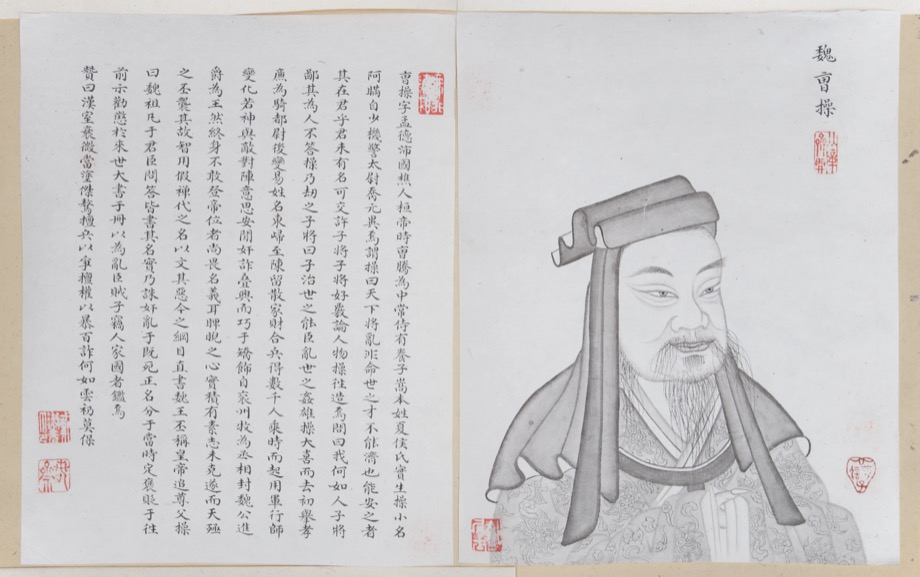
Portrait of Cao Cao
The Man Who Never Wanted the Throne, Only the Game
He is the great villain of Chinese popular memory — the crafty tyrant of the operatic stage, the white-faced schemer of a thousand puppet shows and, eventually, a thousand video games. And he earned every bit of that reputation on the record, not by slander: a man born into a family his rivals never let him forget was tainted, who rose by talent and audacity rather than pedigree, and who at the exact moment total power sat in his open hand — the throne itself, his for the taking after decades spent building the only army and administration in China capable of seizing it — declined to take it. He preferred, he said, to be Zhou King Wen: the power behind the power, and let his son wear the crown.
That is not the biography of a man executing a single grand design toward a single symbolic prize. It is the biography of a mind that loved the game more than the trophy — a mind that read every situation fresh, found the crack in it, and struck through the crack before anyone else had finished describing the wall. Cao Cao inherited none of the legitimacy that mattered in his world and built an empire on wit, timing, and a contempt for orthodoxy so open he wrote it into government edicts. He is, underneath the warlord and the poet, one of history's clearest ENTPs.
Cao Cao thought in openings, not blueprints — an Extraverted Intuition that read a battlefield, a court, or a rival's blind spot the way other men read scripture, backed by a Thinking core cold enough to let the crown itself go unclaimed.
The Grain Depot at Wuchao
In the winter of 200 CE, Cao Cao held a strip of territory against Yuan Shao, the greatest warlord of the age, whose army outnumbered his roughly four to one. Every conventional read of the situation said dig in, starve, wait for reinforcements that would never arrive. Cao Cao instead read the situation the way an ENTP always does — not for its danger but for its exploitable seam. A defector told him where Yuan Shao's grain was stored, lightly guarded, at Wuchao. He did not deliberate for days or convene a council to build consensus; he personally led a night raid deep into hostile territory, burned the depot, and broke an army four times his size in a single stroke. That is Ne in its purest military expression: not raw courage, but the instant recognition that the whole architecture of a superior force rests on one unguarded point, and the willingness to bet everything on reaching it before the enemy notices the exposure.
The pattern repeats across his entire career, not just at Guandu. Against Lü Bu he shifted tactics repeatedly rather than repeating a single siege doctrine. Against the fugitive Emperor Xian in 196 he saw what no other warlord saw — that a powerless, discarded monarch was worth more alive and "welcomed" into his own territory than any city he could conquer, because commands issued in the emperor's name were commands no rival could openly refuse. That was not a move written into anyone's existing playbook. It was Ne noticing a possibility space nobody else had thought to enter: legitimacy as loot, sitting unguarded in the open.
It is also, unmistakably, what undid him. At Red Cliffs in 208 the same appetite for the bold improvisation — chaining his fleet together to steady novice sailors he'd conscripted from the conquered north — turned into the single greatest miscalculation of his life, and fire finished what caution would have prevented. An Ne-dominant does not stop generating audacious options merely because the last one worked; the same faculty that broke Yuan Shao's army also handed Sun Quan and Liu Bei the fire that fixed China's division into three states rather than one.
A Commentary on Sun Tzu, Written by the Man Living It
Cao Cao wrote the earliest surviving commentary on Sun Tzu's Art of War — not as a scholar's exercise but as a working general annotating a text he was actively testing against real armies. That single fact says more about his auxiliary Ti than any battle. Where Ne threw up the raw material of possibility — the grain depot, the fugitive emperor, the chained fleet — Ti was the internal apparatus that stripped each possibility down to its logical skeleton and asked whether it actually held together, independent of what convention or piety said it should look like.
The clearest expression of that Ti is the decision he made about the throne itself. By his final years Cao Cao held every instrument of power a Han emperor could hold — armies, court, the right to appoint and execute at will — and took the title King of Wei, one formal step below the crown. He stopped there deliberately, reasoning through the actual mechanics of legitimacy rather than reaching for its symbol: the throne conferred nothing he did not already possess, while claiming it would convert every rival's private resentment into a public, unifying cause. Better to let his son Cao Pi take that one remaining step after the risk calculus changed. That is a Ti pragmatist's verdict on ornament — the crown was a liability disguised as a prize, and he refused to let symbolism override analysis.
It shows too in the famous "recommend talent regardless of virtue" edicts, which read like logical proofs stripped of sentiment: if the goal is to win, and Confucian virtue-testing filters out effective men who happen to be unconventional or disreputable, then virtue-testing is the wrong filter. He said so in writing, to his own court, and staffed his government accordingly.
Verse for an Audience of an Empire
Cao Cao was also a major poet, and the fact that a warlord found time to become one is itself a tertiary-Fe signature: a felt need to speak to a collective mood, to put his own private reckoning with mortality and ambition into a form other people could recite, share, and answer. His "Short Song Style" — meditating openly on the shortness of life and his hunger for talented men to help him use what remained of it — was written in the stark, direct Jian'an idiom, meant to be performed and felt rather than privately puzzled over. That is Fe reaching outward for resonance, not Ti reaching inward for proof.
The same tertiary pull explains the theatrical, provocative register of his court edicts and his reputation, even among enemies, for wit and charisma. Fe under Ti does not produce warmth for its own sake; it produces performance calibrated to move a room — the emperor's court, an army before battle, a banquet of officers he needed loyal. Cao Cao used poetry, feasts, and public gesture the way he used strategy: as instruments for shaping how a group of people felt and what they would do next.
What Precedent Never Taught Him
Cao Cao's blind spot was precisely what his strengths made unnecessary until it wasn't: a settled respect for established procedure, tested precedent, and the slow, unglamorous verification that inferior Si would have supplied. At Red Cliffs, the failure that permanently split China into three states rather than one, the fatal detail was not strategic but almost administrative — chaining inexperienced northern sailors' ships together to steady them on unfamiliar southern water, a workaround that any commander steeped in naval convention might have flagged as a fire risk on its face. He had no accumulated feel for ships, no inherited caution there to check the improvisation.
The same gap appears in how he treated Confucian orthodoxy generally — not merely disagreeing with it but discarding it wholesale in his recruitment edicts, with no patience for the possibility that tradition might be encoding something Ne couldn't see from a fresh read of the present moment. It served him well against a decadent aristocracy that had ossified around exactly that tradition; it served him poorly wherever raw novelty needed the ballast of hard-won convention. Cao Cao reunified the north, but he never fully learned to trust the kind of knowledge that only comes from doing a thing the same careful way a hundred times before.
Why ENTP Over ENTJ
Why not ENTJ?
An ENTJ reading of Cao Cao assumes one coherent long-range vision, formed early and driven relentlessly toward a single fixed prize — the throne. The record shows something else: a string of adaptive improvisations against whichever rival was most exploitable at that moment, Lü Bu, then Yuan Shao, then a catastrophic overreach against Sun Quan and Liu Bei that he lost. And he declined the single most Te-coded move available to him — actually seizing the crown he had every practical means to take. A Te-Ni master planner finishes the plan. Cao Cao kept generating new openings and, at the final door, chose not to walk through it.
What separates Ne opportunism from Te ambition is exactly this: an ENTJ wants the throne because the throne is the logical terminus of the plan. An ENTP wants the game — the maneuvering, the exploited blind spot, the edict that scandalizes the court, the poem that outlives the battle — and treats the formal prize at the end as almost beside the point. Cao Cao spent a lifetime building the only army in China capable of taking the crown, then handed that final, symbolic step to his son. Ne with a Ti floor explains that. A vision executed to its logical end does not.
Connected Figures
Further Reading
- Imperial Warlord: A Biography of Cao Cao — Rafe de Crespigny (Brill, 2010)The definitive modern biography.
- Sanguozhi (Records of the Three Kingdoms), Book of Wei — Chen ShouThe primary source for his life and campaigns.
- Selected poems in Chinese Lyricism and related anthologies — Burton Watson (trans.)For the stark, direct Jian'an-style verse, including the 'Short Song Style.'
- Fire over Luoyang: A History of the Later Han Dynasty — Rafe de Crespigny (Brill)On the collapse of the Han that created his opportunity.
