 Historical Figure MBTI
#1142 · 8-23-26 · The Fall of the Han
Liu Biao
The Scholar-Governor of Jing Province · Waiting Out a War He Never Joined
142 – 208 CE
6 min read
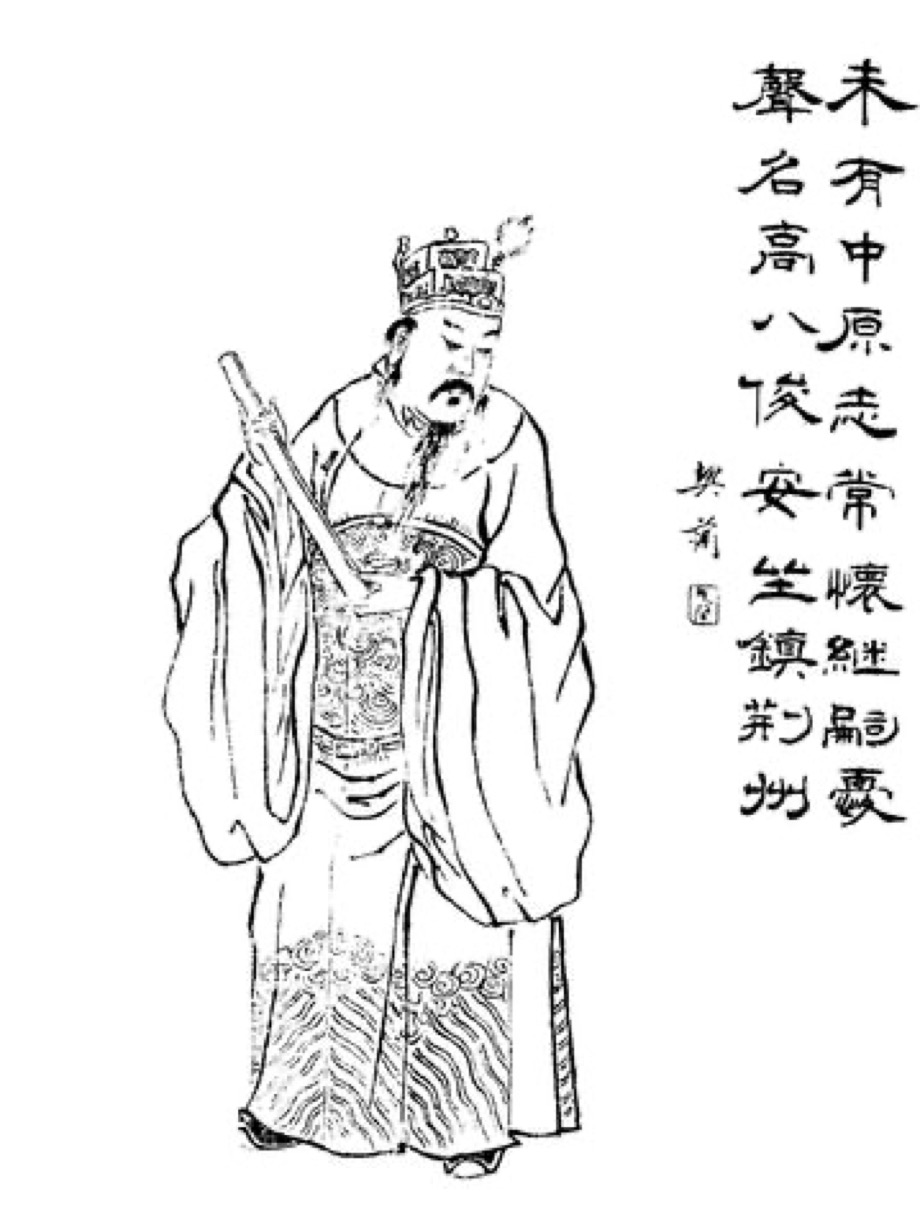
Portrait of Liu Biao
An Island of Order in a Drowning Empire
When Dong Zhuo's soldiers sacked Luoyang and the Han court dissolved into a free-for-all of ambitious governors, Liu Biao did not join the scramble. A distant scion of the imperial clan and already known as a scholar, he arrived in Jing province with almost nothing — no army, no local base, only a reputation for learning. What he built over the next two decades was not a bid for supremacy but a quiet province: markets open, schools running, borders unentered by the campaigns tearing apart the rest of the empire.
Scholars displaced by war settled under his patronage; refugee families, including the household of a boy named Zhuge Liang, found a province where the roads were still safe. Liu Biao never used that stability as a springboard — he turned down the chance to gamble it against Yuan Shao or Cao Cao, and years later took in a defeated, homeless Liu Bei without ever handing him the province's real levers of power. Every one of these decisions has the same shape: a man conserving what he already held, refusing to trade a known good for an unknown gain — ISFJ, Si-dominant with Fe in support, values loyalty measured in decades, not gestures.
Liu Biao was not building toward anything. He was holding the line — an ISFJ's Si insisting, year after year, that what already existed was worth more than what might be won.
The Province That Refused to Change
For nearly twenty years, Liu Biao governed Jing the same way: administer what exists, maintain what works, change as little as possible. He kept the province's institutions running on the model already in place when he arrived rather than remaking them in his own image. Where a warlord like Cao Cao restructured entire regions around his own military machine, Liu Biao's Jing looked, in its fifteenth year, very much like it had in its second.
That same instinct governed his foreign policy. Pressed repeatedly to commit Jing's resources to Yuan Shao's side against Cao Cao, he temporized and kept his soldiers home — not from cowardice but because throwing in with either side risked the one thing Si valued above victory: the province as it stood, undisturbed. The same reflex that made Jing survivable for two decades made it brittle the one moment survival required change.
A Court That Sheltered Rather Than Recruited
Fe gave Liu Biao's conservatism its warmth. He did not merely tolerate the scholars and refugees who drifted into Jing — he actively cultivated a court that welcomed them, funding academies and hosting learned men at his table. Jing became known, in an era when most provinces were known for whichever warlord had most recently burned them, as a place where a family could arrive with nothing and be received.
That same social instinct shaped how he handled Liu Bei, a defeated general with nowhere else to go. Liu Biao did not turn him away, and he did not humiliate him; he gave him a border command and years of quiet support — generosity calibrated by care for harmony, not personal advantage. But that harmony-first instinct also meant he could never quite trust Liu Bei with real power, nor cut him loose. It built loyalty by the boatload; it never once built the hard alliance, backed by real troops, that Jing would eventually need.
The Scholar's Private Reasoning
Liu Biao's scholarly reputation was not decoration. He engaged seriously with classical texts and, by most accounts, reasoned carefully through the political logic of his neutrality rather than defaulting to caution out of temperament alone. His refusal to commit to either Yuan Shao or Cao Cao was an internally coherent argument: any alliance risked dragging Jing into a war it could not control, so the safer position was to commit to neither.
That same private reasoning shaped his wariness toward Liu Bei: he worked out, quietly, exactly how much power such an ambitious guest could safely hold, and settled on a border garrison, not the province — a considered judgment, not a gut reaction. But Ti in the tertiary position reasons within the frame Si already trusts; it never interrogates that frame itself. Liu Biao could calculate precisely how much power to hand a guest. He never turned that rigor on whether two decades of peace had left his province able to survive the war he'd spent those decades avoiding.
The Blindness That Cost Him Everything
Ne, buried at the bottom of Liu Biao's stack, is the function that would have asked the uncomfortable hypothetical: what if the peace doesn't hold, and Cao Cao, done with Yuan Shao, turns south next? A dominant-Ne mind rehearses such branching futures as a matter of course. Liu Biao's did not — he governed as though the present arrangement would simply continue, with no visible contingency for the case where it wouldn't.
That blindness proved fatal. He never resolved which son should succeed him, never built the military capacity Jing would need if diplomacy failed, and never entertained the worst-case futures his strategists occasionally raised. When Cao Cao's army marched south in 208, weeks after Liu Biao's death, the province he had spent twenty years protecting folded almost without a fight — undone less by the invasion itself than by two decades spent unable to imagine it.
Why ISFJ Over ESFJ
Why not ESFJ?
An ESFJ reading would expect an outwardly assertive host, actively courting alliances and angling for greater regional standing. Liu Biao did none of that. Every documented instinct ran inward and protective — hold what Jing already had, welcome refugees quietly rather than recruit them loudly, decline commitment even when both Yuan Shao and Cao Cao pressed him for it. That is Si conserving a known good, not Fe reaching outward to build a bigger one.
ISFJ is the type that explains both halves of Liu Biao's story with the same logic. The same Si-Fe pairing that made Jing a genuine refuge for two decades — stable, welcoming, unwilling to gamble what it already had — is the pairing that left it with no answer when gambling stopped being optional.
Connected Figures
Further Reading
- A Biographical Dictionary of the Later Han to the Three Kingdoms — Rafe de CrespignyEntry on Liu Biao.
- Imperial Warlord: A Biography of Cao Cao — Rafe de CrespignyCovers Cao Cao's invasion of Jing province.
- Sanguozhi (Records of the Three Kingdoms) — Chen ShouThe primary source biography.
