 Historical Figure MBTI
#1082 · 8-13-26 · Spring and Autumn China
Sun Tzu
Strategist · Author of The Art of War
c. 544 – 496 BCE
11 min read
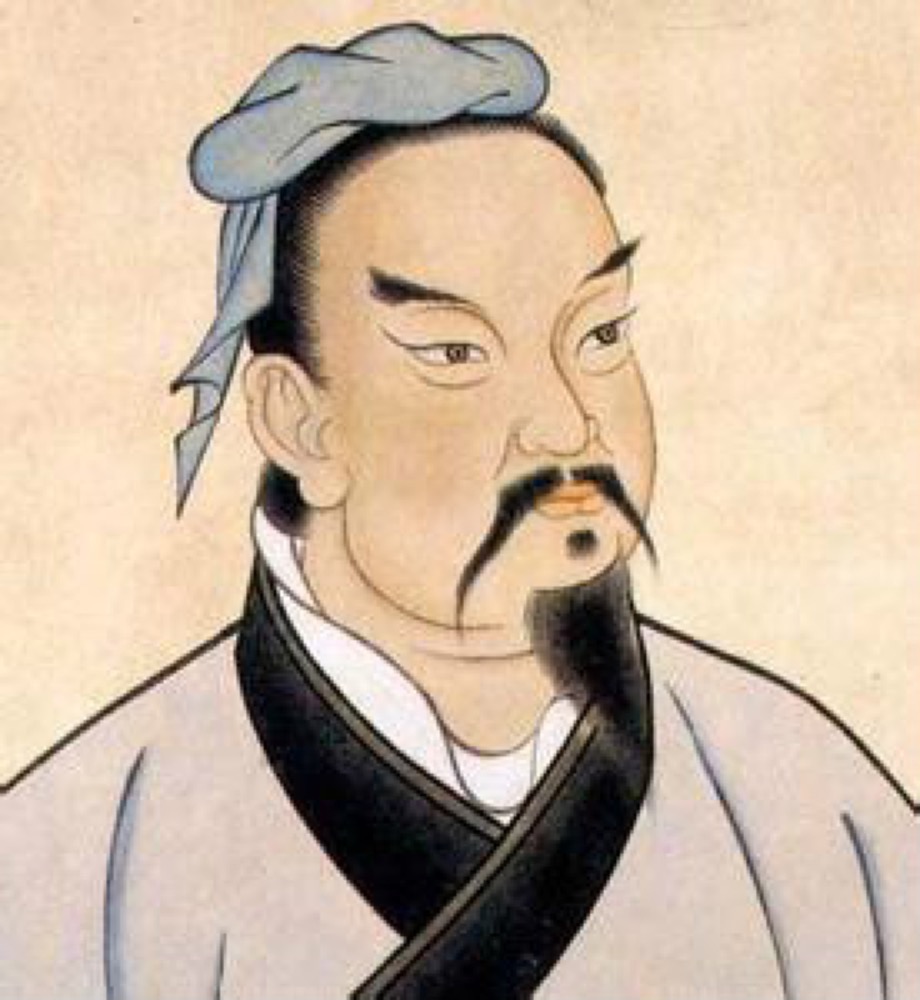
Portrait of Sun Tzu
The Man Who Wanted to Win Without Fighting
He arrives in the record already finished. There is no apprenticeship, no formative defeat, no youth — Sima Qian introduces Sun Wu of Qi at the moment he hands King Helü of Wu a completed manuscript in thirteen chapters and waits to be tested. That is the first and most revealing fact about him. Most commanders are made by campaigns and write afterward, if they write at all. Sun Tzu appears with the theory already built, sealed, and offered as a credential, and then asks for an army to prove it on.
The system he had built was strange for its century. The Spring and Autumn period ran on ritualized aristocratic warfare — chariot duels, honor, the moral weight of a just cause. Sun Tzu wrote about none of that. He wrote about grain wagons and road distances, about the cost of maintaining a hundred thousand men in the field, about spies and misdirection and the terrain a general must never allow himself to be trapped in. He treated war as an accounting problem with lives on one side of the ledger. Its most famous line is not a call to glory but the opposite: to subdue the enemy without fighting is the supreme excellence. The point was never courage. The point was that the battle should already be decided before the armies see each other, and that a general who needs a battle has failed earlier, somewhere upstream, in the planning.
And when Helü challenged him to demonstrate — famously, absurdly, by drilling the palace concubines — Sun Tzu did not treat it as a joke, a courtesy, or a test of charm. He treated it as a small, exact model of the thing itself, and he enforced it to the point of killing the king's two favorites. That episode is the whole man compressed: the vision, the method, the private code that would not bend for a sovereign's affection.
Sun Tzu is the archive's cleanest INTJ — a dominant Ni that saw the shape of a war before it began, and refused to fight one it had not already won on paper.
The Battle Decided Before It Is Fought
Dominant introverted intuition does not predict events; it collapses a mess of particulars into a single governing shape and then acts as though that shape were already the outcome. The Art of War is that habit written down. Its opening chapter is not about weapons or courage but about calculation in the temple before the march — the five factors and seven comparisons, weighed in advance, from which the result is read off. "The one who makes many calculations will win; the one who makes few will lose." The victory exists first as a conclusion, and the campaign is only its execution.
This is why the book is so relentlessly indirect. Sun Tzu's prescriptions are almost all about arranging conditions rather than winning contests: attack where the enemy is unprepared, appear where he does not expect you, shape him until his dispositions are known and yours are formless. The highest form of war is to attack the enemy's strategy — not his army, not his cities, his strategy, the plan itself, several moves before it becomes soldiers on a road. That is an intuitive dominant's instinct given doctrinal form: strike the idea, and the material consequences never have to be fought.
In command against Chu — a state vastly larger than Wu, with more men and more territory — the same logic held. Wu's campaigns did not attempt to out-mass an opponent that could not be out-massed. They exhausted it: feints along the frontier, rotating detachments that forced Chu to march and re-march, so that when the decisive strike came at Boju the larger army was already worn thin and out of position. The battle was won in the months of maneuver, which is precisely the claim the book makes. Ni does not improvise a triumph in the last hour. It arranges, patiently, for the last hour to be a formality.
Grain, Signals, and the Chain of Command
What separates Sun Tzu from every other ancient moralist of war is that his vision comes packaged as machinery. Extraverted thinking is the auxiliary that turns an intuition into an operating system, and The Art of War is an operating system down to the arithmetic. Chapter two is a costing exercise: a thousand fast chariots, a thousand heavy wagons, a hundred thousand mailed troops, provisions carried a thousand li, and a daily expenditure of a thousand pieces of gold. Therefore, he concludes, no state has ever profited from a prolonged war — a conclusion reached not by sentiment but by running the numbers until they force it. He even prices the remedy: a cartload of the enemy's fodder is worth twenty of your own, so feed off the opponent's country.
The rest is procedure. Signal flags and drums exist, he explains, because in the noise of battle the voice cannot carry, and an army that cannot be redirected is not an army but a crowd — so the control system is specified before the courage is invoked. Terrain is not scenery but a typology, sorted into named categories with rules attached to each. Spies are sorted into five classes with distinct functions and distinct handling. Everything is enumerated, ranked, and made transmissible to a subordinate who was not present when the thinking happened. That is the signature of Te: knowledge externalized into a form other people can execute.
The concubine drill is the same function in miniature, staged as a proof. Sun Tzu divided the palace women into two companies, appointed the king's two favorites as commanders, issued the orders for right, left, front, and rear, and — crucially — repeated the instructions and confirmed they were understood before demanding compliance. When the ranks laughed the first time, he blamed himself: if orders are unclear, the fault is the general's. When they laughed the second time, after the orders had been made explicit, he assigned the fault to the officers. The escalation is a procedure, not a temper. Method first, then enforcement, in that order, every time.
"The General in the Field Need Not Obey"
The concubines died because Sun Tzu had a private line and the king stood on the wrong side of it. Helü, watching his two favorites about to be beheaded over a drill, sent word from the terrace that he was satisfied, that he did not wish to see them killed, that the demonstration could stop. Sun Tzu answered that having been appointed commander, there are orders of the sovereign which he does not accept — and executed them. Then he drilled the remaining women until they turned, knelt, and rose in silence, and reported to the king that the troops were ready for inspection.
Read that as tertiary Fi rather than cruelty and it snaps into focus. There is no anger in the account and no pleasure. What there is instead is an inner conviction held with total, unnegotiable privacy: discipline is either real or it is theater, and an army in which the sovereign's affections can suspend the rules is an army that will dissolve on its first bad day. He was not defying Helü for the sake of defiance. He was refusing to let the king's feelings falsify the demonstration — because a demonstration corrupted by favor teaches the wrong lesson to everyone watching.
The same austere code runs through the book, and it is far less bloodthirsty than the episode suggests. Sun Tzu insists on treating captured soldiers well and folding them into your own ranks. He warns against sieges as the last and worst resort, since they consume months and men for a prize better taken another way. He tells the general to regard his troops as his own children — and, in the same breath, warns that indulgence without discipline makes them spoiled children, useless. Fi in a strategist does not soften the strategy; it supplies the fixed personal standard the strategy is measured against, and Sun Tzu's standard was that waste — of lives, of treasure, of a state's substance — was the true failure.
Water Has No Constant Shape
An inferior function is the one a person respects most and trusts least, and Sun Tzu's relationship to the immediate physical moment reads exactly that way. He is enormously attentive to the concrete — the look of dust rising high and straight means chariots, low and wide means infantry, scattered means foraging parties; birds taking flight mean an ambush, startled animals mean a mass attack coming; trees stirring mean the enemy is advancing under cover. Chapter nine is essentially a fieldcraft manual of tells. The sensory world matters to him intensely, but always as evidence to be decoded, never as experience to be lived in.
And his most famous image is an admission that no plan survives the field intact. An army, he writes, should be like water: it has no constant shape, it avoids heights and rushes to hollows, it takes its form from the ground it runs over. He who can modify his tactics in relation to his opponent and thereby succeed in winning may be called a divine commander. That is an intuitive dominant writing a standing order to himself, telling the strategist to keep surrendering the beautiful plan to what the terrain actually turns out to be.
In practice he seems to have managed it. The Wu campaigns against Chu were not textbook set-pieces; they were fast river marches, unexpected crossings, and a willingness to abandon a prepared approach the moment the enemy's dispositions changed. But the anxiety shows in how often he legislates against the sensory temptations — the general undone by recklessness, by a hot temper, by an appetite for honor, by a delicacy about his men that traps him. Those are five dangerous faults he names by name, and four of them are impulse. He was a man who knew precisely which door the disaster would come through, because it was his own.
Why INTJ Over INTP
Why not INTP?
The case for INTP is easy to make and easy to break. A reclusive theorist producing an elegant, aphoristic system about a domain he abstracts into principles — that looks like Ti until you notice what the system is for. The Art of War is not an exploration of war's nature; it is an operational manual with costings, signal procedures, terrain protocols, and a five-class taxonomy of spies, written to be handed to a subordinate and executed on a specific frontier. A Ti-dominant refines a model until it is internally coherent and is content to leave it there. Sun Tzu wrote thirteen chapters and then demanded an army to run them on, and when the demonstration required killing two women to make a rule stick, he killed them. That is Te enforcement, not Ti curiosity.
The deeper tell is the book's indifference to being interesting. It does not entertain objections, chase paradoxes, or qualify itself; it declares, enumerates, and moves on. Where an INTP would open the question of what victory even is, Sun Tzu treats victory as a settled quantity and spends his pages on how to procure it at the lowest cost. The intuition supplies the shape of the war; the thinking function exists to impose that shape on the world, on schedule, through other people. INTJ describes a mind that plans in order to act. Sun Tzu never wrote a sentence that was not, ultimately, an instruction.
Connected Figures
Further Reading
- The Art of War — Sun Tzu, trans. Samuel B. GriffithThe standard English edition, with a soldier-translator's introduction on the text's military logic.
- Sun-tzu: The Art of Warfare — trans. Roger T. AmesTranslation built on the Yinqueshan bamboo strips, with the philosophical context Griffith leaves out.
- Shiji, 'Biographies of Sun Tzu and Wu Qi' — Sima QianThe sole ancient life — source of the concubine drill and of every doubt about it.
- The Seven Military Classics of Ancient China — Ralph D. SawyerPlaces The Art of War inside the tradition it founded, with the rival treatises for comparison.
- The Cambridge History of Ancient China — ed. Michael Loewe & Edward L. ShaughnessyArchaeological and textual grounding for Spring and Autumn warfare and the Wu–Chu–Yue conflicts.
