 Historical Figure MBTI
#1083 · 8-13-26 · Spring and Autumn China
King Helü of Wu
King of Wu · Patron of the Art of War
c. 537 – 496 BCE
6 min read
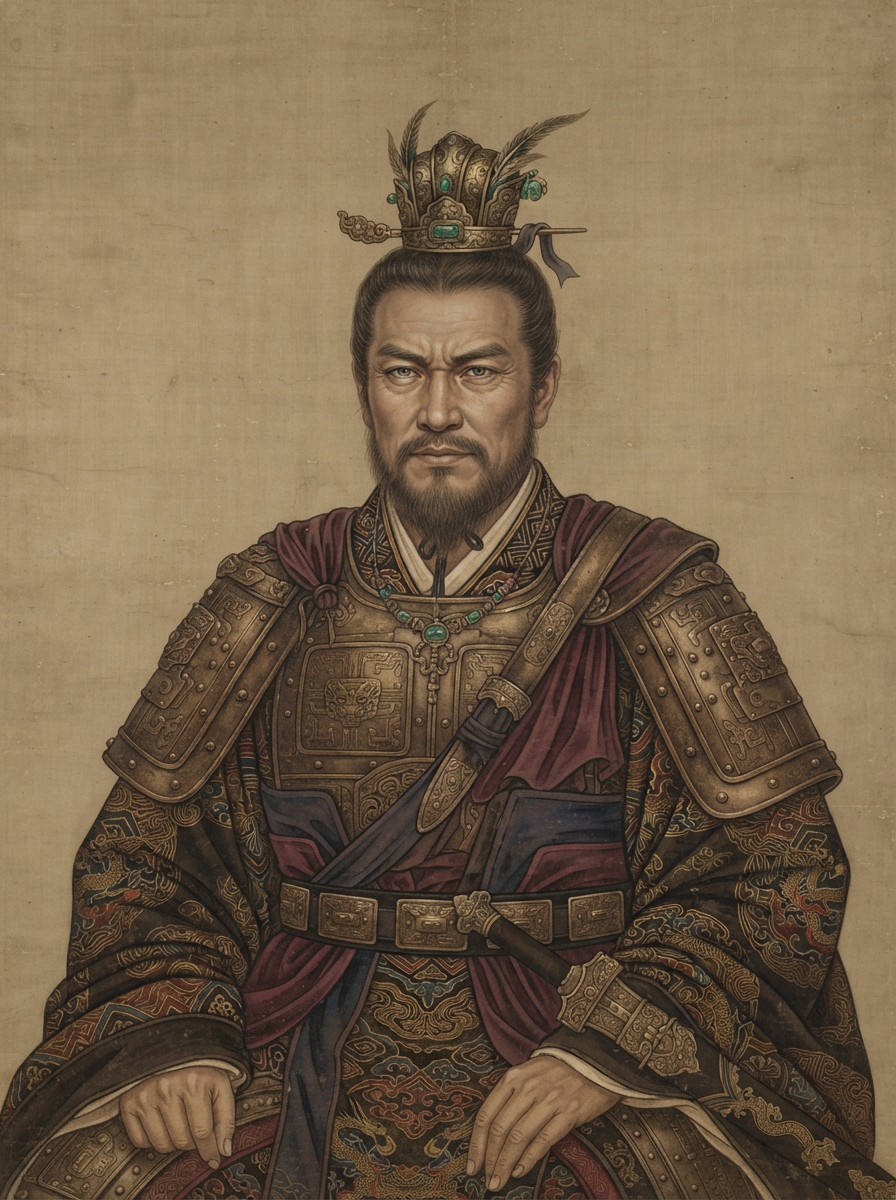
AI-assisted Portrait of King Helü of Wu
The Fish, the Dagger, and the Throne
In 515 BCE a servant carried a whole cooked fish to the banquet table of King Liao of Wu. Inside its belly was a dagger, and the man holding the knife was Zhuan Zhu, an assassin who had spent a year learning to cook that exact dish so that no guard would think to search it. He killed the king with one stroke and was cut down a moment later by the royal bodyguard. The man who had hired him, waiting in the shadows of his own coup, walked out of the chaos and took the throne of Wu as King Helü. It is not a subtle story, and Helü never pretended it was. He did not out-administer his cousin or out-argue him in council — he simply removed him, cleanly and violently, at the first workable opening, and then got on with the business of ruling.
Everything that follows in his nine-year reign carries the same signature: a man who read the physical situation in front of him with total clarity, acted on it without hesitation, and then reasoned his way through the consequences with a cold, practical logic that had no patience for theory. He is best read as an ESTP, and the fish-dagger coup is the purest single act of his life — but the pattern repeats in how he built his court, fought his wars, and finally died chasing one war too many.
Helü did not deliberate his way to power. As a dominant-Se ESTP, he seized the one decisive opening the moment it appeared — a blade in a fish, a banquet, a single stroke — and reasoned out the rest afterward.
A Blade Where the Guard Wasn't Looking
Helü's dominant Se shows up first as pure physical opportunism. King Liao was cautious, guarded, entrenched — everything a careful plotter would need years to work around. Helü instead found the one exploitable seam: a banquet, a trusted cook, a fish large enough to hide a knife. He did not wait for a broader crisis to weaken his cousin's position; he manufactured the opening himself and struck the moment it existed, fully aware the assassin would die in the act and that his own life hung on the next ten seconds going exactly right.
The same instinct governed his wars. When Sun Tzu and Wu Zixu had built Wu's army into the sharpest instrument in the region, Helü did not sit on that advantage — he threw it at Chu immediately, and Wu's forces took the Chu capital of Ying within weeks, an outcome that stunned every other court in China. And when he later marched on Yue before his own kingdom had fully recovered from the Chu campaign, it was the identical reflex: he saw an opening against Goujian of Yue and moved on it, this time without Sun Tzu's discipline to check him. He took a wound in that battle — an arrow to the toe, by tradition — that killed him within days. The same appetite for the immediate opening that built his kingdom also ended his life.
The Test of the Concubines
Once on the throne, Helü ran Wu on sharp, results-first calculation rather than inherited protocol. The clearest evidence of his auxiliary Ti is the story Sima Qian tells of Sun Tzu's audition. Helü had read Sun Tzu's treatise on war and, wanting proof it worked on real people rather than an argument that it should, handed him 180 of the royal concubines and told him to drill them as soldiers. When the women treated the exercise as a joke, Sun Tzu explained the orders again, then executed the two women he had named as company commanders — including, by tradition, two of Helü's own favorites — to make the point that an order is only real if it is enforced.
Helü was furious in the moment and begged him to spare the women. But he did not override the demonstration or dismiss the general who had just killed two of his concubines in front of him: he let the logic of the test stand, because the logic was sound, and the remaining women drilled perfectly afterward. That is Ti in its most Se-flavored form — not abstract system-building, but a hard-nosed willingness to accept an unpleasant conclusion because the reasoning behind it checked out. He applied the same standard to statecraft generally, keeping whichever arrangement of generals and ministers actually produced results and discarding what didn't, with little sentiment for how things had always been done.
Recruiting the Exile and the Nobody
Helü's tertiary Fe explains how he built the court that made his wars possible. Wu Zixu arrived in Wu a broken man — his father and brother executed by the king of Chu, his own life spent fleeing across state lines. Helü did not treat him as a useful foreign defector to be filed away; he took him in personally, made him a trusted confidant, and gave him the standing to shape Wu's strategy for a generation. Sun Tzu, for his part, was a nobody with a manuscript when Wu Zixu brought him to court. Helü could have politely declined an untested theorist — many kings would have. Instead he engaged with him directly, tested him publicly, and once the test succeeded, handed him command of Wu's armies.
That is the tertiary function at work: real personal warmth and investment in the people around him, not the cold transactional patronage of a purely calculating ruler. Helü built loyalty by making Wu Zixu and Sun Tzu feel personally backed, and both men repaid it with the campaign that broke Chu. It was a rapport-driven court, assembled quickly around whoever proved themselves capable — the opposite of a slow, institutional civil service built over decades.
Why ESTP Over ESTJ
Why not ESTJ?
An ESTJ builds power through steady institutional administration — codified offices, established chains of command, incremental consolidation. Helü did none of that. He took the throne through a single violent improvisation, staffed his court around personal chemistry with an exiled minister and an untested strategist rather than vetted bureaucrats, and launched his final war on his own impatient timetable rather than a planned schedule. That is a life run on daring and read-the-room opportunism, not Te-driven system-building.
The distinction matters because Wu under Helü never became an institution in the way Chu or Jin were — it stayed, for better and worse, an extension of one man's nerve. He could not out-organize his rivals over decades; he could only out-act them in the moment, which won him Ying but also sent him to Yue a year too early.
Connected Figures
Further Reading
- Shiji (Records of the Grand Historian): Biography of Sun Tzu and Wu Qi — Sima QianThe primary source for the concubine drill and Sun Tzu's rise under Helü.
- Shiji: Hereditary House of Wu (Wu Taibo Shijia) — Sima QianTraces Helü's coup against King Liao and the fall of Wu after his death.
- Zuo Zhuan — Traditionally attributed to Zuo QiumingThe near-contemporary chronicle covering the Wu-Chu wars of Helü's reign.
- The Art of War — Sun TzuThe treatise Helü commissioned into practice, written for exactly this king.
