 Historical Figure MBTI
#1149 · 8-24-26 · The Fall of the Han
Dian Wei
The Bodyguard Who Died in a Doorway · Covering the Retreat
d. 197 CE
3 min read
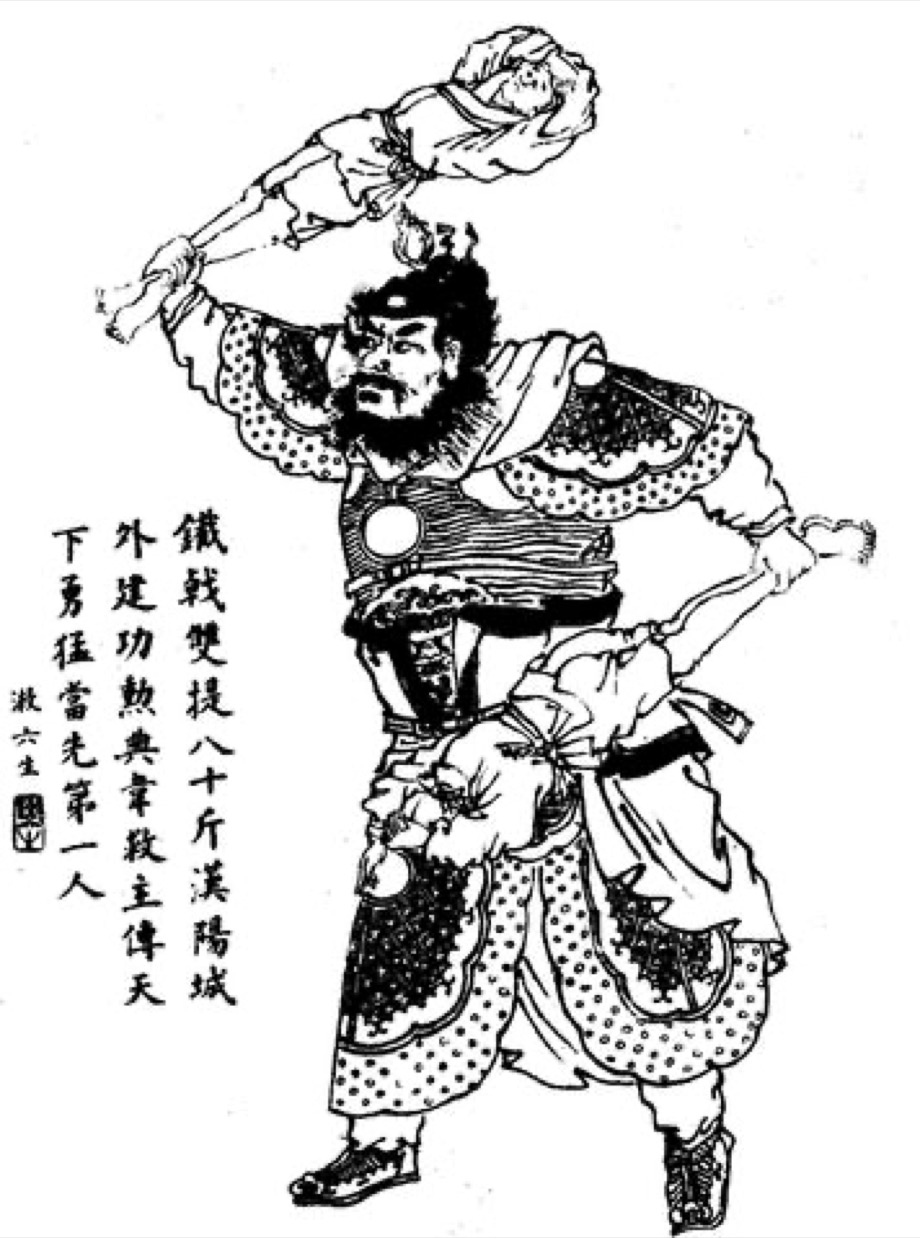
Portrait of Dian Wei
The Weapons Broke Before He Did
Dian Wei left almost no record of speech. What survives of him is entirely physical — a man reportedly strong enough to wield a pair of iron halberds far heavier than any soldier around him could manage, who was noticed for that strength, recruited for it, and kept close to Cao Cao as a personal bodyguard for exactly that reason. There is no surviving account of him angling for rank, courting favor, or offering counsel at Cao Cao's councils. He is a bodyguard in the purest sense: a body, positioned between his lord and whatever came through the door.
That door came in 197, at Wancheng, when the warlord Zhang Xiu — acting on the advice of the strategist Jia Xu — broke a fragile, recent surrender and struck Cao Cao's camp without warning. In the panic that followed, Dian Wei held the entrance to Cao Cao's quarters. He fought with his halberds until they were destroyed or lost, then kept fighting with his hands, buying the minutes his lord needed to get out alive. He did not get out himself. Cao Cao's own son and nephew died in the same ambush, and it was reportedly Dian Wei's death, as much as his family's, that Cao Cao wept over afterward.
An ISTP built entirely for the moment the door gives way — no ambition, no rhetoric, just a body used until there was nothing left to use it with.
A Body, Not a Mind, on Record
There is not enough of Dian Wei on the page to type him by inference or nuance — only by what he consistently did. He shows no recorded interest in Cao Cao's politics, no rivalry with fellow officers like Xiahou Dun, no visible hunger for higher rank. What repeats, campaign after campaign, is proximity and readiness: he stayed close to his lord and met trouble with his body first, immediately, without deliberation. That is the mark of a type oriented entirely around the concrete and the physical in the moment — hands-on problem-solving under pressure, not strategy sessions or long-range planning.
Wancheng did not reveal something new in him; it simply used what was already there until it ran out. When Jia Xu's ambush hit the camp, Dian Wei did not need orders or a plan — he planted himself in the doorway of Cao Cao's quarters and fought with the nearest tool available, first his halberds, then his hands, until he had bought his lord enough time to escape and had nothing left himself. It is the last and most complete demonstration of a life spent as pure, applied physical presence.
Connected Figures
Further Reading
- Imperial Warlord: A Biography of Cao Cao — Rafe de CrespignyCovers the Battle of Wancheng in detail.
- A Biographical Dictionary of the Later Han to the Three Kingdoms — Rafe de CrespignyEntry on Dian Wei.
