 Historical Figure MBTI
#1148 · 8-24-26 · The Fall of the Han
Zhang Liao
Eight Hundred Against a Hundred Thousand · The Defense of Hefei
169 – 222 CE
6 min read
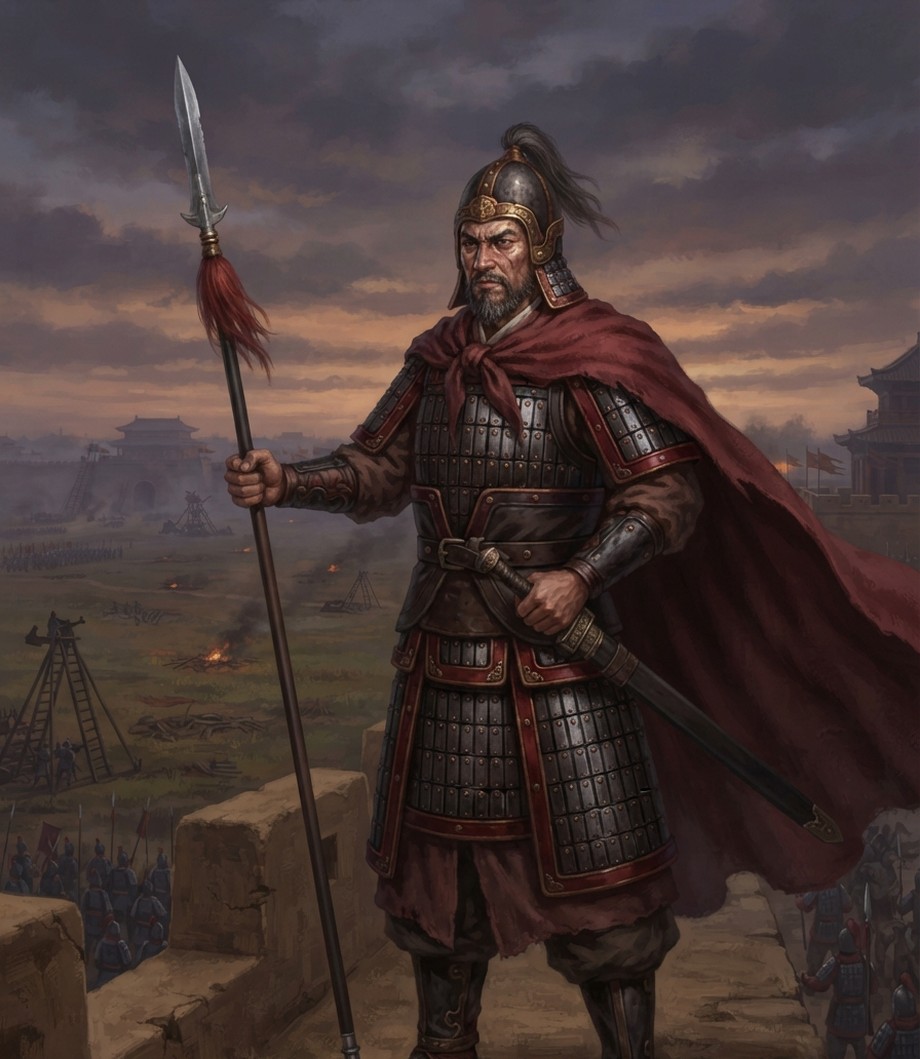
AI-assisted Portrait of Zhang Liao
The General Who Chose to Attack
Zhang Liao arrived in Cao Cao’s service the way most of the empire’s talent arrived in those years — through defeat. He had served the volatile warlord Lü Bu, and when Lü Bu was captured and executed at Xiapi in 198, most of his surviving officers were treated as a liability to be watched rather than an asset to be used. Zhang Liao was the exception. Within a few years he was one of Cao Cao’s most trusted field commanders, entrusted with the empire’s most exposed and contested frontier — the garrison town of Hefei, the hinge on which the entire southeastern border against Wu turned.
That trust was tested in 215, when Sun Quan marched on Hefei with a force reported at roughly a hundred thousand men against a garrison of perhaps eight hundred. The textbook response is to close the gates and wait for relief. Zhang Liao did not wait. Before dawn, he led a small strike force out of the city and directly into the heart of the besieging camp, cutting through the Wu formation with such violence and speed that he came within reach of Sun Quan’s own command post before withdrawing his men back inside the walls in good order — one of the most audacious tactical decisions in the history of Chinese warfare, and almost too neatly a portrait of a psychological type.
Zhang Liao is ESTP to the bone — a dominant Se that does not merely tolerate physical danger but actively prefers it to any alternative, reading the battlefield in real time and trusting its own hands over any plan drawn the night before.
A Sortie, Not a Siege
Se — dominant
The single clearest window into Zhang Liao’s mind is the choice he made before the Hefei assault — not the raid itself, but the decision to see a siege of a hundred-to-one as an opportunity rather than a sentence. Dominant Se does not calculate odds so much as it reads terrain and timing, trusting that a body moving fast and first through a gap will outperform one waiting behind a wall for that gap to close on its own. He picked his moment — pre-dawn, before the Wu camp had fully organized around its own numbers — and moved.
What makes the raid Se rather than mere recklessness is its physicality. He did not direct the assault from behind the lines; he led it, cutting a path through the enemy formation with his own blade, close enough to Sun Quan’s position to force a genuine scramble. That is a sensation-first relationship to combat — danger experienced directly, in the body, in the instant — rather than a strategist’s relationship to danger, which prefers to stay one remove from the blade.
The Read Beneath the Blade
Ti — auxiliary
An Se dominant with no auxiliary discipline is a brawler, and brawlers do not survive a hundred-thousand-man siege with eight hundred men, let alone hold the same city for years afterward. What kept Zhang Liao’s audacity from becoming suicide was a private, in-the-moment tactical logic — auxiliary Ti sorting the raid’s variables even as he executed it: a strike aimed at disruption rather than a headlong charge, hitting the command structure hard enough that a besieging army many times his size lost its coordination before it could bring that size to bear.
It shows most clearly in the withdrawal. He did not press the advantage past its natural limit; he cut, disrupted, and pulled his men back inside Hefei’s walls while the raid was still a victory rather than a story of a garrison that overreached — structural reasoning working fast and silently, mid-motion, never surfacing as a dominant thinker’s deliberate strategy but present all the same.
A Name Wu Mothers Knew
Fe — tertiary
Tertiary Fe in an ESTP rarely looks like warmth for its own sake; it looks like an instinct for the audience — an awareness, even mid-battle, that other people are watching and that a bold enough act will be remembered. Zhang Liao did not fight the Hefei raid in a vacuum; he fought it in front of his own garrison, whose morale in a hundred-to-one siege depended on believing their commander could turn the odds — and he won that belief before he won the battle. It surfaces too in how thoroughly his loyalty was returned: officers who had served Lü Bu were, as a rule, sidelined by Cao Cao, yet Zhang Liao became one of the inner circle, trusted alongside men like Xiahou Dun — trust earned through the visible, relational work of being someone colleagues want fighting beside them.
It lives on, too, in the folk memory that outgrew the man himself — the claim that mothers in Wu invoked his name to quiet crying children, generations after Hefei. A private tactician does not acquire that kind of legend; a figure whose boldness was always, in part, performed for an audience does.
No Grand Design
Ni — inferior
What is almost entirely absent from Zhang Liao’s record is the sweeping, long-horizon vision a dominant intuitive would have brought to the same frontier — some grand theory of how the war between Wei and Wu would resolve, or a strategic architecture spanning years rather than a single dawn. His genius was tactical and immediate, not prophetic. Hefei remained, for him, a position to be defended rather than a springboard toward conquest. He held the line for Cao Cao and, later, for Cao Pi, with tenacity and skill, but the record gives no sign of him pushing for a unifying strategic vision of his own — no attempt to reshape the war’s larger trajectory the way a dominant Ni type would feel almost compelled to.
Why ESTP Over ISTP
Why not ISTP?
An ISTP reading would frame Zhang Liao as a quiet technical specialist who preferred to let the work speak for itself. Nothing about his career supports that. The Hefei raid was a loud, extroverted act of physical courage aimed at breaking an enemy’s will and building his own legend, and it succeeded so completely that his name became a byword for terror across a rival state for generations. That is Se in the extroverted register — courage performed and remembered — not an introverted specialist’s private competence.
Every other candidate type falls away for the same reason. Zhang Liao was not a planner, and he was not a private craftsman content to let results speak without him in front of them. He was a man who read a battlefield in real time, trusted his body over any plan drawn the night before, and turned the boldest possible physical act — charging eight hundred men into a hundred-thousand-man camp — into both a tactical victory and a legend. That is ESTP, and very little else fits the shape of what he did at Hefei.
Connected Figures
Further Reading
- Imperial Warlord: A Biography of Cao Cao — Rafe de CrespignyCovers the Hefei campaign and its command context.
- A Biographical Dictionary of the Later Han to the Three Kingdoms — Rafe de CrespignyEntry on Zhang Liao.
- Sanguozhi (Records of the Three Kingdoms), Book of Wei — Chen ShouThe primary source biography.
