 Historical Figure MBTI
#1146 · 8-24-26 · The Fall of the Han
Jia Xu
Five Masters, One Survivor · The Coldest Strategist of the Age
147 – 223 CE
8 min read
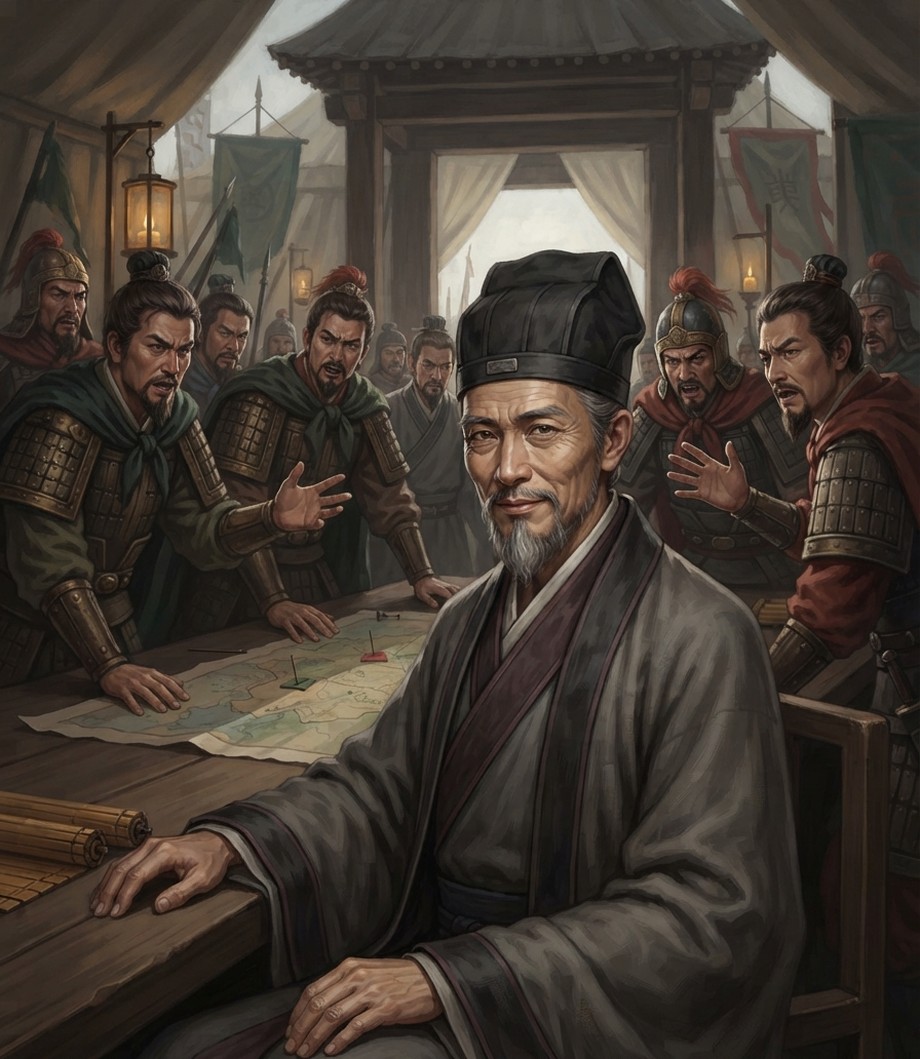
AI-assisted Portrait of Jia Xu
The Man Who Served Five Masters and Answered to None of Them
Nobody who worked for Jia Xu died wondering whether he had been loyal to them. He was not built for loyalty, and he never pretended otherwise. Across the collapse of the Han dynasty — the single bloodiest, most treacherous stretch of political chaos in Chinese history, a landscape littered with strategists who guessed wrong and paid for it with their households — Jia Xu advised five different masters in succession: Dong Zhuo, then Dong Zhuo's mutinous subordinates Li Jue and Guo Si, then the warlord Zhang Xiu, and finally Cao Caohimself. He outlived all of them, outmaneuvered most of them, and died at seventy-six of nothing more dramatic than old age — an ending so rare among his contemporaries that it is, on its own, a kind of argument for how his mind worked.
What makes Jia Xu strange, even among the era's famous schemers, is that his switching cost him almost nothing. He was never purged for treachery, never hunted as a turncoat, never even much resented — because he never framed his advice as devotion in the first place. He read a situation, extracted the correct move, delivered it without embellishment, and moved on when the situation changed under him. That is not the profile of a man managing alliances. It is the profile of a man solving problems, one after another, for whoever happened to be standing in front of him.
Jia Xu is INTP at its most ruthlessly practical — a Ti-dominant mind that treated every master as a fresh data set, and every loyalty as a variable subject to revision.
The Calculation, Stripped of Sentiment
The clearest evidence of Jia Xu's Ti is the sheer variety of contexts in which it produced the correct answer. Under the tyrant Dong Zhuo he was a minor advisor with no particular influence. After Dong Zhuo's assassination, with Li Jue and Guo Si's remaining forces facing annihilation and considering scattering to save themselves, Jia Xu did the math out loud: run, and you'll be caught and killed one by one as deserters; turn and retake the capital, and you at least die fighting for something with a chance of winning. It was not counsel born of any attachment to Li Jue or Guo Si — it was the objectively survivable move in a field of bad options, and it worked. Chang'an fell back into their hands.
The same cold clarity produced his most spectacular success. Advising the warlord Zhang Xiu, Jia Xu read Cao Cao's overconfidence after a first, undefended surrender and engineered an ambush at Wancheng in 197 that killed Cao Cao's eldest son, his nephew, and his fiercest bodyguard, Dian Wei, and very nearly took Cao Cao's own life. It is a plan with no moral center to it at all — just an accurate read of a rival's blind spot, executed without hesitation.
And when the facts changed, so did the conclusion. Once Cao Cao's position had become the only rational bet left on the board, Jia Xu told Zhang Xiu to surrender to the very man he had humiliated — a proposal so logically sound, so free of face-saving hedges, that it worked a second time. Cao Cao took them both into his service without reprisal, because Jia Xu's read of the situation had, once again, simply been correct.
A Parable Instead of an Answer
The most revealing episode of Jia Xu's later career is not a battle at all — it is a conversation he almost didn't have. When Cao Cao privately asked which of his sons, Cao Pi or Cao Zhi, should be named heir, he was posing the single most dangerous question at court. Advisors who answered directly had a way of becoming casualties of whichever son didn't win. Jia Xu understood this instantly, and instead of stating a preference, he fell silent, as if lost in thought, then offered a seemingly unrelated observation: he had been thinking, he said, of Liu Biao and Yuan Shao, two earlier rulers who had each passed over an elder son and thrown their territories into ruin.
That is Ne in its purest strategic use — not brainstorming, but lateral displacement. Jia Xu never touched the actual question. He built an oblique parallel structure, handed Cao Cao the pattern, and let him draw the conclusion himself. Cao Cao laughed and understood exactly what was meant. No one could ever quote Jia Xu as having taken a side, because he hadn't — and yet the message had landed with total precision.
The same instinct shaped his entire tenure at Cao Cao's court. Where a rival like Xun Yu built a visible faction and a reputation for principled opposition — and paid for it — Jia Xu rarely volunteered an opinion unless asked directly, kept no faction, and cultivated no public profile at all. It is Ne used defensively: generating the sideways angle that lets a dangerous truth get said without anyone having to have said it.
Memory as a Warning System
Si shows up in Jia Xu not as nostalgia but as an internal archive of precedent, consulted the moment a decision needed weight behind it. His parable to Cao Cao worked because he had two specific, well-chosen historical failures ready to hand — Liu Biao's household and Yuan Shao's household, both recent, both catastrophic, both instantly legible to a ruler who had watched them unfold in his own lifetime. That is not improvisation. It is a stored library of outcomes, retrieved precisely when the present situation rhymed with the past.
The same faculty is what let him recognize, again and again, when a regime had crossed from viable into doomed. He distanced himself from Li Jue and Guo Si once their rule curdled into the kind of internecine violence he had seen consume other cliques before — he didn't need to watch the whole collapse to know its shape. Si gave him the pattern library; Ti did the deciding.
The Blind Spot He Turned Into a Shield
Inferior Fe in Jia Xu doesn't look like warmth — it looks like an acute, almost paranoid sensitivity to how his presence would land on others, paired with a near-total refusal to manage it through ordinary social means. Rather than build goodwill, cultivate allies, or perform loyalty the way court politics usually rewarded, he simply made himself small. He avoided factions, kept his opinions to himself unless directly asked, and stayed conspicuously out of the succession fight that consumed other advisors at court.
It reads as a man who understood exactly how easily collective feeling could turn on an advisor — Fe's territory — without ever trusting himself to manage that current directly. His solution wasn't charm; it was invisibility. He starved the group dynamic of anything to react to, which is a very different, much colder strategy than the diplomatic warmth a dominant Fe user would have reached for in the same court.
Why INTP Over INTJ
Why not INTJ?
An INTJ reading would expect a strategist building toward something — a coherent long-range vision, a position of real personal power, a plan that outlasts any single master. Jia Xu shows none of that. He never angled for territory, never built a faction of his own, never used any of his five masters as a stepping-stone toward his own ambition. His genius was purely reactive: read the situation in front of him, extract the correct move, then deliberately erase himself from view once the problem was solved. That is Ti working case by case, not Ni architecting toward a future.
The difference matters because it explains the shape of his whole career. An INTJ who survived five regimes would have used at least one of them to consolidate lasting influence. Jia Xu used none of them for anything but solving the immediate problem, and then went quiet again — which is exactly why he was still alive, unresented and untouched, when men with actual ambition around him were long since dead.
Connected Figures
Further Reading
- Imperial Warlord: A Biography of Cao Cao — Rafe de CrespignyCovers the Wancheng ambush and Jia Xu's eventual defection to Cao Cao's service.
- A Biographical Dictionary of the Later Han to the Three Kingdoms — Rafe de CrespignyReference entry on Jia Xu's career across all five masters.
- Sanguozhi (Records of the Three Kingdoms), Book of Wei — Chen ShouThe primary source biography of Jia Xu.
