 Historical Figure MBTI
#1151 · 8-24-26 · The Fall of the Han
Kong Rong
Confucius's Descendant · One Joke at Cao Cao's Expense Too Many
153 – 208 CE
8 min read
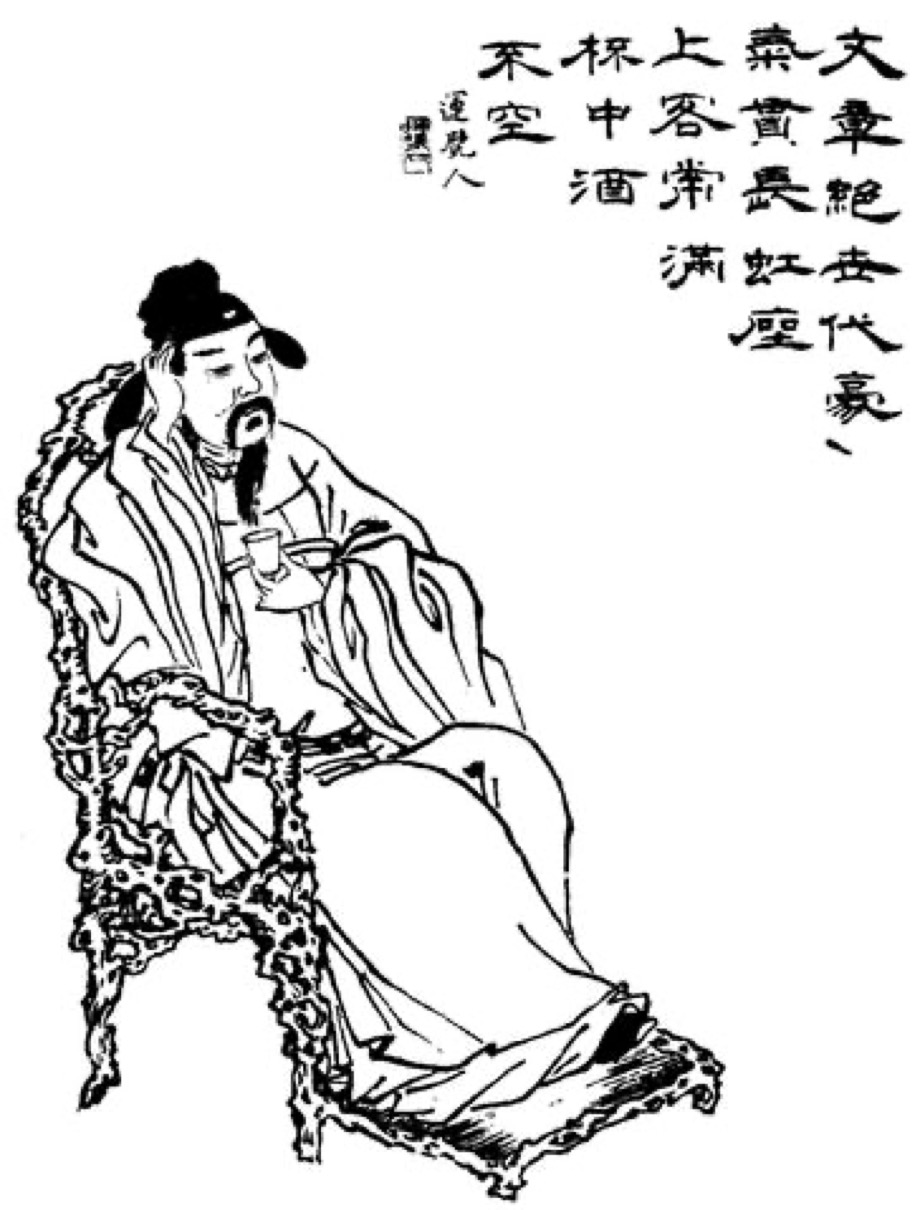
Portrait of Kong Rong
The Smallest Pear
The story every Chinese schoolchild still learns about Kong Rong happened when he was four years old. Offered a plate of pears and told to take his pick, he reached past the biggest ones and chose the smallest, explaining that as the youngest brother he should leave the better fruit for his elders. It is a story about a boy performing virtue with startling fluency — reading a social situation instantly, understanding exactly what gesture it called for, and making that gesture without visible effort. Kong Rong, twentieth-generation descendant of Confucius, never really stopped being that child. He grew into an adult who measured his own worth by the fullness of his hall and the warmth of his hospitality, a man who reportedly said that so long as his guests kept coming and his wine cup never ran dry, he had nothing in the world to worry about.
That is a description of a life built entirely outward, toward other people's company and other people's good opinion — and it is also, eventually, a description of the thing that killed him. Kong Rong was a mediocre administrator by his own era's account, but a magnetic host and a ferociously witty writer, and he turned that wit again and again on the one man in the empire who could least afford to be publicly mocked: Cao Cao. He needled Cao Cao's wartime prohibition on alcohol with an elaborate mock-philosophical defense of wine as the very engine of sage government; he took other, sharper shots at Cao Cao's family and his policies, each one calibrated for maximum applause from the audience of scholars and officials watching. In 208, Cao Cao had had enough. Kong Rong was arrested on charges of disloyalty that his contemporaries mostly understood to be pretext, and executed along with his entire family.
Kong Rong was ENFJ down to the marrow — a life organized entirely around Fe, the dominant function that reads a room, performs generosity, and cannot stop needing an audience, even an audience it is provoking to fury.
A Hall Always Full
Everything memorable about Kong Rong is a story about Fe operating at full strength — reading the emotional temperature of a room and a moment, then acting to shape it. The pear story is Fe before Kong Rong could even talk in complete sentences: an instinctive read of the hierarchy of a family, and a gesture calibrated to affirm it. The adult version was louder and more public but ran on the identical current. He did not merely enjoy company; he needed it as a kind of proof of his own worth, and he built an entire identity around being the man whose door was always open, whose table was always set, whose conversation never ran dry.
That same function explains why his conflict with Cao Cao took the specific shape it did. Kong Rong did not retreat into private disagreement or quiet non-cooperation, the way a more introverted or thinking-led critic might have. He wrote memorials — public documents, meant to be read and repeated — mocking Cao Cao's policies in front of the entire court. The wine-prohibition satire was not a private joke; it was a performance, pitched at an audience of officials and scholars whose laughter and approval he was, on some level, courting even as he provoked the one man whose approval he actually needed to survive.
And Fe explains the register of the provocations, too. They were moralizing, not merely clever — arguments dressed as defenses of virtuous government and sage-kingship, appeals to shared values rather than pure logical demolition. Kong Rong was not trying to win an argument on its intellectual merits alone; he was performing rectitude for a watching community, the same instinct that had once handed him the smallest pear.
A Lineage Read as Destiny
Ni gave Kong Rong the long lens through which he understood his own life: as a descendant of Confucius, he read his existence as a single continuous thread running from the sage himself down through the centuries to his own dinner table. That sense of standing at the far end of an inevitable moral inheritance gave his hospitality and his public virtue a settled, almost prophetic confidence — he was not merely a gracious host, he was living out what a Confucian gentleman was for.
It also gave him, at the very end, an eerily calm sense of where the story was always going to lead. Contemporaries and later chroniclers were struck less by Kong Rong's own resignation than by his children's — informed that their father had been condemned and the family doomed, his young sons reportedly kept playing their board game, reasoning that if the nest is overturned, the eggs cannot possibly remain unbroken. It is a chilling image, and a very Ni one: an entire household that had absorbed, perhaps from Kong Rong himself, the sense that some outcomes are simply written into the shape of things, to be met with composure rather than panic.
The Cup Never Empty
Se shows up in Kong Rong less as physical daring than as an appetite for the immediate, sensory pleasures of a full room — the wine, the conversation, the crowded hall. His own summary of a good life was strikingly concrete and present-tense: guests in the hall, wine in the cup. Not reputation banked for later, not principle vindicated in some future reckoning, but the felt, sensory fact of company and drink, here, now.
That same appetite for immediacy is visible in how he fought Cao Cao. His wine-prohibition memorial was written in the heat of a specific, present controversy, seizing the moment's material — an actual wartime edict — and turning it instantly into spectacle. It was not a campaign built over years; it was a string of pointed, occasion-driven jabs, each one a reaction to whatever Cao Cao had just done, delivered with the confidence of a man who trusted his wit to carry any room he was in.
Cleverness Without a Governor
Kong Rong's inferior Ti is easiest to see in what it failed to do: it never once stepped in to ask whether a brilliant line was actually a wise thing to say to Cao Cao. His wit was genuinely sharp — the mock defense of wine as essential to sage government is an elegantly constructed piece of argument, built with real logical craft — but that craft served the performance rather than governing it. A dominant-Ti mind builds an argument to see whether it holds up; Kong Rong built his to land.
Contemporaries who admired him as an official also, pointedly, did not trust him with hard administrative responsibility, and the pattern fits a chronically underdeveloped inferior function: real intelligence, deployed impressively in conversation and prose, but never quite marshaled into the kind of dispassionate risk calculation that might have told him to stop. He kept refining the joke instead of asking whether the joke was survivable — right up until it was not.
Why ENFJ Over ENTP
Why not ENTP?
An ENTP reading would cast the provocations as pure intellectual sport — argument for the pleasure of argument, detached from any real stake in the audience's feelings. But Kong Rong's entire public identity was built on warmth and moral reputation, not clever detachment: the pear story, the always-full hall, the insistence that hospitality was the measure of a life. His barbs at Cao Cao read as moralizing performance for a watching community whose good opinion he needed (Fe), dressed in argument, rather than cool provocation pursued for its own sake (Ti-Ne).
The distinction matters because it changes what killed him. An ENTP might provoke a tyrant out of sheer restless curiosity about how far the game could go. Kong Rong provoked Cao Cao because his whole sense of self depended on being seen — by his guests, by the court, by history — as the man who spoke virtuous truth to power, generous and unbroken to the last. That is Fe chasing its own reflection in an audience, with an inferior Ti too weak to notice the audience included an executioner.
Connected Figures
Further Reading
- A Biographical Dictionary of the Later Han to the Three Kingdoms — Rafe de CrespignyEntry on Kong Rong
- Sanguozhi (Records of the Three Kingdoms), Book of Wei — Chen ShouThe primary source biography, including the Cao Cao conflict
- Imperial Warlord: A Biography of Cao Cao — Rafe de CrespignyOn Cao Cao's growing intolerance of dissent
