 Historical Figure MBTI
#1152 · 8-24-26 · The Fall of the Han
Hua Tuo
Surgeon, Anesthetist · Executed for Refusing to Stay a Court Physician
c. 140 – 208 CE
7 min read
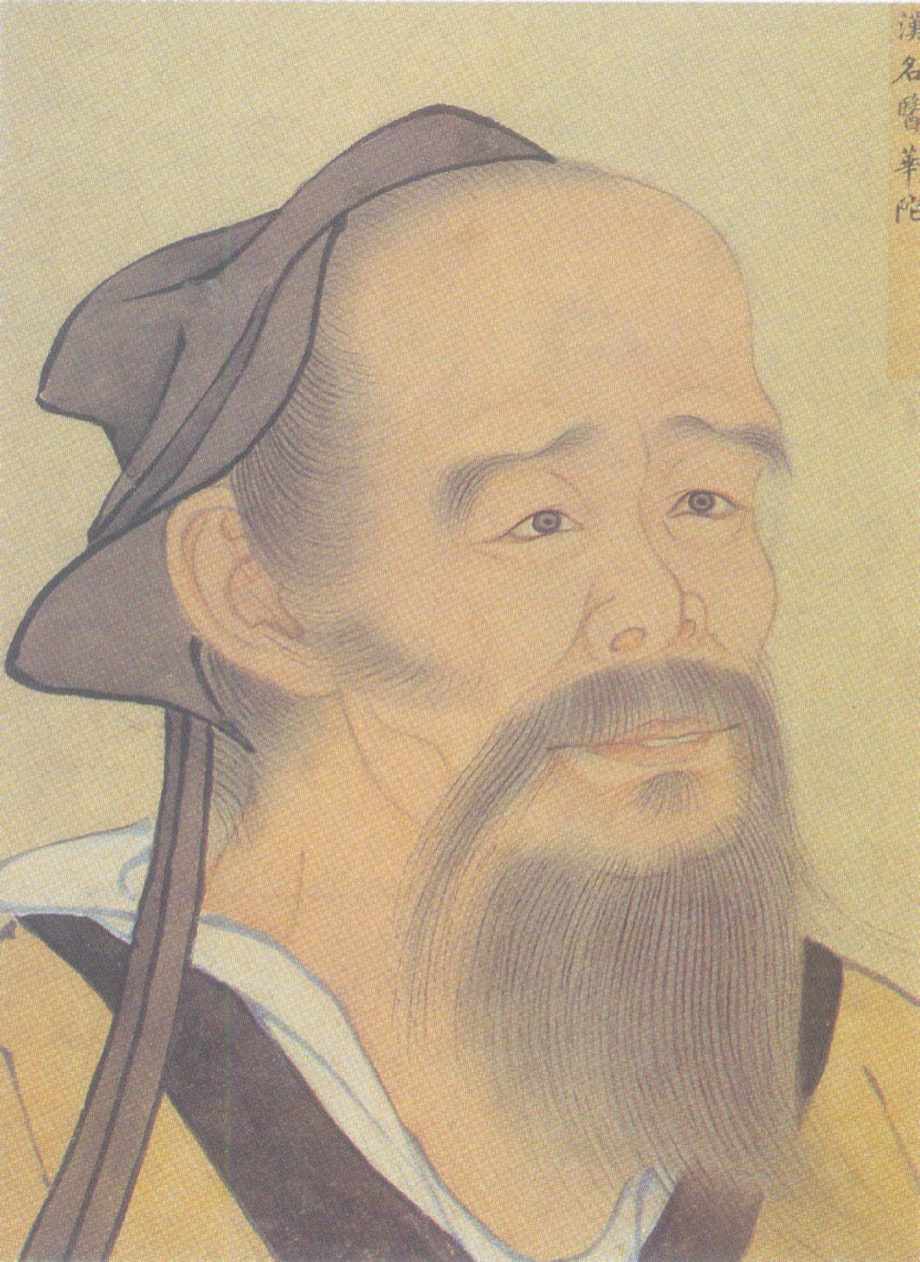
Portrait of Hua Tuo
The Wandering Surgeon Who Would Not Be Owned
Almost everything reliably known about Hua Tuo concerns his hands. He mixed a wine-based compound called mafeisan, likely infused with cannabis and other herbal agents, that could put a patient under before he cut into them — a genuine anesthetic, centuries ahead of what any other tradition of the period is known to have possessed. Later legend swelled this into tales of abdominal surgery performed calmly, and while the specifics were surely embellished, the reputation for surgical daring was real and contemporary. He also devised the Five Animal Frolics, exercises modeled on the tiger, deer, bear, ape, and bird, built from patient observation of how each creature moved. He developed none of this in a court workshop. He developed it on the road, moving from town to town, treating whoever needed treating.
That itinerancy was close to the whole point of the work. When Cao Cao, suffering from severe headaches, summoned him and found the treatment effective, the obvious move would have been to accept permanent, well-compensated court service. Hua Tuo did the opposite: he treated Cao Cao, then left, and when summoned again invented an excuse — a sick wife requiring his presence — rather than surrender his freedom to practice among ordinary patients. Cao Cao discovered the lie and imprisoned him; facing execution, Hua Tuo tried to pass his writings to his jailer, who refused out of fear of implication, and Hua Tuo burned the manuscripts himself. Cao Cao, still headache-ridden, is said to have regretted the killing only after his own son died of an illness Hua Tuo might have cured.
Hua Tuo was an ISTP, a Ti-dominant craftsman whose loyalty ran to the work itself — not to any patron wealthy or powerful enough to try to keep him.
A Formula Trusted to No One Else
Mafeisan is the clearest evidence of Hua Tuo's Ti at work. Anesthesia is not a discovery you stumble into; it is a solved technical problem, arrived at through iterative testing of what dose reliably suppresses pain without killing the patient — precisely the kind of private, empirical refinement a dominant Ti mind pursues for its own internal logic, indifferent to whether anyone outside the craft understands it. He built a working system before he built an explanation, and by tradition never fully wrote the explanation down for anyone but himself.
The Five Animal Frolics show the same instinct aimed at a different problem. Rather than inherit an existing framework for health, Hua Tuo built his own from direct observation — watching how a tiger's shoulders moved, how a bird's chest expanded — and translated those mechanics into a reproducible system. This is Ti's native mode: take the raw material of the physical world and construct an internally consistent method that works on its own terms.
It shows again, more starkly, in his death. Offered a last chance to preserve his writings by handing them to his jailer, Hua Tuo did not simply mourn the loss — he judged that the man in front of him could not be trusted to protect the work correctly, and burned it himself rather than let an unqualified hand mishandle it. That is not despair. That is a craftsman enforcing his own standard to the very end, alone.
A Life Spent on the Road, Not the Dais
Se orients a person toward the immediate, physical present, and Hua Tuo's career was built on staying inside that orientation. He treated the patient in front of him, then moved to the next town. Where a court physician's world narrows to one powerful body kept comfortable indefinitely, Hua Tuo's stayed wide and changing — new villages, new ailments, new hands to work with — and he preferred it that way even with a permanent post at the seat of imperial power his for the taking.
It also explains the shape of his resentment toward Cao Cao. He did not object to being useful; he refused confinement — the demand that he abandon movement and sit on call in one place, waiting. An auxiliary Se, paired with dominant Ti, wants freedom to act directly on the world, not freedom deferred to some future reward. Surgery itself is an Se craft as much as a Ti one: it rewards a steady hand and comfort with risk that theory alone cannot supply. Even his final excuse — the invented sick wife — was a bid to get back onto the road. It cost him his life. He made the trade anyway.
Reading the Trap Before It Closed
Tertiary Ni surfaces in Hua Tuo less as visionary foresight than as a quiet, sharpening suspicion — a sense of where a situation was heading, arriving late enough to color his choices but not early enough to spare him. Once the second summons came, he seems to have understood exactly what permanent court service would cost him: the erasure of the traveling practice that gave his work meaning. The lie about his wife was a single-move attempt to escape a future he could already feel closing in.
It surfaces again, more grimly, at the end. Facing execution, he made an immediate read of the jailer, judged correctly that fear would win out over duty, and acted to control the outcome before it was taken out of his hands. That is a Ni flash used defensively, protecting Ti's standard — not the sustained strategic vision an Ni-dominant would carry for years.
Care Delivered Widely, Not Spoken Of
Inferior Fe, undeveloped and easily strained, appears in Hua Tuo mostly as an absence — an unwillingness to manage other people's feelings about him even when doing so would have kept him alive. He gave Cao Cao no diplomatic softening of a refusal any Fe-attentive courtier would have known was dangerous to deliver bluntly. He simply left, then lied, then let the lie be exposed rather than negotiate his way back into favor. A more Fe-fluent physician might have found a face-saving way to serve part-time. Hua Tuo did not manage the relationship. He ended it.
And yet a kind of care runs under all of it, expressed the only way an inferior-Fe type reliably expresses care: through the work itself, offered indiscriminately, rather than through warmth directed at any one person. He treated villagers with the same skill he brought to the ruler of the north, and asked no special deference for it. It is generosity with the social wrapping stripped away — real, but never articulated as feeling, only demonstrated as practice.
Why ISTP Over ISFP
Why not ISFP?
An ISFP reading would want to see Hua Tuo's practice as values-driven caregiving — a Fi conviction that ordinary people deserved his skill more than any court did. But the record emphasizes technical achievement, not felt compassion: a novel anesthetic, an exercise regimen built from observation, surgical daring precise enough to become legend. That is a craftsman safeguarding his methods — dominant Ti — not a healer primarily motivated by expressed emotional care.
The clearest tell sits in the burned manuscripts. An ISFP protecting a legacy out of feeling would more likely have pleaded. Hua Tuo instead made a cold, technical judgment — this custodian will not preserve the work correctly, so I will end it myself — and carried it out without ceremony. It is Ti asserting control over its own standard, alone, to the last.
Connected Figures
Further Reading
- A Biographical Dictionary of the Later Han to the Three Kingdoms — Rafe de CrespignyEntry on Hua Tuo, situating his career within the collapse of Han authority.
- History of Chinese Medicine — K. Chimin Wong and Wu Lien-tehOn Hua Tuo's surgical technique and pharmacological reputation.
- Sanguozhi (Records of the Three Kingdoms), Book of Wei — Chen ShouThe primary source biography, including the account of his death.
