 Historical Figure MBTI
#828 · 6-15-26 · The American Civil War
Charles Sumner
The Senator Beaten for His Words
1811–1874
6 min read
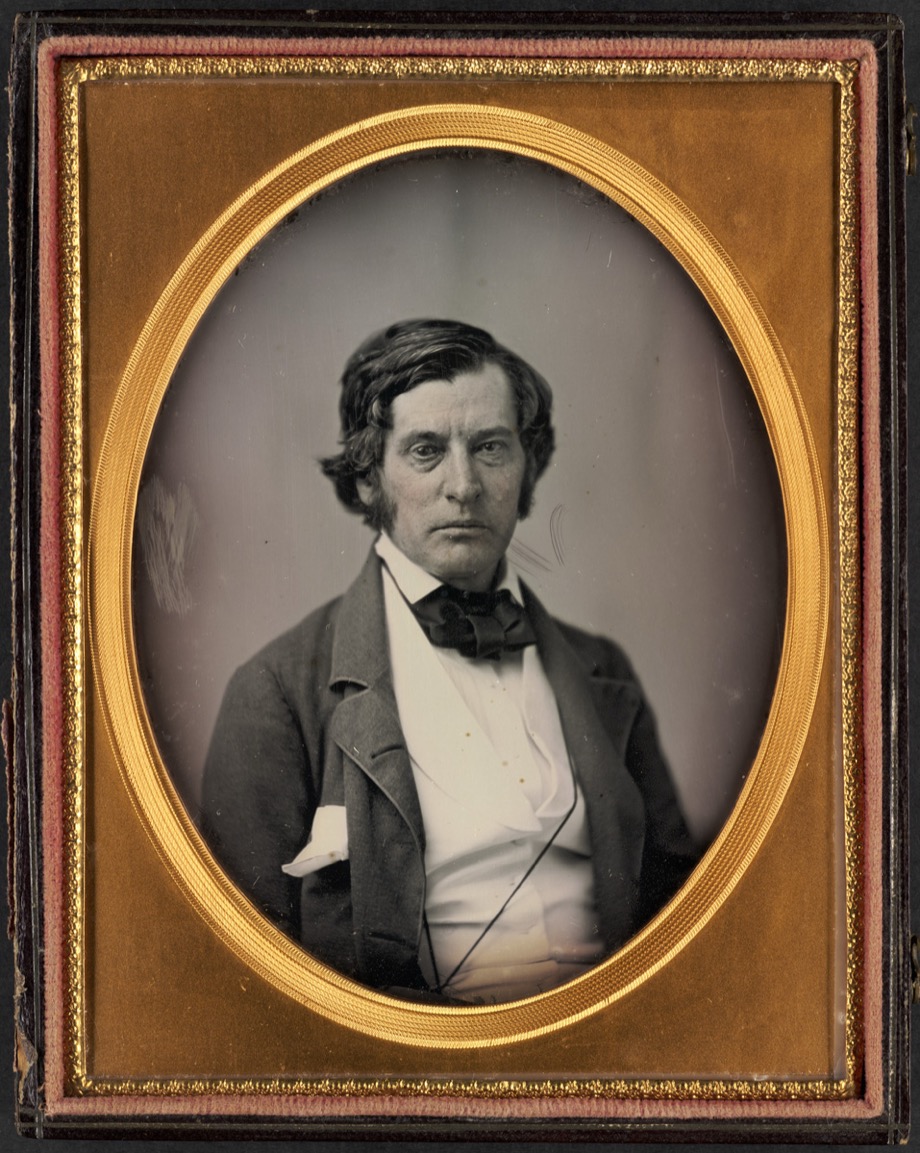
Portrait of Charles Sumner
The Man Who Would Not Soften a Word
Charles Sumner did not raise his voice on the Senate floor to persuade wavering colleagues. He raised it because slavery was, to him, a settled moral fact — an absolute wrong that no procedural compromise, however cleverly constructed, could launder into something tolerable. Other senators triangulated, calculated votes, weighed the Union's survival against the immediate cost of principle. Sumner treated that entire calculus as a category error. He had arrived at his conviction years earlier, whole and unshakeable, and everything he said afterward was simply that conviction finding its most forceful possible expression.
That is the signature of an INFJ running its dominant function without a governor: a single, deeply internalized vision of how things must ultimately resolve, delivered outward with a moral intensity that made compromise itself feel like betrayal. On May 19 and 20, 1856, Sumner rose to deliver "The Crime Against Kansas," a speech that spent hours cataloguing the sins of the slave power and singled out South Carolina's Andrew Butler by name, mocking his infirmities along with his politics. Two days later, Butler's cousin, Congressman Preston Brooks, walked onto the Senate floor and beat Sumner half to death with a gold-headed cane. Sumner did not fully recover his health for more than three years. He returned to the Senate not chastened but confirmed — the beating had simply proven, in his own mind, exactly what kind of enemy he was dealing with.
Sumner is what happens when an INFJ stops asking whether a truth is expedient to say and starts asking only whether it is true.
The Fixed Point
Sumner's abolitionism was never a policy position he arrived at through debate; it was closer to a fixed star he navigated by. From his earliest years as a Boston lawyer arguing against segregated schools, through his 1851 election to the Senate, to his final wartime advocacy for immediate and total emancipation, the destination never moved. What changed was only his estimate of how urgently the country needed to reach it. This is Ni operating exactly as it does at its most formidable: not flexible, not especially interested in incremental steps for their own sake, but relentlessly oriented toward a single long-range outcome that felt to him less like an opinion than a fact already visible on the horizon.
That certainty is also what made him so difficult to work with, even among fellow abolitionists. Sumner rarely doubted his own read of where history was heading, and he treated colleagues who wanted to slow down, hedge, or preserve the Union at the cost of moral clarity as people who simply hadn't yet seen what he saw. It cost him allies. It also meant that when the war finally vindicated the position he had held essentially unchanged for two decades, he felt no need to revise his methods — if anything, the vindication convinced him the vision had been correct all along, and that the beating he took for voicing it had only confirmed its cost.
Oratory as Weapon
What carried Sumner's Ni conviction into the world was Fe of unusual force — not the warm, harmonizing Fe of a natural conciliator, but a moralized, publicly directed emotional intensity aimed at making an audience feel the weight of an injustice as sharply as he did. His speeches were exhaustively researched, often running for hours, built less like legal arguments than like accumulating moral indictments. He wanted senators, reporters, and the country at large to sit with the full, specific, human cost of slavery until it became impossible to treat as an abstraction.
That same Fe made "The Crime Against Kansas" personal rather than purely political. Sumner did not simply argue that Andrew Butler's position was wrong; he characterized Butler himself in openly contemptuous, physically mocking terms, treating the man as inseparable from the sin he represented. It was Fe turned into a blade — an insistence that public wrongdoing deserved public, named, personal shame, not polite institutional distance. The approach was electrifying to allies and unforgivable to opponents, and it is very much why Preston Brooks felt licensed to answer him with a cane rather than a rebuttal.
A Body He Could Not Command
Sumner's inferior Se shows up not as an interest he avoided but as a vulnerability he never saw coming. He had spent his career operating almost entirely in language and principle, seemingly unbothered by the physical stakes of saying what he said. When Preston Brooks caught him seated at his Senate desk on May 22, 1856, and beat him with a cane until he collapsed bleeding and half-conscious, Sumner had no defense for it — not tactically, and not psychologically. The trauma lingered in his body for years after the wounds themselves had closed; witnesses described him unable to sit for long periods, startled by sudden proximity, plagued by symptoms his doctors could not fully explain.
That prolonged, visible incapacity became, involuntarily, part of the era's political theater. Massachusetts re-elected him and left his Senate seat symbolically empty during his recovery, turning his damaged body into the clearest possible argument for the very cause his words had been making. It is a fittingly ironic arc for inferior Se: the function he had least developed, least anticipated needing, became the site where the conflict he had spent his career narrating in the abstract was finally, brutally made concrete against him.
Why INFJ Over ENFJ
Why not ENFJ?
An ENFJ's Fe is dominant and outward-facing from the start, built to read a room and adjust its appeal in real time — coalition-building is instinctive, not a chore. Sumner did the opposite: he escalated when escalation cost him allies, named enemies by name when discretion would have served him better, and never showed the extraverted Fe hallmark of calibrating a message to what an audience could bear. His moral certainty came first and stayed fixed regardless of the room; the persuasion, such as it was, existed to serve a private vision rather than to build toward one collaboratively. That is Ni leading and Fe in service to it, not the reverse.
The clearest tell is what Sumner never adjusted for consequences. An ENFJ reads the temperature of a room and modulates; Sumner read the moral stakes of an issue and did not modulate at all, even after being told in the most violent terms imaginable that his words had a physical price. The conviction came from an inward, singular place — an INFJ's Ni — and the oratory was simply the vehicle built to carry it into the world, however much damage that vehicle absorbed along the way.
Connected Figures
Further Reading
- Charles Sumner and the Coming of the Civil War — David Herbert DonaldThe definitive biography of Sumner's early career and rise to prominence
- The Caning: The Assault That Drove America to Civil War — Stephen PuleoA close narrative account of the 1856 assault and its aftermath
- Team of Rivals: The Political Genius of Abraham Lincoln — Doris Kearns GoodwinSituates Sumner among the era's competing Republican factions
- The Impending Crisis: America Before the Civil War, 1848–1861 — David M. PotterPlaces the Kansas speech and the caning within the sectional crisis
