 Historical Figure MBTI
#830 · 6-15-26 · The American Civil War
Thaddeus Stevens
The Radical Who Never Softened
1792–1868
6 min read
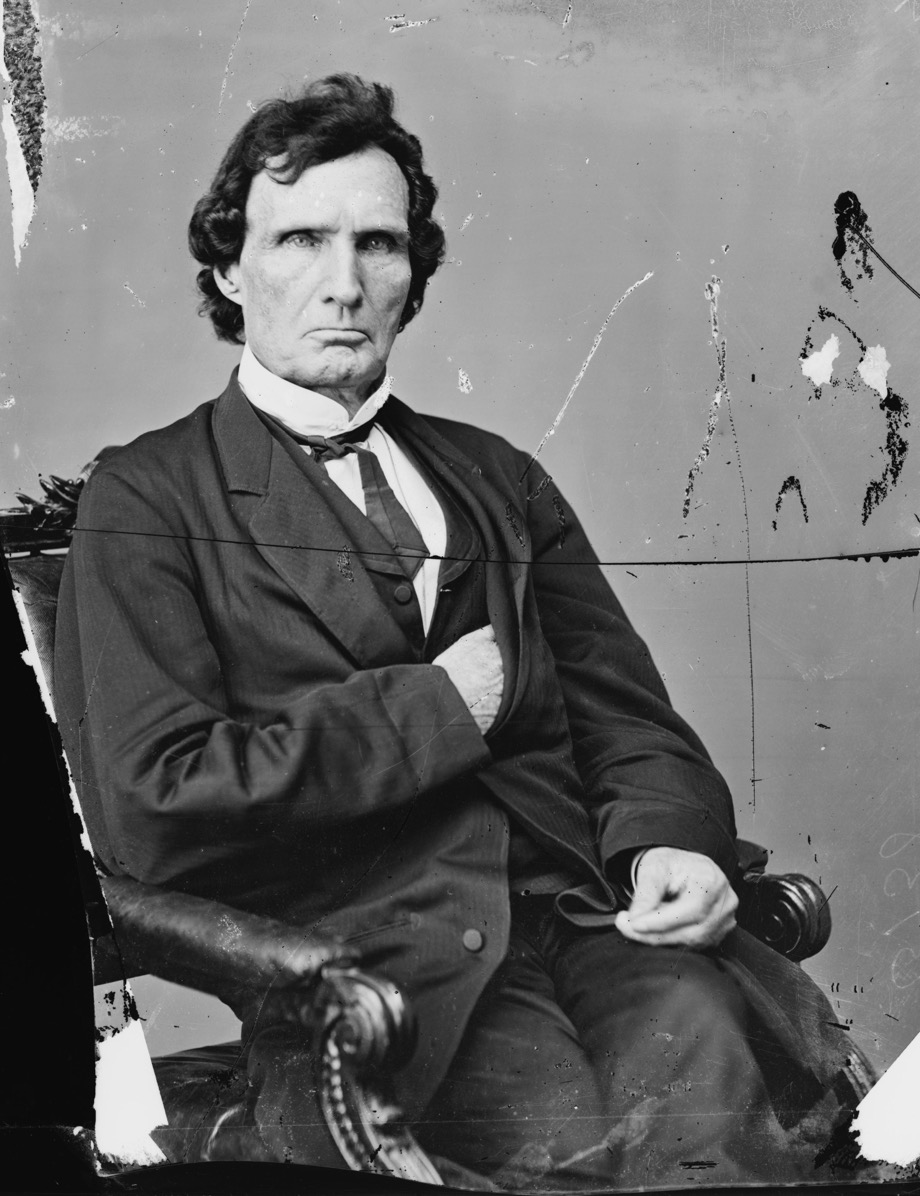
Portrait of Thaddeus Stevens
The Man Who Would Not Wait
By the time the guns opened on Fort Sumter, Thaddeus Stevens had already spent thirty years arriving at conclusions the rest of the country would not reach for another decade. Born in Vermont in 1792 with a clubfoot that made him, by his own account, an object of both pity and cruelty in childhood, he built himself in Pennsylvania into one of the most feared lawyers and legislators in the state — and then in Washington, as chairman of the House Ways and Means Committee, into the man who controlled how the Union financed the war it was fighting. Money was leverage, and Stevens spent it deliberately.
What set him apart from nearly every other man in Congress was not that he opposed slavery — by 1861 that opposition was common enough — but that he had already worked out, years in advance and without flinching from the implication, that abolition alone solved nothing. He wanted full civil and political equality for Black Americans, an outcome so far outside the mainstream of his own party that even fellow abolitionists found him extreme. He arrived at it the way he arrived at everything: by tracing a structure forward from first premises to its unavoidable end, and then refusing to pretend he hadn't seen it.
That combination — a mind that worked years ahead of the room, married to an unsentimental command of the machinery needed to drag the room toward it — is the signature of an INTJ. Stevens did not persuade Lincoln with warmth. He maneuvered him, with a tongue sharp enough that colleagues dreaded being on the wrong end of it.
Stevens did not wait for the country to catch up to what he already knew was coming. He built the machinery to drag it there.
Seeing the War Lincoln Hadn't Fought Yet
Stevens's dominant Ni showed itself not as prophecy but as a refusal to unsee an endpoint once he had reasoned his way to it. Long before the war began, he had concluded that the conflict, whenever it came, would not be resolvable on the terms most Republicans hoped for — a restored Union with slavery merely contained. He treated that conclusion as settled fact and organized his political behavior around it years ahead of the consensus, which is exactly the trap dominant Ni sets for everyone standing next to it: he was neither guessing nor performing radicalism, he was reporting what he had already worked out.
This is why he read Lincoln's caution not as prudence but as delay. Where Lincoln, weighing border-state loyalty and public opinion in real time, wanted room to maneuver, Stevens had no interest in the intermediate steps — he wanted the House to legislate as though the destination were already reached. His impatience with incrementalism was not temperament for its own sake; it was the discomfort of a mind that had already arrived somewhere everyone else was still traveling toward, and rarely explained the chain of reasoning behind it — he simply held the position, with total conviction, and expected Congress to catch up.
The Committee Chairman Who Controlled the War
If Ni supplied Stevens's destination, auxiliary Te supplied the machinery to move Congress toward it. As chairman of Ways and Means, he held one of the war's most consequential levers — the financing of the Union war effort — and he used the position with the cold efficiency of a man who understood that moral conviction without institutional control accomplishes nothing. Where Radical colleagues gave speeches, Stevens moved bills, votes, and appropriations.
His command of debate was famously merciless, and it was a Te weapon as much as a rhetorical one: he did not merely disagree with an opponent, he dismantled the structure of their argument in public, efficiently and without apparent effort, until there was nothing left for them to stand on. It is also what separated him from the purely ideological abolitionists of his era — he treated the Radical cause as a legislative problem to be won, counting votes and timing bills for maximum leverage against an administration he considered too slow. The conviction was Ni's; the war of attrition that turned it into policy was Te's.
A Conviction the Party Couldn't Talk Him Out Of
Tertiary Fi is the function that explains why Stevens would not settle for less than full equality even when allies treated that position as a political liability. It was not a value adopted for coalition purposes and therefore negotiable — it sat beneath his strategy as a fixed personal standard, immune to the argument that half a victory was still a victory.
This is also what made him different from the purely tactical operators of his party. A man running purely on Te calculation might have traded the harder demand for a faster, more achievable compromise — and many of his colleagues urged exactly that. Stevens refused, repeatedly, at real political cost: the same man who could gut an opponent's argument in committee without visible feeling held, underneath it, a conviction he never trimmed to fit the room. Even the Emancipation Proclamation, when it came in January of 1863, struck him as a beginning rather than an answer.
Why INTJ Over ENTJ
Why not ENTJ?
ENTJ leads with Te, and it would explain Stevens's command of the House floor and his ruthless efficiency as chairman well enough on its own. But it does not explain the years-ahead fixity of his positions, formed in private and treated as settled before he ever brought them to a vote — that is Ni's signature, not Te's. Nor does it explain why he held to full racial equality at real cost rather than trading it for an easier win. An ENTJ negotiates toward the best available outcome; Stevens negotiated only the path, never the destination.
Stevens's Te made him effective. His Ni and Fi made him unmovable — and it was the immovability, not the efficiency, that history would eventually vindicate.
Connected Figures
Further Reading
- Thaddeus Stevens: Nineteenth-Century Egalitarian — Hans L. TrefousseThe standard biography, tracing his radicalism from Pennsylvania politics through Reconstruction.
- Team of Rivals — Doris Kearns GoodwinCovers the pressure Radical Republicans, Stevens included, placed on Lincoln's cabinet and agenda.
- Fiery Trial: Abraham Lincoln and American Slavery — Eric FonerContextualizes the gap between Lincoln's incrementalism and the Radical wing's demands.
