 Historical Figure MBTI
#1004 · 7-24-26 · The Second World War
Enrico Fermi
The Architect of the Chain Reaction · Nuclear Pioneer · Quiet Genius
1901 — 1954
8 min read
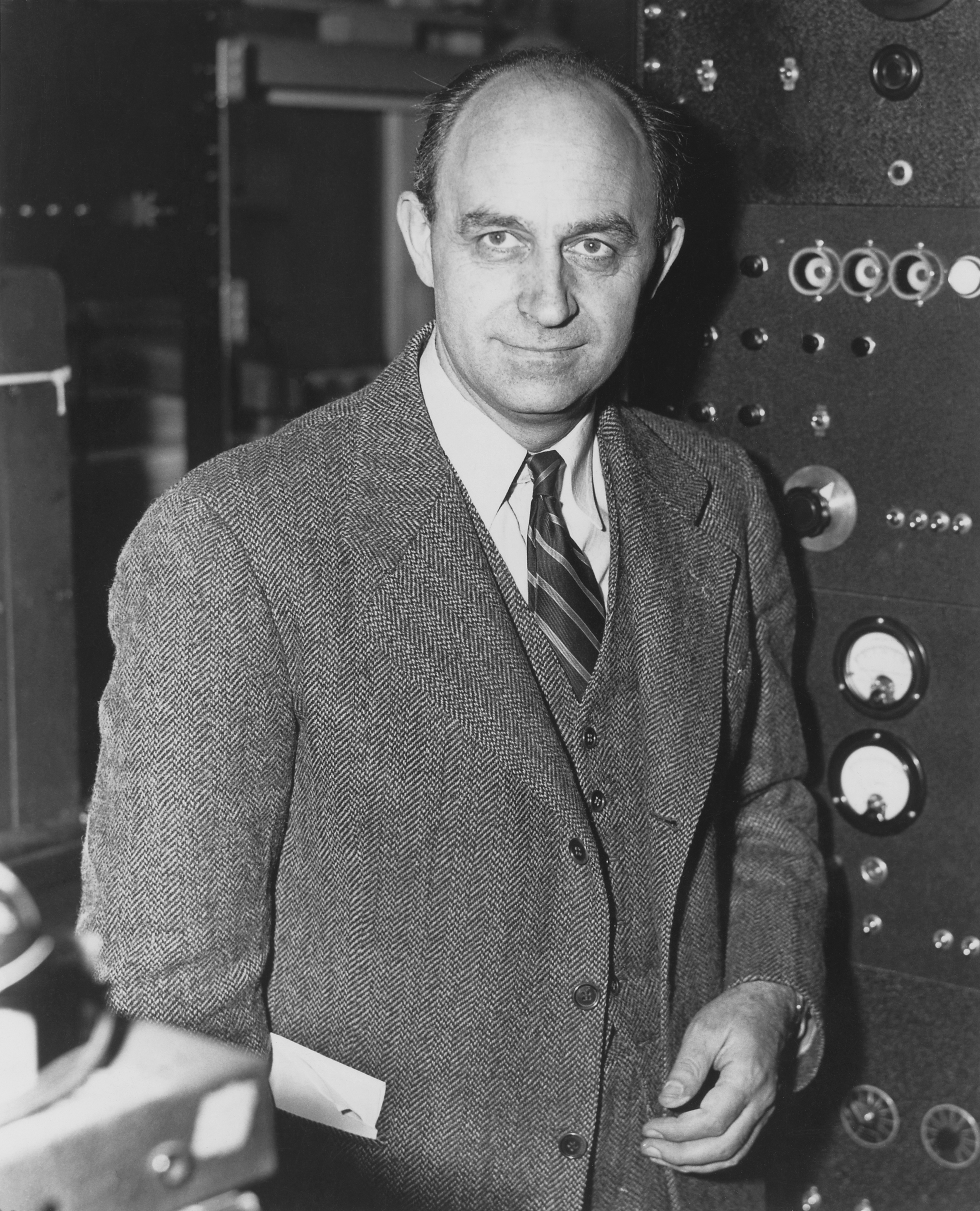
Portrait of Enrico Fermi
The Man Who Started the Nuclear Age and Then Went to Lunch
At 3:25 in the afternoon of December 2, 1942, in a doubles squash court under the west stands of Stagg Field at the University of Chicago, a lattice of graphite bricks and uranium slugs went critical and stayed there. Humanity had produced the first controlled, self-sustaining nuclear chain reaction. Enrico Fermi watched the neutron counters for twenty-eight minutes, ordered the cadmium rods reinserted, and closed the pile down. Someone produced a straw-covered bottle of Chianti; the physicists drank it from paper cups without a toast and signed the label. Then Fermi went home to dinner. The Italian navigator, in the phrase Arthur Compton coded down the telephone, had landed in the New World.
That composure is the man. Fermi was the last physicist genuinely first-rate at both theory and experiment, and among the few who found the distinction faintly irritating. He worked with his hands: machined uranium, laid graphite bricks alongside the crew until his own hands were black, calculated in his head faster than colleagues could with slide rules, and knew instinctively which of a problem’s twelve complicating factors could be thrown away.
He is the archive’s model ISTP: an internal logic of extreme economy, wired directly to physical apparatus, deployed calmly on whatever object happens to be in front of him — a neutron beam, a stack of graphite, or a fireball on a desert floor.
An ISTP whose dominant Ti stripped every problem to the two variables that mattered — and whose Se insisted on touching the apparatus, so that when the nuclear age began, it began under his hands.
The Logic of Discarding Everything Unnecessary
Fermi’s theoretical work has a signature: it is austere. His 1933 theory of beta decay, rejected by Nature as too speculative and now one of the load-bearing papers of twentieth-century physics, introduced the weak interaction with a construction so economical that it survived essentially intact for decades. He did not build cathedrals of formalism. He built the smallest structure that would carry the observation, and then stopped.
The pile itself was Ti made out of bricks. The design problem was a single number — the neutron multiplication factor, k — and Fermi’s method was to build the lattice layer by layer, measure how the neutron intensity climbed with each addition, and plot the curve toward the point where it would go infinite. He knew from the graph, several days before the event, roughly which layer would be the critical one. There was no dramatic uncertainty on December 2 for the man running it; there was a calculation, arriving on schedule.
The same instinct produced the teaching device that still carries his name. A Fermi problem — how many piano tuners in Chicago — shows that an answer good to an order of magnitude can be reasoned out from almost nothing, once you identify which quantities actually constrain the result. It is the purest statement of Ti: not knowing more, but needing less.
Paper Scraps in the Blast Wave
At Trinity on July 16, 1945, while the theorists ran a betting pool on the yield and the instrumentation crews waited on their oscilloscopes, Fermi stood up with a handful of torn paper. At the moment the shock front reached him he let the scraps fall, watched how far the blast displaced them, and announced from the displacement that the device had gone off at somewhere around ten kilotons. The instrumented answer, days later, was about twenty-one — the right order of magnitude, obtained in seconds with no equipment at all. It is the most famous single act of physical intuition in the history of the field, and it is also just how he worked.
Rome had been the same. In October 1934 his group found neutron counts jumping wildly depending on what the source stood on — a wooden bench gave different results from a marble one. Fermi interposed a block of paraffin on what he later called an unaccountable impulse, and the activity leapt a hundredfold. Slow neutrons. He had the explanation within hours, and the discovery is the direct ancestor of every moderated reactor, his own included.
The Long Look Ahead, Used Sparingly
Tertiary Ni is a quiet faculty in an ISTP — occasional, unelaborated, and usually right. In 1938, having travelled to Stockholm to collect the Nobel Prize for his neutron work, Fermi simply did not go home. Mussolini’s racial laws had been promulgated that autumn and his wife Laura was Jewish; the family sailed from Southampton to New York with the prize money, having arranged the whole emigration under cover of the ceremony. Many Italian scientists told themselves the laws would be applied loosely. Fermi read the trajectory and left.
He used the same forward projection on the physics. When word of Hahn and Strassmann’s fission result reached America in January 1939 — carried by Niels Bohr — Fermi grasped immediately that secondary neutrons would make a chain reaction possible, and that a bomb followed from it. He is reported to have stood at a window in Pupin Hall at Columbia, cupped his hands, and said that a little bomb like that would make all of it disappear.
Ni also supplied the question he is best known for outside physics. Over lunch at Los Alamos in 1950, amid talk of flying saucers, he asked where everybody was — if the galaxy is old and large, the absence of visitors is itself a datum. The Fermi paradox is a whole research field in one sentence, which is a very ISTP way to found one.
The Teacher Who Never Raised His Voice
Fermi’s inferior Fe was not absent so much as channelled entirely into one activity: teaching. He was, by consensus, the finest physics teacher of his generation, and the Chicago postwar cohort he trained — Chamberlain, Lee, Yang, Steinberger, Segrè before them in Rome — collected an implausible number of Nobel Prizes. His method was to explain anything from first principles at whatever level the questioner needed, without condescension and without display. The room mattered to him; he simply expressed it through clarity rather than warmth.
On the moral questions he was reticent. He sat on the Interim Committee’s scientific panel in 1945 and declined to endorse a demonstration shot, on the grounds that physicists had no special competence in political affairs. In 1949 he did oppose the hydrogen bomb — with I. I. Rabi, in language calling it a thing of evil in any light — and then went to Los Alamos and did the calculations anyway when the decision went the other way. He gave the judgement, then deferred to the decision.
The contrast with J. Robert Oppenheimer is exact and instructive. Both men opposed the H-bomb; one made his conscience a public performance and was destroyed by it, while the other filed a dissent and returned to the bench. Fermi testified for Oppenheimer at the 1954 hearing, plainly and briefly. He was already dying of stomach cancer; he had months left, and used some of them for that.
Why ISTP Over INTP
Why not INTP?
A theoretical physicist of the first rank is the obvious INTP candidate, and Fermi’s beta-decay paper would support it. But look at how he actually worked: paraffin blocks shoved into a neutron beam on an impulse, graphite laid by hand under a squash court, yields estimated from falling paper in a live blast wave. That is Se auxiliary — real-time engagement with physical apparatus — not Ne’s branching exploration of possibility. An INTP builds frameworks and enjoys the open question; Fermi took the shortest available path to a number and then stopped. Even the Fermi paradox is posed as a blunt empirical observation over lunch, not a framework, and he never developed it.
The cleanest test is the pile itself. In 1942 the chain reaction was an unresolved theoretical question a dozen physicists were prepared to argue about at length. Fermi stopped arguing and built a stack of bricks in a squash court in the middle of a major city, with no containment, no shielding, and a young physicist above it holding an axe to cut the safety rod’s rope. By any modern standard it was outrageous — and he did it with total calm, because he had measured the curve and knew what the next layer would do. Confidence derived from contact with the apparatus rather than from theory or consensus: that is the ISTP signature, and it put his hands on the switch of the twentieth century.
Connected Figures
Further Reading
- Enrico Fermi, Physicist — Emilio SegrèBy a student who became a Nobel laureate himself — the closest thing to an insider's technical biography.
- Atoms in the Family: My Life with Enrico Fermi — Laura FermiHis wife's memoir; the essential source for Rome, the racial laws, and the Nobel-trip escape of 1938.
- The Making of the Atomic Bomb — Richard RhodesContains the definitive narrative reconstruction of the Chicago Pile-1 experiment.
- The Last Man Who Knew Everything: The Life and Times of Enrico Fermi — David N. SchwartzThe most recent full biography, with fresh attention to his postwar Chicago years and students.
