 Historical Figure MBTI
#1005 · 7-24-26 · The Second World War
Niels Bohr
The Conscience of Physics · Quantum Pioneer · Voice for Openness
1885 — 1962
7 min read
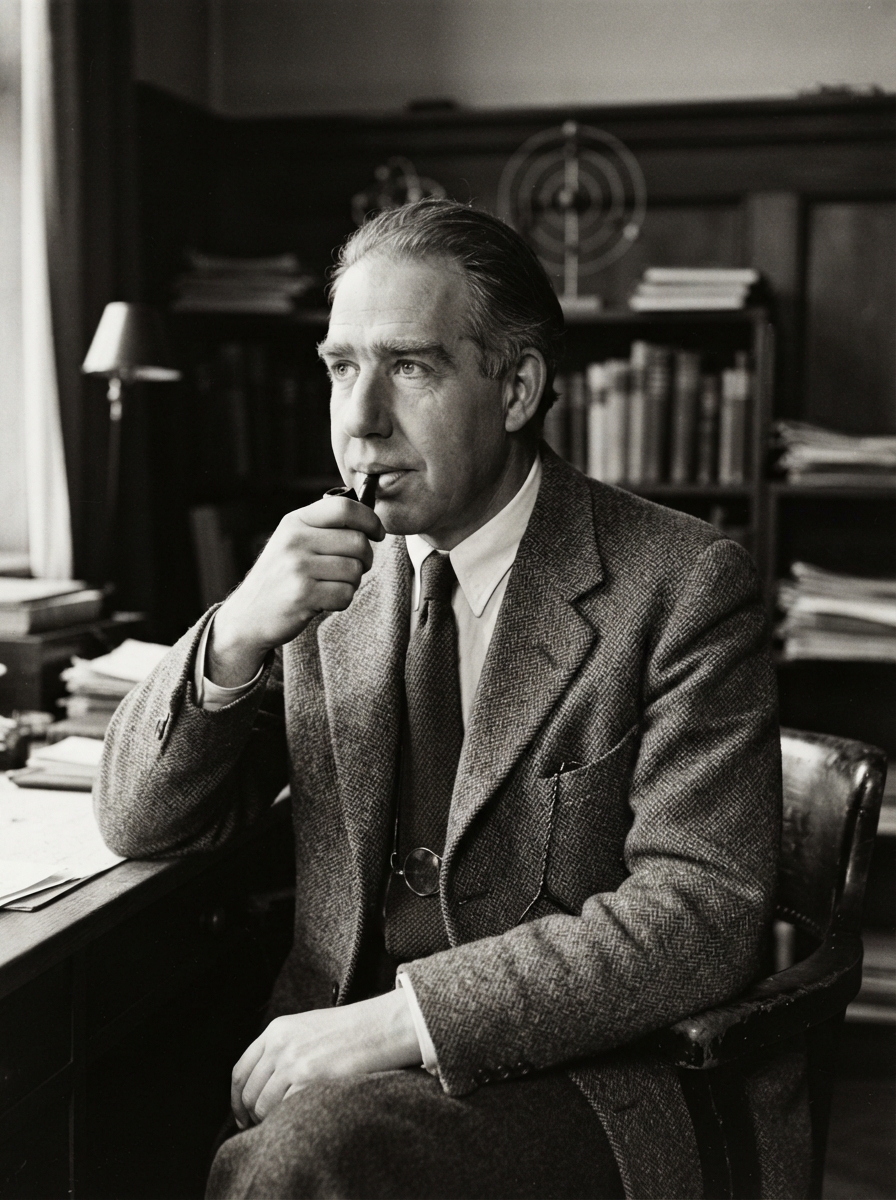
AI-assisted Portrait of Niels Bohr
The Mumbling Oracle of Copenhagen
He was almost impossible to hear. Bohr spoke in a low, hesitant murmur, in whichever of four languages he had drifted into, revising each sentence two or three times before finishing it, and everyone in the room leaned forward anyway — because what emerged, eventually, had usually reorganised the problem. He wrote the same way, dictating draft after draft over months, and thought the same way: nothing arrived finished, everything was provisional, every position was a thing to be turned over and argued against, including his own.
Out of that method came the 1913 model of the atom that first explained why matter is stable; the Copenhagen institute that trained a generation of the world’s physicists; the complementarity principle, which holds that a thing can be a wave and a particle and that the contradiction is a feature of nature rather than a defect in our description; and a decade of argument with Einstein over whether any of it could possibly be true.
Then, alone among the physicists of the bomb, he looked past the weapon to the world that would have to live with it — and started making the argument years before there was a weapon to argue about. He is a textbook INTP: an interior logic of unusual subtlety, coupled to a restless exploratory reach, applied first to the atom and then, with exactly the same tools and considerably less success, to politics.
An INTP whose dominant Ti built the atom the twentieth century actually used — and whose Ne could not stop following the argument outward, to the arms race he saw coming and no statesman would let him prevent.
A Structure That Should Not Have Worked
The 1913 papers are an act of sheer internal nerve. Rutherford’s nuclear atom was, by classical electrodynamics, impossible: an orbiting electron radiates, loses energy, and should spiral into the nucleus in a fraction of a second. Bohr’s response was not to fix the mechanics but to declare the classical rule inapplicable — electrons occupy discrete stationary states and radiate only in jumping between them — and then to show that the indefensible postulate produced the hydrogen spectrum to the observed accuracy. That is Ti: internal coherence and explanatory yield outranking inherited authority.
Complementarity, worked out over the following fifteen years, is the mature form of the same habit. Rather than resolve the wave–particle contradiction, Bohr formalised it: the two descriptions are mutually exclusive and jointly necessary, and which one applies depends on what you have chosen to measure. It is a logical position of remarkable severity, and he defended it for thirty years against Einstein’s ingenious thought experiments — the photon-in-a-box at Solvay in 1930 among them, which Bohr demolished overnight using Einstein’s own general relativity.
His institute ran on the same principle: relentless collective argument, with Bohr taking whichever side was underdefended and treating a good objection as worth more than an agreement. He told a student that the opposite of a profound truth may well be another profound truth — either mysticism or a very precise statement about the limits of a formal system, and with Bohr it was always the second.
Following the Argument Out of Physics
Bohr could not leave an idea inside its own discipline. He extended complementarity to biology, psychology, and whole cultures, arguing that the same structure recurred wherever an observer was entangled with what was observed. Some of it was thin, but the reflex is the point: Ne runs a pattern outward until something stops it.
Applied to the bomb, this became prophecy. In January 1939 he carried the news of Hahn and Strassmann’s fission result across the Atlantic and, within weeks, identified with John Wheeler that it was the rare isotope uranium-235 that fissioned with slow neutrons — which converted the whole enterprise from a curiosity into an engineering problem about isotope separation. He then followed the implication past the weapon entirely: a bomb built in secret by one power would not stay one power’s bomb, and the only stable outcome was an international regime of openness established before the thing was used.
He spent 1944 and 1945 selling that argument at the highest level available. Roosevelt was courteous and non-committal; Churchill, in May 1944, was hostile and cut the meeting short, afterwards writing that Bohr ought to be confined, or at least made to see he was near the edge of mortal crimes. Voluntarily telling Stalin anything struck Churchill as lunacy. The prediction was nonetheless exact: the Soviets tested in 1949, and the arms race arrived on schedule.
Carlsberg, Copenhagen, and the Fishing Boat
For a man of such intellectual restlessness, Bohr was extraordinarily rooted. He was born in Copenhagen, founded his institute there in 1921 and directed it until he died, and lived for decades in the Carlsberg honorary residence granted by the brewery to Denmark’s most distinguished citizen. Tertiary Si shows as this: one place, one institution, one deep continuity, maintained across four decades of upheaval.
Which makes the rupture of 1943 the more striking. Warned that the Gestapo meant to arrest him — his mother was Jewish — Bohr crossed the Øresund to Sweden by fishing boat in late September, lobbied the Swedish government to broadcast its willingness to receive Danish Jews, and was flown to Britain in the empty bomb bay of an unarmed Mosquito. He lost consciousness in flight, the helmet being too small for a famously large head, and was revived on landing. Within days he was at the centre of the atomic project.
Even his most famous unresolved episode belongs to this register: the 1941 meeting in occupied Copenhagen with Heisenberg, his closest scientific son, now working for Germany. Something was said about physicists building weapons; Bohr took it as a probe, the friendship never recovered, and the letters he drafted afterwards for years — and never sent — were released only in 2002. He kept the wound exactly as he kept everything else: carefully, and unfinished.
The Open Letter Nobody Answered
Inferior Fe in an INTP is genuine moral concern arriving without the political instrument to deliver it. Bohr cared enormously — he had spent the 1930s finding posts and funding for refugee scientists arriving from Germany, quietly and at scale — but when he needed to move a prime minister he had only argument, delivered in a murmur, at length, in his fourth language. Churchill later complained that he could not follow what the man was saying. The content was correct and the transmission failed completely.
He kept at it anyway. His 1950 Open Letter to the United Nations put the case in public: the bomb had made secrecy itself the danger, and only an open world of free exchange and mutual inspection could be secure. It landed in the middle of the Korean War and was largely ignored. He lived to see one partial vindication in the 1955 Atoms for Peace conference, and helped found CERN — an institution built on precisely his premise.
At Los Alamos, where he arrived in December 1943 as a consultant under the transparent alias Nicholas Baker, his contribution to the physics was real but modest. His contribution to the mesa’s conscience was not. J. Robert Oppenheimer said afterwards that Bohr had made the enterprise seem hopeful, when many of the men there had properly felt reservations — that he had come not to help build the weapon but to talk about what would come after it.
Why INTP Over INTJ
Why not INTJ?
The postwar campaign looks strategic — a long-range political vision pursued for two decades — which is the INTJ case. But watch the method. Bohr never converged; he explored, dictated draft after draft, revised in company, and treated his own positions as provisional propositions to be argued against. Complementarity is literally a philosophy of keeping contradictory truths open rather than resolving them, which is the opposite of Ni’s drive toward a single settled picture. And an INTJ with that vision would have built the political machinery to deliver it; Bohr simply went and explained it to Churchill, twice, and was astonished it did not work.
The comparison with J. Robert Oppenheimer sharpens it. Oppenheimer’s Ni produced a single convergent image and an enormous emotional performance of its consequences; Bohr produced an open-ended argument and asked, patiently and repeatedly, that people follow it. One became the symbol of the atomic age’s guilt; the other became its most ignored good advice. Bohr never expressed personal anguish about the bomb, and the absence is diagnostic — he had not made it, he had reasoned about it, and the reasoning pointed at institutions rather than at his own soul. He was right about the arms race, right about secrecy, and rebuffed by every statesman he reached, because the INTP’s great weakness is that a correct argument does not carry its own force.
Connected Figures
Further Reading
- Niels Bohr's Times: In Physics, Philosophy, and Polity — Abraham PaisBy a physicist who knew him; the standard scientific biography, strong on complementarity and on the Churchill meeting.
- The Making of the Atomic Bomb — Richard RhodesGives Bohr's 1939 crossing, the escape from Denmark, and the openness campaign their fullest narrative treatment.
- Open Letter to the United Nations, June 9, 1950 — Niels BohrThe public statement of the open-world argument he had been making privately since 1944 — the primary document.
- Copenhagen — Michael FraynThe 1998 play on the 1941 Bohr–Heisenberg meeting; not history, but the best account of why the episode is unresolvable.
- Atomic Physics and Human Knowledge — Niels BohrHis own essays extending complementarity beyond physics — the clearest sample of how his mind actually moved.
