 Historical Figure MBTI
#1006 · 7-25-26 · The Second World War
Harry Truman
The Accidental President · The Buck Stops Here · Man Who Ended a War
1884 — 1972
11 min read
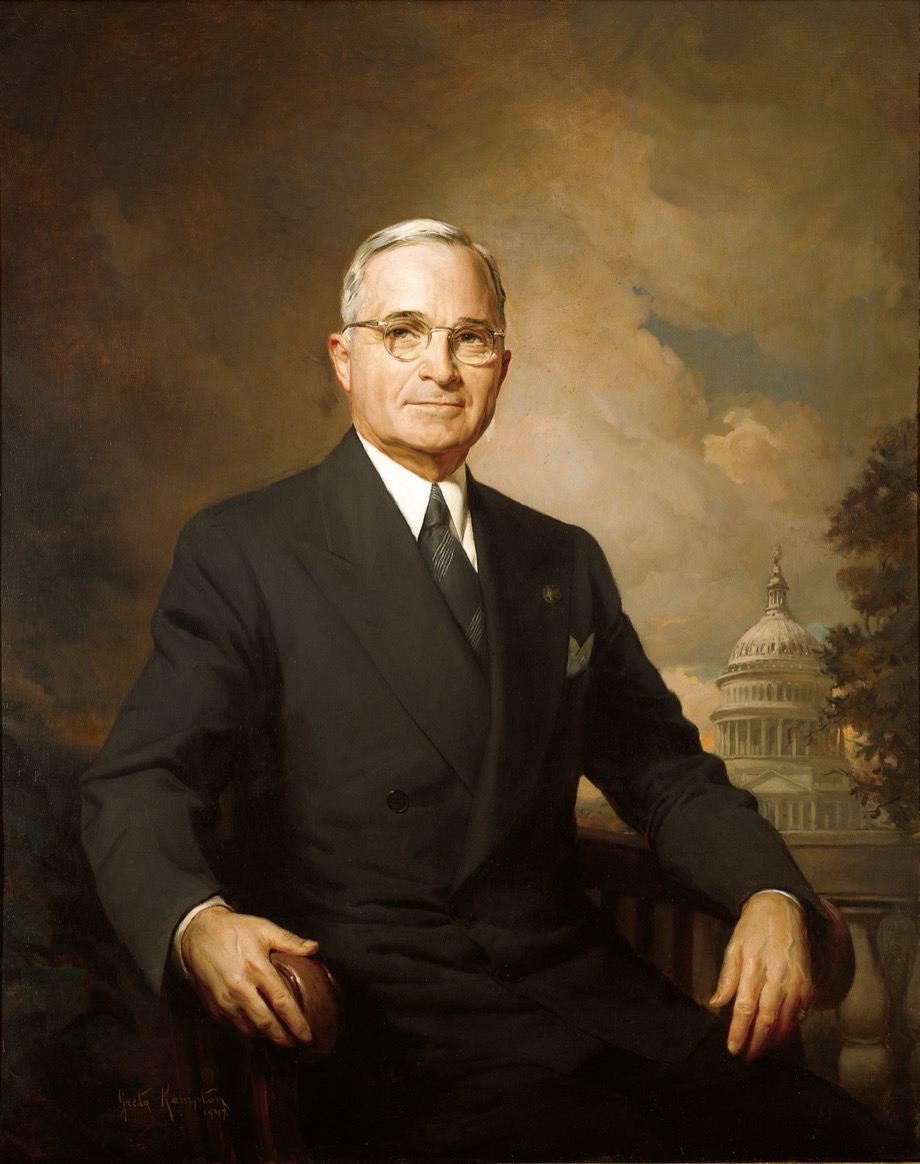
Portrait of Harry Truman
The Man Nobody Briefed
On the evening of April 12, 1945, the Vice President of the United States was summoned to the White House, taken upstairs, and told by Eleanor Roosevelt that her husband was dead. Harry Truman asked her if there was anything he could do for her. She answered with the question that has outlived them both: is there anything we can do for you — for you are the one in trouble now. He had been Vice President for eighty-two days. He had met with Franklin Roosevelt privately perhaps twice. He did not know that the United States was building an atomic bomb.
Within four months this failed haberdasher from Independence, Missouri — a man who had never attended college, who had come up through the Pendergast machine of Kansas City, whose greatest previous distinction was a Senate committee that audited defense contracts — authorized the only combat use of nuclear weapons in human history. Hiroshima on August 6. Nagasaki on August 9. He signed off on the Marshall Plan, the recognition of Israel, the Berlin airlift, NATO, the desegregation of the armed forces, and a war in Korea. He fired the most celebrated general in America. And he did all of it with the manner of a county judge closing out a docket: read the file, weigh the recommendations, decide, move on.
The sign on his desk read THE BUCK STOPS HERE — a novelty gift from a friend, and the most accurate self-portrait any president ever put on display. It is not a statement about wisdom. It is a statement about location. Truman's entire psychology can be read off that four-inch block of walnut: decisions are objects, they travel through an organization, and somewhere the traveling has to end. He believed the office was a job, that jobs have holders, and that a holder who cannot answer for the output has no business holding anything.
Truman was an ESTJ — extraverted thinking in its purest executive form, a mind that converted uncertainty into an order, a signature, and a name on the order.
The Decision as a Physical Object
Extraverted thinking wants the world arranged: authority mapped, responsibility assigned, the chain of command legible from any point on it. Truman took office and immediately began doing what Roosevelt had conspicuously refused to do — he delegated cleanly, held cabinet meetings that were actually meetings, and insisted that recommendations arrive at his desk in a form he could act on. He disliked Roosevelt's habit of running the government through overlapping, competing personal channels, not on principle but because it was inefficient. Te does not resent ambiguity morally. It resents it operationally.
The bomb is the case that defines him, and it defines him precisely because he treated it as an executive question rather than a metaphysical one. Henry Stimson briefed him on the Manhattan Project on April 25, 1945 — thirteen days into the presidency. Truman convened the Interim Committee, listened to the military estimates for an invasion of Kyushu, read the Franck Report's dissent, took Stimson's argument that Kyoto be spared, and made the call. He did not agonize in public and he did not agonize much in private either. In his Potsdam diary he wrote about the weapon in the flattest possible register — a thing that worked, a thing that would be used on a military target, a thing that might end the war. When the news of Hiroshima reached him aboard the Augusta, he told the sailors it was the greatest thing in history and went back to lunch.
The same reflex produced the recall of Douglas MacArthur in April 1951. MacArthur was the most decorated soldier alive, the proconsul of Japan, a man with a national constituency and a talent for public insubordination. Truman's polling was somewhere near twenty percent. He fired him anyway, and the reasoning he gave was not about strategy but about structure: the Constitution places the military under civilian control, MacArthur had made his own foreign policy in public, and a system in which a theater commander overrides his president is not a system. That is Te in its highest form — not stubbornness, but a conviction that the organizational chart is a real thing and must be defended even at ruinous personal cost.
Independence, Missouri, Carried Everywhere
Truman's judgment ran on stored precedent. He was, by any accounting, the best-read president of the century in one narrow channel — history, especially military and biographical history, absorbed from the Independence public library as a thick-spectacled farm boy who could not play ball. He read Plutarch and the lives of generals not for theory but for cases, and he cited them the way a foreman cites a job that went wrong in 1912. Introverted thinking builds systems; introverted sensing builds a filing cabinet of what has already happened, and Truman reached into that cabinet constantly.
It shows most clearly in the doctrine that carries his name. Faced with Greece and Turkey in 1947, he did not reason from first principles about the structure of world order. He reasoned from Munich — from the concrete, remembered spectacle of a decade earlier, in which incremental concession had produced a world war that killed sixteen million people and left him holding a weapon he had to decide whether to use. Containment as George Kennan articulated it was an intellectual architecture; containment as Truman executed it was an old lesson applied to a new file. The same memory made the Marshall Plan obvious to him: the punitive peace of 1919 had produced Hitler, so the peace of 1945 would be the opposite of punitive.
Si is also why the man never inflated. He kept the routine of a Missouri small-holder — up before six, a brisk morning walk at a hundred and twenty paces a minute, bourbon and a swim, bed early. He wrote to Bess nearly every day for decades. He returned to Independence in 1953 with no pension, no staff, and no Secret Service, drove himself home in his own car, and refused for the rest of his life to sit on corporate boards trading on the office. He said the presidency was not for sale and he had been its custodian, not its owner. That is memory as conscience: he knew who he had been before, and he intended to still be him after.
The Improviser Behind the Plain Speech
The caricature of Truman is a small man executing large plans drafted by better minds. It is wrong, and the tertiary function is why. Extraverted intuition in the third slot does not generate visions; it generates a tolerance for the unprecedented, an openness to the option nobody has tried. Truman's first term was a four-year run of institutions that had never existed: the Marshall Plan, the National Security Act, the CIA, the Air Force as a separate service, NATO — the first peacetime alliance in American history — and the Berlin airlift, a proposal so improbable that most of his advisers thought supplying a city of two million by air through a winter was arithmetic fantasy. He authorized it in an afternoon.
The recognition of Israel on May 14, 1948 is the sharpest instance. George Marshall — the man Truman admired above all living Americans — told him to his face that recognition was a mistake and that he would vote against him for it. The State Department was uniformly opposed. Truman recognized the new state eleven minutes after its declaration. He was not following a plan; he was following a hunch about where history was going, sharpened by an old friendship with his former haberdashery partner Eddie Jacobson, and he acted before the machinery could grind the option away.
Ne in the tertiary is also playful and slightly reckless, and it produced his most famous liability: the mouth. The whistle-stop campaign of 1948, in which he abandoned the prepared text and simply talked at people from the back of a train for thirty thousand miles, was pure unrehearsed improvisation — and it beat a result every pollster in America had already printed. So was the letter he wrote to a music critic who had panned his daughter's singing, offering to rearrange the man's face. The same faculty that let him imagine an airlift let him imagine, vividly and in writing, a fistfight with the Washington Post.
What He Would Never Say Out Loud
Inferior introverted feeling is a private, unarticulated moral core that its owner refuses to display and cannot fully examine. Truman never publicly second-guessed Hiroshima — not once, across twenty-seven years, through interviews, memoirs, lectures, and a long correspondence with people who begged him to reconsider. The line never varied: it ended the war, it saved lives, he would do it again, and he never lost sleep over it. Some of that is Te doing what Te does with a closed file. Some of it is Fi refusing to be cross-examined.
The evidence that something was moving underneath is circumstantial but consistent. After Nagasaki he told the cabinet that the thought of wiping out another hundred thousand people was too horrible, and ordered that no further atomic bomb be dropped without his express authorization — a decision he did not announce and did not explain. He read the casualty descriptions. He wrote in his diary before Potsdam that the weapon might be the fire destruction prophesied in the Euphrates Valley, after Noah and his fabulous ark. That is not the vocabulary of a man untroubled; it is the vocabulary of a man troubled in a register he has no intention of using in public.
Fi in the inferior also breaks out sideways, as heat. Truman's rages were real and personal — at critics of Bess, at his daughter's reviewer, at Stalin's broken promises over Poland, which he took as a violation of an agreement between men rather than a shift in geopolitics. He judged people, quietly and durably, by whether they kept their word, and the judgments never softened. The plainest read on him is this: he did not have a small inner life. He had a fiercely held one that he considered nobody's business, and he ran a public office in the belief that a man's private convictions are what he draws on, not what he discusses.
Why ESTJ Over ISTJ
Why not ISTJ?
The plain speech, the library habit, the Missouri modesty and the reverence for precedent all point toward introverted sensing in the lead — and plenty of readers have typed him that way. But an ISTJ's dutifulness is inward-facing and deliberative: it accumulates, it hesitates, it prefers to be right before it is visible. Truman was the opposite in every documented instance. He decided fast, in public, and put his name on it: the bomb inside four months of taking an office he had not been briefed for, MacArthur's recall against a twenty-percent approval rating, Israel eleven minutes after the declaration and over George Marshall's direct objection. He also sought and wielded authority — county judge, senator, chair of an investigating committee that made him nationally famous by hauling contractors in front of it — with none of an introvert's reluctance to be the visible face of a judgment. Si supplied his materials; Te ran the shop.
The confusion is understandable because Truman looked like an ISTJ and behaved like an ESTJ. He had no charisma, no oratory, no theory of himself, and he dressed like a bank examiner. But the test of dominant extraverted thinking is not volume — it is where the person puts the decision. Truman put it outward every time: onto a desk, into an order, under a signature, in front of a press corps that would have forgiven him for hedging. The buck stops here is not a humble sentence. It is a claim of jurisdiction, made by a man who believed that the alternative to somebody owning the outcome is nobody owning it, and that nobody owning it is how catastrophes happen.
Connected Figures
Further Reading
- Truman — David McCulloughThe definitive one-volume life; the essential account of the transition, Potsdam, and the 1948 campaign.
- Memoirs, Vol. 1: Year of Decisions — Harry S. TrumanHis own flat, unrepentant narration of 1945 — the best primary window on how he framed the bomb to himself.
- Man of the People: A Life of Harry S. Truman — Alonzo L. HambyThe most psychologically searching biography, attentive to the insecurities beneath the plain-spoken exterior.
- The Decision to Use the Atomic Bomb — Gar AlperovitzThe leading revisionist case that Japan was near surrender and the bomb was aimed partly at Moscow.
- Racing the Enemy: Stalin, Truman, and the Surrender of Japan — Tsuyoshi HasegawaReconstructs August 1945 from American, Soviet, and Japanese archives at once.
- Off the Record: The Private Papers of Harry S. Truman — Robert H. Ferrell, ed.Diaries and unsent letters, including the Potsdam entries on the weapon.
