 Historical Figure MBTI
#1028 · 7-31-26 · The Second World War
James F. Byrnes
The Assistant President · Secretary of State at Potsdam · Architect of the Pivot
1882 — 1972
6 min read
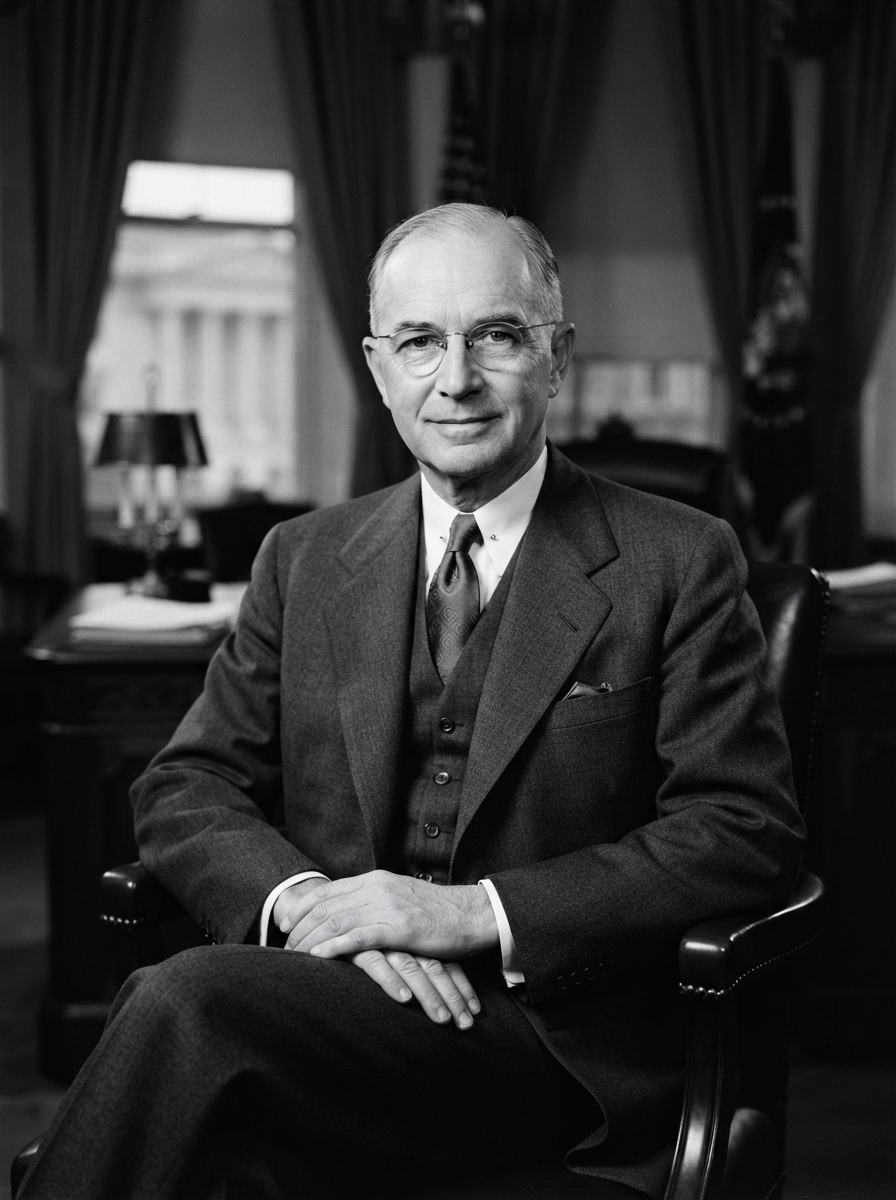
AI-assisted Portrait of James F. Byrnes
The Man Who Held Every Job in Washington
No American of the twentieth century held a stranger collection of titles than James F. Byrnes. Congressman, senator, Supreme Court justice, director of war mobilization, secretary of state — he moved through the machinery of federal power the way other men moved through a single career, and at each stop he was known less for vision than for velocity. Franklin Roosevelt, tired of a mobilization bureaucracy that could not decide who set the price of steel or who released a soldier from a factory floor, put Byrnes in charge of resolving such questions permanently, and the press began calling him the "assistant president." It was not flattery so much as description: Byrnes ran the wartime economy from a corner office, cutting through turf battles that had stalled better-credentialed men.
That same instinct — find the lever, pull it, move to the next problem — followed him to Potsdam in 1945, where he sat beside a newly installed Truman and watched the wartime partnership with Stalin curdle into something colder. Byrnes did not arrive as a theorist of Soviet behavior; he arrived as a dealmaker who assumed, at first, that firmness and horse-trading could produce an agreement, any agreement. When that assumption failed, he adjusted his tactics without ever quite rebuilding his premises, and within two years he had become one of the architects of an American posture toward Moscow he had not set out to design.
Byrnes was an ESTJ to the marrow — a dominant Te operator who measured every institution by what it could be made to produce, and who trusted the record of what had worked before more than any new theory of what should.
The Fixer of the War Economy
Byrnes's Te showed itself first as a talent for organizational plumbing. As director of the Office of War Mobilization, he had no statutory army of his own — only a mandate to referee the agencies that did, from the War Production Board to the armed services, all of them competing for the same steel, rubber, and manpower. Byrnes did not write theory about how a war economy should be organized; he simply decided disputes, fast, and made the decisions stick, because everyone in Washington understood that Roosevelt would back him. Historian David Robertson's title for his biography, "Sly and Able," captures the operating style exactly: less a visionary than an extremely effective closer of open questions.
That same closer's instinct carried him to Potsdam and into the State Department. Confronted with a Soviet Union that would not honor the loose language of Yalta, Byrnes did not develop a new grand strategy — he tried, first, to negotiate concrete trades: reparations figures, zonal boundaries, atomic diplomacy as leverage. When Stalin proved immovable, Byrnes hardened his position by increments, matching pressure with pressure, always looking for the next lever rather than the underlying design. It was Te doing what Te does best: treating the world as a set of solvable problems, and growing impatient with anyone who wanted to stop and ask what kind of world was being built.
Thirty Years of Knowing How Washington Actually Works
No one in the Roosevelt or Truman administrations arrived with a deeper catalogue of precedent than Byrnes. He had been a courthouse clerk, a congressman, a senator who helped write New Deal legislation, and — briefly — a Supreme Court justice, a résumé that gave him an almost encyclopedic sense of which lever moved which committee and which precedent could be cited to settle which fight. His Si showed up as institutional memory turned into leverage: he did not need to imagine how a bureaucratic standoff might resolve, because he had usually watched a version of it resolve before, in a hearing room or a Senate cloakroom, and could reproduce the maneuver.
At Potsdam this same groundedness became a limitation as much as a strength. Byrnes reached for the tools of prewar diplomacy — trades, precedent, personal rapport — in a situation whose terms had already changed underneath him. He kept refining the old machinery of great-power bargaining even as Kennan, watching from Moscow, argued that the machinery itself no longer matched what the Soviets were doing. Byrnes eventually absorbed the containment argument and hardened toward Moscow, but he arrived there by trial and adjustment, not by original analysis — Si processing new facts through the grid of known method, until the old grid finally gave the same answer the theorists had already reached.
Why ESTJ Over ENTJ
Why not ENTJ?
Byrnes had ENTJ's appetite for command but not its native pull toward building new systems from first principles. He was, at every stage of his career, an executor and coalition-manager working the levers of institutions already standing — the Senate, the Court, the war-mobilization apparatus, the State Department — rather than an architect drafting a doctrine that did not yet exist. That drafting work, the intellectual reframing of Soviet behavior into a durable American strategy, was George Kennan's role. Byrnes absorbed Kennan's conclusions and acted on them with real force, but he did not originate them, and an ENTJ of Byrnes's ambition and ability would have been far likelier to try.
The distinction matters because it explains both Byrnes's effectiveness and his limits. He could be dropped into almost any broken machine in Washington and make it run again, which is precisely what made him invaluable to Roosevelt during the mobilization crisis and to Truman in the opening chaos of postwar diplomacy. But when the moment called not for better management of an existing order but for a genuinely new conception of America's role in the world, Byrnes reached first for the tools he already trusted, and only came around to the new framework once its logic had already proven itself elsewhere. That is Te and Si working exactly as they should — with tremendous force, and one half-step behind the frontier.
Connected Figures
Further Reading
- Speaking Frankly — James F. ByrnesByrnes's own 1947 memoir of his wartime and postwar State Department years.
- Sly and Able: A Political Biography of James F. Byrnes — David RobertsonThe standard scholarly biography, tracing his career from courthouse clerk to Secretary of State.
- All in One Lifetime — James F. ByrnesByrnes's later autobiography, covering his full career including the South Carolina governorship.
- Present at the Creation — Dean AchesonA successor Secretary of State's memoir of the same postwar diplomatic transition.
