 Historical Figure MBTI
#1027 · 7-30-26 · The Second World War
Hans Frank
The Butcher of Poland · Governor-General · Confession Before the Gallows
1900 — 1946
9 min read
Portrait of Hans Frank
The Killing Ground He Administered
From October 1939 until January 1945, Hans Frank ruled occupied Poland as Governor-General of a territory the Reich called simply the General Government. What happened there under his administration is among the largest crimes in recorded history. The Warsaw, Kraków, Lublin and Łódź-adjacent ghettos were established and sealed on his authority. The death camps of Operation Reinhard — Treblinka, Bełżec, Sobibór — were built and operated inside his jurisdiction, and roughly 1.7 million Jews were murdered in them in less than two years. Millions more Polish Jews died in the ghettos, in the Aktionen, and at Auschwitz, also within his territory. He signed decrees imposing the death penalty for a Jew found outside a ghetto and for any Pole who fed one. He ran the AB-Aktion, the systematic murder of Poland's teachers, priests, professors and officers, and boasted of it. He organized the deportation of well over a million Poles to forced labor in Germany. In December 1941, addressing his own cabinet in Kraków, he told them the Jews had to disappear, that pity was out of the question, and that they would have to be dealt with in whatever way led to the goal.
None of this was a matter of a man swept along. Frank was a lawyer by training and by temperament, and he did his killing the way a lawyer does anything: in writing, in sequence, with the paperwork kept. He also lived well while doing it — installed in Wawel Castle, the ancient royal seat of the Polish kings, holding concerts there, collecting looted art, with Leonardo's Lady with an Ermine hanging in his residence while the people he governed starved by design.
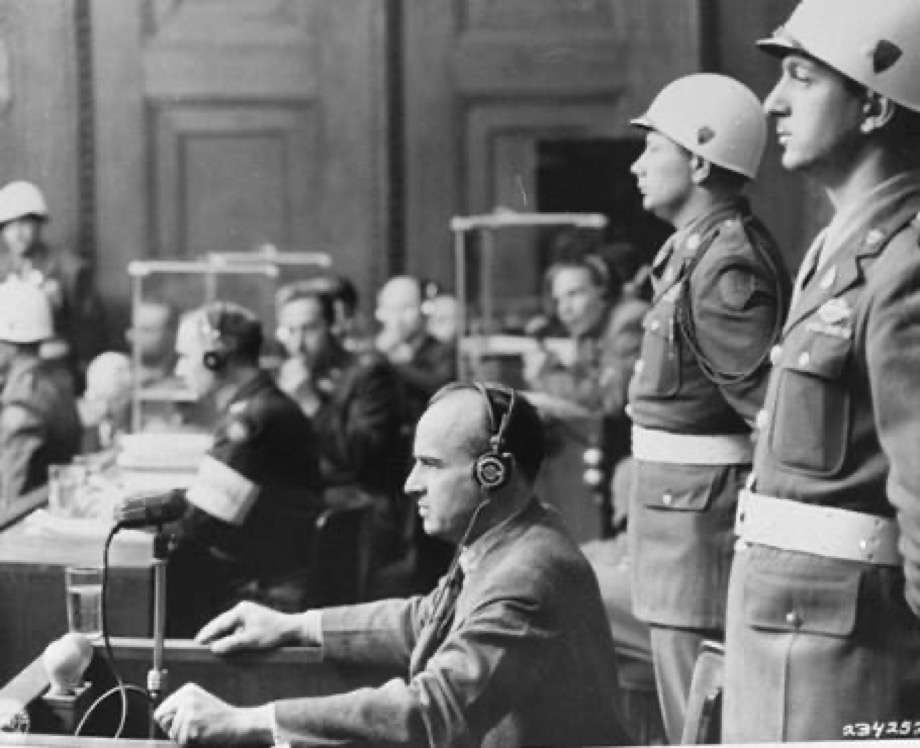
And then, at Nuremberg, he did something the other defendants did not. He handed the Allies dozens of volumes of his own official diary — a meticulous, dated, verbatim record of five years of conferences in which he and his subordinates discussed the extermination of a population in the flat language of administration. It became one of the prosecution's most devastating exhibits, against him and against others. He converted to Catholicism in his cell, wept in court, and told the tribunal that a thousand years would pass and the guilt of Germany would still not be erased. What that confession was worth is the central question of his life, and the psychology is not flattering to him.
Frank is the archive's starkest case of dominant Si turned lethal: an ISTJ administrator who supplied no idea of his own to the Reich, only procedural devotion — and whose famous repentance reads less as moral reasoning than as the collapse of a man who had never had a self of his own to fall back on.
The Diary That Hanged Him
Introverted Sensing is the accumulation and preservation of the concrete past — records, precedents, the way things have been done. Frank's expression of it was pathological in its thoroughness. From 1939 he kept a stenographer present at essentially every official conversation, and the transcripts were bound, indexed, and stored: eventually some eleven thousand pages across dozens of volumes. This was not a diary in the confessional sense; it contained almost nothing of his inner life. It was an archive of what had been said and decided, kept because keeping it was what a properly constituted office did.
The instinct served the Reich's machinery. Frank was, in his own estimation, the man who made occupation legal — who converted conquest into an ordered structure of decrees, jurisdictions, quotas and courts. Poland under his rule was not chaos; it was a system with its atrocity assigned to departments, and that is what let it work at the scale it did. The Si administrator does not need to invent the goal; told it, he will build the repeatable procedure that reaches it, and keep the file. The same function destroyed him. When the Americans arrived at his Bavarian house in May 1945 he surrendered the volumes to them, apparently without grasping that the record he had preserved out of bureaucratic piety was a confession — a man who could not conceive of an official act going unrecorded, and so recorded the extermination of a people in triplicate.
Atrocity Reduced to Jurisdiction
Frank's auxiliary Extraverted Thinking is visible in what he actually spent his energy on, which was rarely ideology and almost always control. He came to the party as a young lawyer in 1923, became Hitler's personal attorney, and made his career defending party members in court and then, after 1933, building the legal scaffolding that let a lawless movement present itself as a state. He headed the Academy of German Law and the National Socialist Jurists' League. His self-conception was as the regime's builder of forms.
In Poland this became a relentless institutional turf war. Frank fought Heinrich Himmler for years over control of the SS and police in the General Government, and lost. He fought Martin Bormann over access to Hitler, and lost. He fought Göring's Four-Year Plan apparatus over exploitation quotas, and lost most of that too. It is essential to see what he was fighting about: not the murders, which he administered without visible resistance, but the question of who had authority to order them. In 1942 he gave a series of university lectures calling for a restoration of legal norms, and was stripped of his party offices for it — but even this flicker was Te in shape rather than moral protest. What offended him was a police state operating outside the legal structure he had built, arresting without process. He never asked for the killing to stop. He asked for it to be properly authorized.
The Cultured Man in the Castle
Tertiary Introverted Feeling in an ISTJ is a private, largely unexamined store of personal values — often expressed not as ethics but as taste, as a self-image the person protects and rarely interrogates. Frank's was elaborate. He played the piano seriously and well, read and quoted Goethe, courted artists and musicians, held recitals at Wawel, and spoke of himself as a man of the German cultural inheritance temporarily obliged to do hard administrative work. Gustave Gilbert, the prison psychologist at Nuremberg, found him vain, theatrical, emotionally labile and enormously invested in being perceived as sensitive.
Nothing in that self-image ever touched what he was doing. This is the ordinary function of unintegrated Fi: it curates the person's sense of who he is, sealed off from the record of what he does. Frank could record that the Jews of the General Government must be liquidated and, in the same period, be moved to tears by a nocturne played in a castle stolen from the nation he was destroying. The two selves never had to be reconciled, because they were never in the same room. Which refutes the oldest excuse offered for men like him: Frank was not a coarse thug who did not know better. He was educated, articulate, aesthetically alive, and personally squeamish about visiting the camps he supplied. The cultivation did not restrain the crime by one hour. It functioned as insulation.
The Collapse in the Dock
The inferior function erupts rather than operates. In an ISTJ, inferior Extraverted Intuition surfaces as catastrophic possibility-thinking — the sudden inability to stop seeing what else all of this could mean — usually when the structure holding the person upright is removed. Frank's was removed completely in 1945: office, party and state gone, and the record he had kept now read aloud against him in a courtroom. What followed was spectacular and, in feeling, largely sincere. He attempted suicide on capture. In prison he returned to the Catholicism of his childhood, received the sacraments, and told Gilbert he was under judgment. In the witness box in April 1946 he said he had himself a thousand times helped fill the country with the horror of extermination, and delivered the line still quoted: that a thousand years would pass and Germany's guilt would not be erased. Then, cross-examined, he retreated — insisting he had not known the extent, that he had only administered, that responsibility lay elsewhere. Both statements were his.
That oscillation is the tell. A worked-out moral position is stable under pressure; Frank's was not, because it was not a position but a flood. The confession has real historical value — it is the only genuine acknowledgment of collective guilt any major defendant offered — and it must be held alongside the fact that it cost him nothing he still had, arrived only after the structure was gone, and was walked back before the trial ended. He was hanged on 16 October 1946.
Why ISTJ Over INTJ
Why not INTJ?
An INTJ leads with a private vision and bends institutions toward it — the pattern of Albert Speer, who conceived a new architecture and a new industrial system and drove both through the Reich's bureaucracy. Frank originated nothing. Every idea he acted on came down to him from above; his contribution was procedure, jurisdiction, and the record. His one apparent independent stand, the 1942 lectures, demanded that the existing program run through proper legal channels rather than challenging the program. And his confession, which an INTJ reading would treat as a reasoned reversal of worldview, behaved like an inferior-function eruption: sudden, total, theatrical, and walked back under cross-examination. A collapse, not a conclusion.
The distinction matters because the two types produce different kinds of monster, and Frank is the more common and more disturbing kind. The visionary criminal at least authors his crime, which lets the rest of us locate the evil in an identifiable act of imagination. Frank authored nothing. He received a goal, found it administratively interesting, built the machinery that reached it, and kept an immaculate file so the work could be audited. The type is not the crime — take the ideology away and he would have been a pompous Bavarian jurist. But this type, in that structure and given that order, produced a man who could discuss the disappearance of three million people as a scheduling problem and see no contradiction with the Chopin.
Connected Figures
Further Reading
- Trial of the Major War Criminals Before the International Military Tribunal (the 'Blue Series') — International Military TribunalFrank's testimony, cross-examination, and the diary extracts entered into evidence — the primary record for everything asserted here.
- The Anatomy of the Nuremberg Trials: A Personal Memoir — Telford TaylorThe best insider account of how the prosecution used Frank's own archive against him and his co-defendants.
- Hitler's Shadow: Nazi War Criminals, U.S. Intelligence, and the Cold War — Richard Breitman and Norman J. W. GodaOn the postwar documentary record of the Reich's administrators and what Allied intelligence did with it.
- Nuremberg Diary — G. M. GilbertThe prison psychologist's contemporaneous notes — the source for most of what is known about Frank's conduct and moods between sessions.
- East West Street: On the Origins of Genocide and Crimes Against Humanity — Philippe SandsTraces Frank's rule in Lemberg and Kraków alongside the invention of the legal categories under which he was hanged.
