 Historical Figure MBTI
#1012 · 7-26-26 · The Second World War
Hannah Arendt
The Philosopher Who Named It · Banality of Evil · Witness at Nuremberg’s Echo
1906 — 1975
9 min read
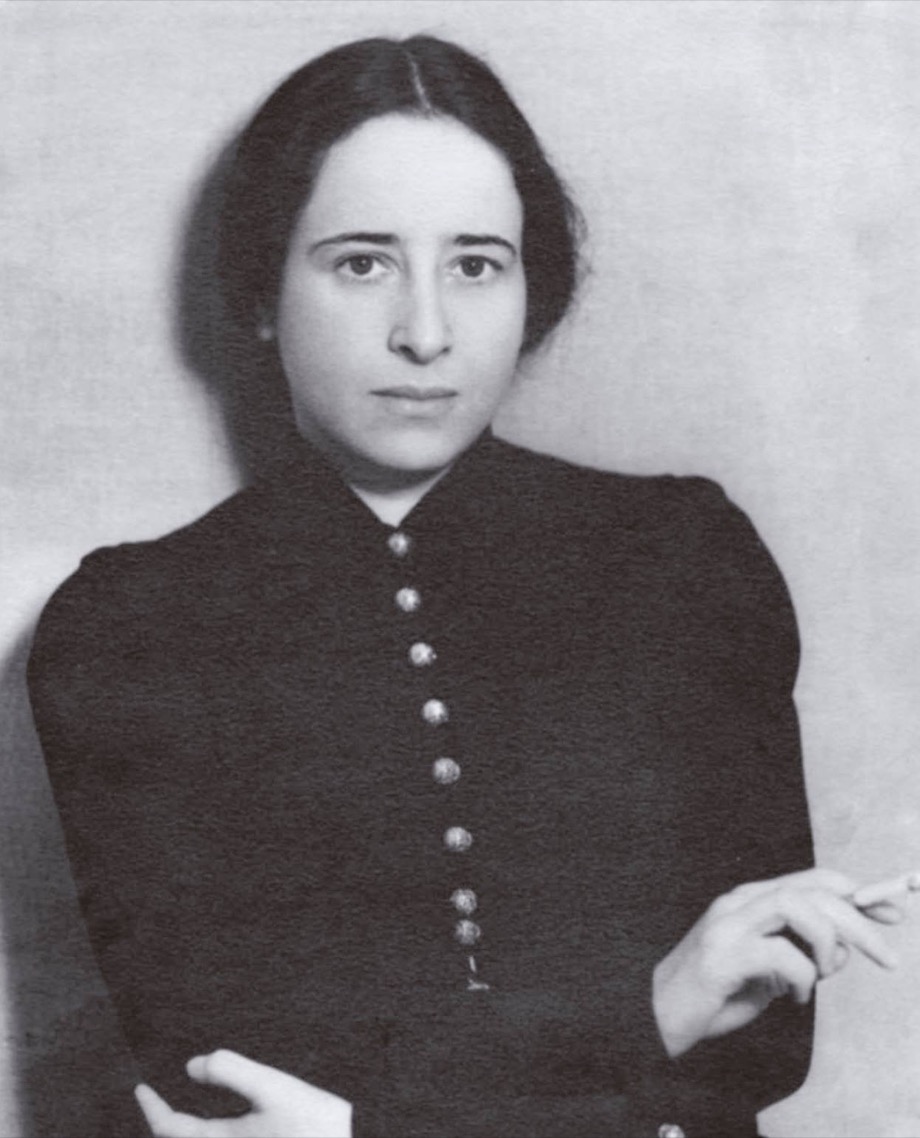
Portrait of Hannah Arendt
Five Words That Changed How We See Atrocity
In April 1961, a German-Jewish philosopher who had escaped the Gestapo, escaped a French internment camp, and reached New York as a stateless refugee sat down in a Jerusalem courtroom to watch Adolf Eichmann stand trial for organizing the deportation of millions of Jews to their deaths. Hannah Arendt had gone expecting to confront something enormous. What she found in the glass booth was a middle-aged man with a cold, a bad back, and a vocabulary made almost entirely of official clichés, who could not construct a sentence outside the bureaucratic idiom of his old office and who seemed sincerely more wounded by his stalled promotions than by the fate of the people on his transport lists.
Out of that observation she built a thesis and gave it a subtitle that has outlived every argument about it: Eichmann in Jerusalem: A Report on the Banality of Evil. Her claim was not that Eichmann was innocent or that his crimes were small — she supported his conviction and his execution, and said so plainly. Her claim was that the greatest crime of the century had been carried out in large part by unremarkable people who were fully guilty and psychologically ordinary; that evil at this scale needed no demonic depth, only functionaries who did their work, advanced their careers, and never thought.
She had been building toward this for a decade. The Origins of Totalitarianism, published in 1951, had already argued that Nazism and Stalinism were a genuinely new political form rather than old-fashioned tyranny scaled up — regimes that governed through terror and ideology, atomized their populations, and rendered whole categories of people superfluous. Eichmann was the human specimen that confirmed the theory. The book that resulted cost her friendships, drew ferocious attacks from parts of the Jewish intellectual world, and became one of the most consequential works of political thought of the twentieth century.
Arendt is a textbook INTJ: dominant Ni watching a courtroom until an entire theory of modern evil crystallizes, then auxiliary Te hammering it into a thesis she would defend, unmoved, against the anger of everyone she knew.
Seeing the Pattern Beneath the Event
Introverted Intuition works by convergence: it takes a mass of particulars and resolves them, often suddenly, into a single underlying shape. Arendt’s entire method is this. Faced with the archives of nineteenth-century antisemitism, imperial expansion, and mass politics, she did not produce a chronicle; she produced The Origins of Totalitarianism, which argues that these apparently unrelated developments were the assembling parts of one novel machine. Historians have quarreled with her evidence ever since. Almost none of them have shaken the shape she found.
The Eichmann insight is Ni at its most compressed. Every other observer in that courtroom saw the man through the frame they had brought — a monster, a sadist, a demon of antisemitism. Arendt watched the same defendant and perceived an absence where the depth was supposed to be, and understood immediately that the absence was the finding. The phrase “the banality of evil” appears exactly once in the book, in its final pages, arriving as the conclusion of something she had been assembling for months.
Her later work turned that perception into a lifelong question. The Life of the Mind, unfinished at her death, begins from Eichmann: what is this activity called thinking, whose absence made him possible? Ni does not let go of a problem once it has caught its outline; it circles the same insight from new directions for decades. Arendt spent her last years trying to give a philosophical account of the faculty she had watched a man conspicuously lack.
The Thesis, Stated and Defended
Extraverted Thinking is what turns a private vision into a public structure, and Arendt’s prose is relentlessly architectural. She defines her terms, draws distinctions and holds them — labor from work from action, power from violence, authority from both — and organizes each book into a sequence of load bearing arguments. The Human Condition is built like an engineering drawing. She was not a philosopher of tentative gestures; she made claims and expected them to be tested.
The backlash to Eichmann in Jerusalem shows the same function under pressure. Accused of exculpating a mass murderer, of mocking the victims with her tone, and above all of a few caustic pages on the Jewish Councils whose leaders cooperated with the deportation machinery, she gave essentially no ground. She wrote letters, published a postscript, restated the argument in public lectures, and insisted that her critics had responded to a book they had not read. Gershom Scholem told her she lacked love for the Jewish people; she replied that she had never loved any people, only her friends, and that this was not what the argument was about.
That reply is Te-Fi in one sentence — an unyielding logical distinction delivered with total personal conviction and no interest in softening the blow. It cost her enormously. Old friendships ended, Jewish organizations denounced her, and the fight ran for years. Her position never moved, because for her the question was whether the analysis was correct, and she believed it was.
Loyal to Persons, Not to Camps
Tertiary Introverted Feeling gave Arendt a private, fiercely held code that never mapped onto any faction. She refused to be a party intellectual of any kind: she had been a Zionist activist in the 1930s and became a sharp critic of the Israeli state’s direction; she was hated by the American left for her judgments on revolution and by conservatives for almost everything else. Her allegiances were to particular people — her husband Heinrich Blücher, her friends Karl Jaspers and Mary McCarthy — and to positions she had personally examined.
The most difficult instance is Martin Heidegger, her teacher and, at nineteen, her lover, who joined the Nazi Party and served as a rector under the regime. Arendt broke with him, spent the war years as a refugee from the movement he had endorsed, and then, after 1949, resumed contact and helped bring his work to an English-speaking audience. It has been criticized ever since, and it is unmistakably Fi: a private moral accounting conducted alone, on its own terms, indifferent to how it looked to anyone else.
It also explains her most misread sentences. When she wrote about the Jewish Councils, she was applying to her own people the same standard she applied to everyone — that individuals remain responsible for what they do under coercion, because that responsibility is what preserves them as human. To her this was the deepest possible respect. To many readers, arriving eighteen years after the camps, it read as cruelty. Both things can be true, and the collision between them defined the rest of her life.
History Arriving in the Body
Inferior Extraverted Sensing is the underdeveloped channel — the immediate, physical, present-tense world — and for Arendt it kept forcing itself in. She was arrested by the Gestapo in Berlin in 1933 for researching antisemitic propaganda, held for eight days, and fled to Paris; in 1940 she was interned by the Vichy authorities at Camp Gurs and escaped in the chaos after the French collapse, crossing to Lisbon and reaching New York in 1941 with almost nothing. A theorist of statelessness had been stateless for eighteen years. Her abstractions were paid for in border crossings.
She also reported. It would have been entirely possible to write about Eichmann from her desk; she went to Jerusalem, sat in the room for weeks, and watched a specific man’s specific mannerisms until they yielded the argument. The whole thesis rests on sensory observation of the concrete — his phrasing, his tics, his little bursts of professional pride. Inferior functions can be startlingly powerful when a dominant function needs them.
But the weakness shows too. Arendt persistently misjudged how her words would land in the immediate emotional atmosphere of the moment. The mordant, ironic tone of the Eichmann book — natural to her, and deliberate — struck grieving readers as flippancy about the murdered. She seemed genuinely surprised by the scale of the fury. A mind fixed on the pattern rather than the room is often the last to notice what the room can bear.
Why INTJ Over INTP
Why not INTP?
An INTP explores: builds frameworks provisionally, holds conclusions loosely, and prefers the open question to the settled verdict. Arendt did the opposite. Her books advance firm, structured, deliberately controversial theses — totalitarianism as a genuinely new political form, the banality of evil, the distinction between power and violence — and she defended them for years against attacks that cost her friendships and her standing with communities she belonged to. That is auxiliary Te building an argued position and holding it, not Ti circling a problem for its own sake.
The distinction is exactly what makes her the right philosopher for this cluster. Arendt’s subject was men who could not think — who took their frame from the hierarchy above them and optimized inside it — and her answer to them was not a counter-ideology but the demand that each person judge for themselves, without a rule handed down. She held herself to it at real cost. Set her beside Eichmann and Hoss, both ISTJs whose Te executed brilliantly within a frame supplied by someone else, and the whole shape of the argument appears: the same competent, judging faculty, pointed at the world by a mind that insisted on generating its own premises.
Connected Figures
Further Reading
- Eichmann in Jerusalem: A Report on the Banality of Evil — Hannah ArendtThe 1963 book, drawn from her New Yorker trial dispatches, that made and nearly unmade her reputation.
- The Origins of Totalitarianism — Hannah ArendtHer 1951 argument that Nazism and Stalinism were a new political form rather than tyranny by another name.
- The Human Condition — Hannah ArendtHer most systematic work of political philosophy, separating labor, work, and action.
- Hannah Arendt: For Love of the World — Elisabeth Young-BruehlThe standard biography, written by a former student, covering the flight from Europe and the Eichmann controversy in depth.
