 Historical Figure MBTI
#1013 · 7-27-26 · The Second World War
Oskar Schindler
The Hustler Who Saved a List · War Profiteer Turned Rescuer · Improvised Righteousness
1908 — 1974
10 min read
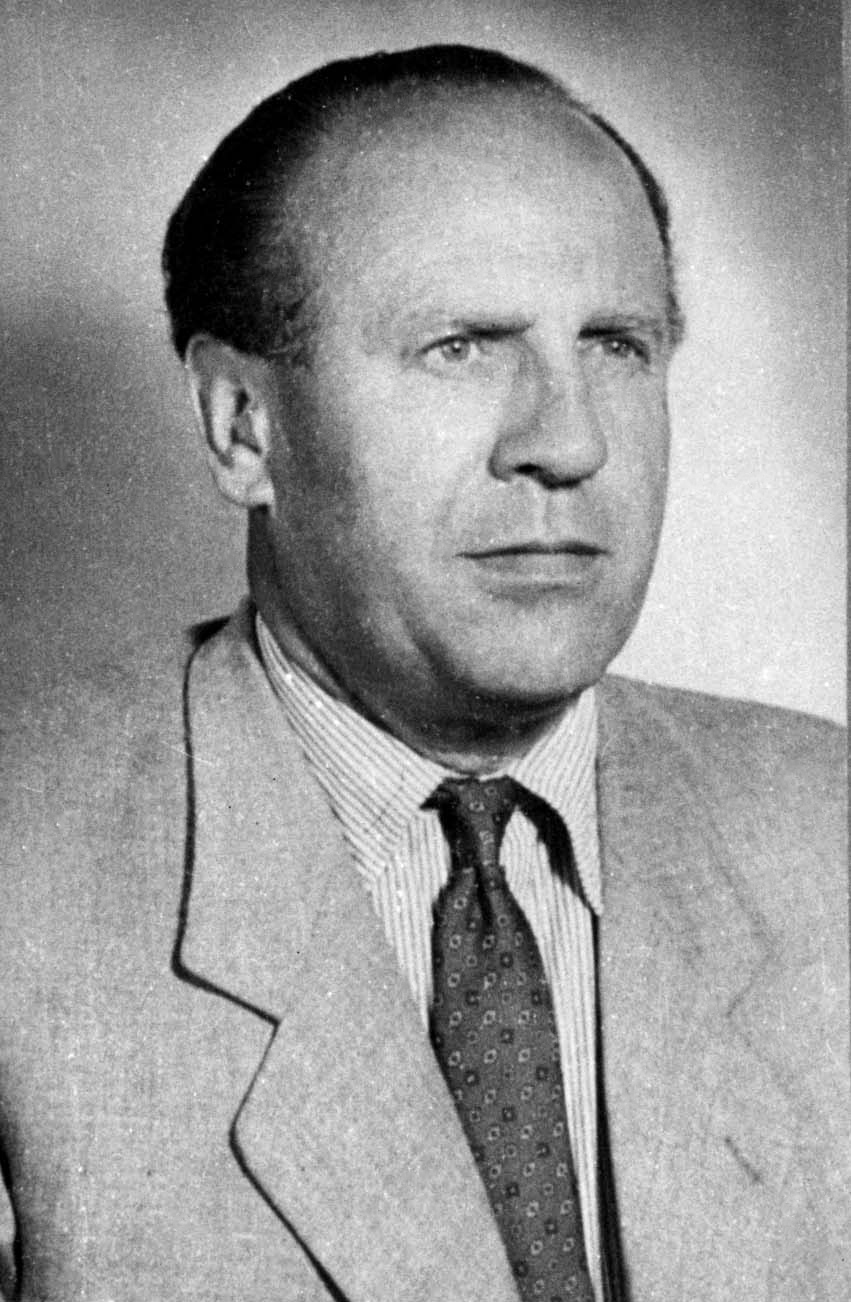
Portrait of Oskar Schindler
The Salesman in the Room Where It Happened
He was, by any reasonable accounting, a bad man who did the single most extraordinary thing available to anyone in occupied Poland. Oskar Schindler was born in 1908 in Zwittau, in Moravia — then a German-speaking corner of Austria-Hungary — and he arrived at the Second World War with a résumé of failed ventures, a marriage he treated as a formality, a taste for cognac and other men's wives, and a genuine talent for making people like him within ninety seconds of meeting him. He joined the Nazi Party in 1939. He joined it for contracts. When the Wehrmacht rolled into Kraków, he followed the army the way gulls follow a trawler, and he took over a bankrupt enamelware works because the German war economy needed mess kits and because Jewish labor, under the General Government, could be had for almost nothing.
Nothing in that biography predicts what came next. The men who write the histories of rescue like their rescuers to have been decent all along — a quiet conscience waiting for its moment. Schindler had no such conscience on file. What he had was an animal alertness to the room, an operator's memory for who could be bought and with what, and — this is the part that matters — a capacity to look directly at what was happening to human beings in front of him and not perform the small mental trick, nearly universal among his countrymen, of turning them into a category. He watched the liquidation of the Kraków ghetto in March 1943 from a hillside. Something in him seized on it and would not let go. He spent the next two years and every reichsmark he had ever earned dismantling his own fortune to keep roughly 1,200 people out of Auschwitz.
He was not transformed into a saint. He remained a drinker, a philanderer, and an operator to the end; after the war he failed at farming in Argentina and at cement in Germany, lived on the charity of the people he had saved, and died in 1974 largely unknown outside their circle. The transformation was narrower and stranger than sainthood. A man built to work angles simply pointed the angles somewhere else.
Schindler is the archive's cleanest case of a rescuer who improvised rather than resolved — an ESTP whose dominant Se read every room in occupied Kraków for exactly what it would take to get one more name onto a list.
The Man Who Could Not Look Away
Extraverted Sensing is often caricatured as thrill-seeking. Its real signature is narrower and more useful: an unmediated grip on what is actually in front of you, unbuffered by theory. Schindler had it in the vulgar register long before the war — the cars, the tailoring, the parties, the instinctive sense of which colonel was lonely and which was greedy. He was a salesman of the purest kind, one who did not prepare a pitch so much as read a face and improvise into it.
That same faculty is why the ghetto liquidation landed on him the way it did. Ideology is an abstraction, and abstraction was Schindler's weakest instrument. He could not process the Final Solution as policy; he could only process a child in a coat running between buildings while men shot into doorways. The Nazi machinery ran on the ability to convert people into paperwork — this is precisely the transformation Adolf Eichmann performed for a living. Schindler was constitutionally bad at paperwork and constitutionally good at seeing. That asymmetry saved twelve hundred lives.
Se also explains his method, which was not a plan but a continuous performance. He bribed with what was scarce that week: cognac, cigarettes, silk, diamonds, a ham. He talked his way into the Płaszów camp office and out of Gestapo cells — he was arrested at least twice on suspicion of black-marketeering and favoring Jews, and talked his way clear both times. He cultivated the camp commandant Amon Göth as one cultivates a dangerous animal, drinking with him, flattering him, feeding his vanity, extracting concessions in the hour before dawn when Göth was too drunk to count. None of this could have been scripted. All of it required a man who improvised at speed and did not flinch when the room turned.
The Cold Arithmetic Under the Charm
Charm alone does not survive contact with the SS. What kept Schindler alive and his workers on the payroll was introverted Thinking working quietly beneath the bonhomie: a private, unsentimental model of exactly how the system functioned and where its seams were. He understood, with a clarity most of his contemporaries never reached, that the machine did not care about Jews as such — it cared about quotas, production certificates, armaments priority, and the personal appetites of the men administering it. Every one of those was a lever.
So he built the Deutsche Emailwarenfabrik into something the Reich needed, then argued relentlessly that his workers were essential, skilled, irreplaceable. They were mostly not. He had metalworking certifications forged for teachers, musicians, and children. He listed a one-armed man as a machinist. When his enamelware plant was converted to munitions production in 1944, he ran it in a way that produced, over months, effectively nothing usable — and then bought artillery shells from other factories to fill his quotas so the deception would hold. That is not spontaneity. That is a sustained, deliberate fraud maintained for years under the noses of an occupying army.
The list itself was the Ti artifact. In the autumn of 1944, with Płaszów being dissolved and its population routed to Auschwitz, Schindler proposed moving his labor force to a new plant at Brünnlitz in his native Moravia — and then had to specify who, by name, was essential. The roster was assembled with his manager Itzhak Stern and paid for with the last of his money, and it functioned as a bureaucratic instrument turned against the bureaucracy: paperwork that looked exactly like the machine's own, doing the opposite of what the machine intended. When 300 women on it were misrouted to Auschwitz anyway, he sent an agent with a bag of diamonds and got them back — the only recorded instance of a group leaving that place alive by transaction.
Loyalty Learned in the Wrong Order
Tertiary Feeling arrives late and unevenly, and Schindler's is the textbook shape: for years an instrument of manipulation, then, without ceremony, the thing he organized his life around. Early on his warmth was a tool — he was warm because warm men close deals. What changed was not the warmth but its object. The workers stopped being an input cost and became, in his own recurring phrase, "my Jews" — a possessive that is neither humble nor especially admirable, and is exactly how an Fe-tertiary claims people: by folding them into his own household and then defending the household with everything he has.
It shows in the specifics. He argued for individuals by name in front of men who could have shot him for it. He fed his workforce far beyond regulation rations at his own expense. When his employees were seized in sweeps, he retrieved them. At Brünnlitz he took in a trainload of frozen prisoners from Goleszów whom no one else would accept, and had those who died buried with rites rather than dumped. None of this was systematic humanitarianism; he saved the people in front of him, the ones whose faces he knew, and made no attempt at anything larger.
And in May 1945, before fleeing west ahead of the Red Army — as a Party member and war profiteer, he had every reason to run — he gathered the Brünnlitz workers and spoke to them, and they gave him a ring made from a worker's gold tooth, inscribed with the Talmudic line about saving one life. The accounts of that night describe a man undone by it. Fe in the tertiary slot does not produce a philosopher of ethics. It produces a man who cannot bear to be thought badly of by the specific people he has come to love, and who discovers only afterward that this was the strongest thing in him.
The Future He Could Never Quite See
Inferior Intuition is the blind spot, and Schindler's blind spot was the long run — before the war, during it, and most cruelly after. He had no strategic theory of the Reich's collapse; he simply kept improvising until the improvising ran out. He never calculated how much the bribes would cost him in total, because calculating totals was not how he operated. He arrived at the peace with nothing: the fortune gone, the factories in territory he could not return to, and a Party card that made him a suspect in the country he had helped rob.
The postwar years are the inferior function's full bill. Argentina, a nutria farm, failure. Germany, a cement business, failure. Bankruptcy in 1963. He lived out his last decade on stipends from the Schindlerjuden and their organizations, splitting his year between Frankfurt and Israel, where he was recognized and welcomed and where the Yad Vashem commission wrestled for years with the question of whether a Nazi profiteer could be named Righteous Among the Nations. He was honored in stages — a tree at Yad Vashem in 1962, the full recognition granted in 1993, long after his death.
Yet the moments where Ni surfaced were decisive. Somewhere on that hillside in 1943, watching the ghetto emptied, a man who dealt exclusively in the present grasped where all of it was going and what it would mean to have stood by. That is the inferior function arriving as revelation rather than reasoning — sudden, total, unarguable, and impossible to explain afterward. Asked for the rest of his life why he had done it, Schindler never produced a satisfying answer, which is the most honest evidence there is that the insight came from a part of him he did not otherwise use.
Why ESTP Over ESFP
Why not ESFP?
The ESFP reading is tempting because Schindler was hedonistic, charismatic, and visibly moved by suffering in front of him — and because rescue is easy to romanticize as spontaneous warmth. But what he built was not a series of generous impulses; it was an elaborate, multi-year fraud requiring forged certifications, falsified production quotas, purchased shells to disguise sabotage, and a running ledger of which officials took which bribes. That is Ti judgment applied to lethal risk, not Fi values expressed outward. An Fi-auxiliary rescuer typically declares a line and holds it; Schindler never articulated a principle in his life and instead solved, week by week, a logistical problem whose failure condition was mass death. The cold nerve at Amon Göth's dinner table — flattering a man he had watched shoot prisoners for sport, in order to extract a concession — is not the warmth of Fe-Se play. It is a Ti operator running a system he has mapped precisely.
The ESTP verdict also explains the shape of his failures. An Fi-driven man who had done what Schindler did would have carried a coherent story about it — would have known what he stood for, and could have lived on that afterward. He had no such story, only a set of moves that had worked and a war that ended, taking with it the entire theater in which his talents functioned. Peacetime offered him no rooms worth reading and no seams worth exploiting. The same improvisational, present-tense engine that made him the most effective private rescuer of the war made him, in a settled world, a man who could not hold a business together for five years running.
Connected Figures
Further Reading
- Schindler's Ark — Thomas KeneallyThe 1982 Booker-winning nonfiction novel, built from interviews with surviving Schindlerjuden, that rescued the story from obscurity.
- Oskar Schindler: The Untold Account of His Life, Wartime Activities, and the True Story Behind the List — David M. CroweThe major documentary biography — corrects the popular narrative, including the origins and authorship of the list itself.
- Righteous Among the Nations: Oskar and Emilie Schindler — Yad VashemThe commission file and testimony records behind the 1993 recognition, including the long internal debate over honoring a Party member.
- Searching for Schindler — Thomas KeneallyKeneally's memoir of how the book came to be written, and of the survivors whose testimony formed its spine.
