 Historical Figure MBTI
#1015 · 7-27-26 · The Second World War
Chiune Sugihara
The Consul Who Disobeyed · Visas for Life · Quiet Defiance in Kaunas
1900 — 1986
6 min read
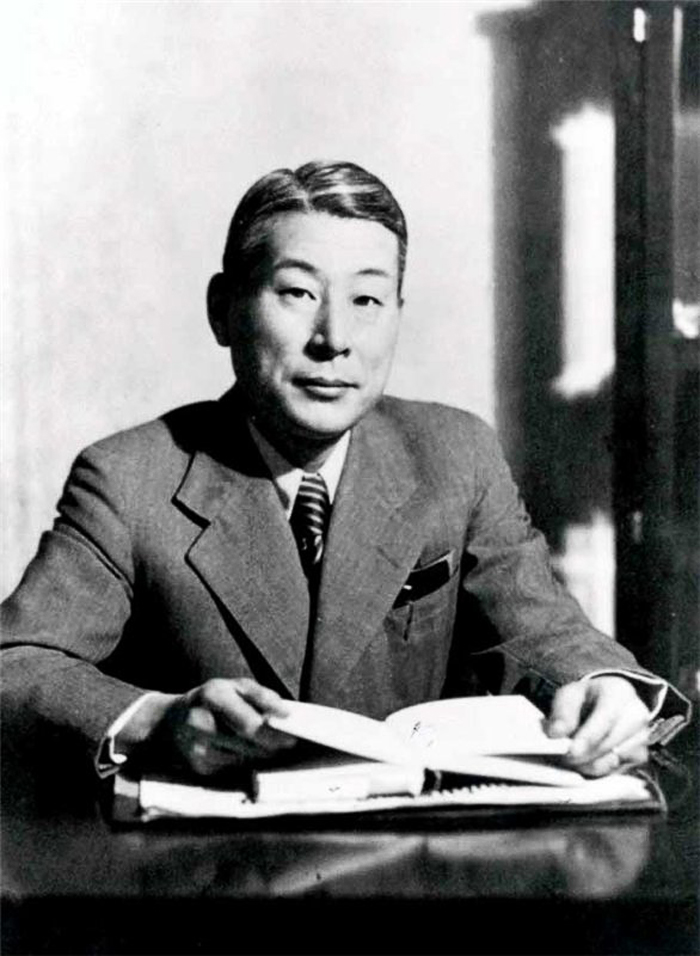
Portrait of Chiune Sugihara
A Line of Refugees, a Stack of Blank Paper
In the summer of 1940, the Japanese consulate in Kaunas, Lithuania, was a small room with a line outside it that never seemed to shorten. Poland had fallen the previous autumn, and thousands of Jewish refugees — many of them Polish, many already stateless — had drifted east into Lithuania only to find the Soviet Union closing in behind them. A transit visa through Japan was one of the last doors still open. Chiune Sugihara, the vice-consul, was not an important man in the Foreign Ministry's eyes. He was a career diplomat with a talent for Russian, posted to a backwater precisely because Tokyo did not expect much to happen there.
What happened instead was that Sugihara cabled Tokyo three times asking permission to issue visas to people who did not meet the requirements — no onward destination confirmed, no funds verified, nothing but need. Three times he was refused. He issued the visas anyway, by hand, for eighteen to twenty hours a day, for close to a month, until his own consulate was ordered shut and he had to leave. Witnesses describe him still writing on the train platform, still passing visas through the window as the train pulled out, discarding only the consular stamp itself into the crowd so that someone could keep forging his signature after he was gone.
None of this reads like ambition, ideology, or a plan to be remembered. It reads like a man who could not make himself refuse the people standing in front of him, and who kept a private, immovable sense of what a decent person owed to another human being even when his government told him otherwise. That is the signature of an ISFJ.
Sugihara's defiance was not rebellion — it was Introverted Sensing fused to a duty he felt no institution had the standing to cancel.
A Duty That Predated the Order
Dominant Introverted Sensing does not improvise a new ethics for a new crisis; it consults an internal record of what has already been established as right, and holds to it against pressure. Sugihara's record was built long before Kaunas — a Christian upbringing layered onto a samurai-descended family's code of personal obligation, and years of diplomatic postings across a collapsing Manchuria and a tense Baltic frontier that taught him exactly what abandonment by a government looked like from the receiving end. When the refugees arrived, he was not reasoning from first principles about human rights in the abstract. He was measuring the request against a settled internal standard, and the standard said yes.
That same Si shows in the method, not just the motive. Sugihara did not organize a rescue network, negotiate with Berlin, or improvise a clever workaround to the letter of the law — he simply kept doing the one procedural thing within his power, over and over, at a scale that outran the bureaucracy meant to stop him. Visa after visa, in his own hand, following the same consular form he had always used, because the form was the tool he knew and trusted. It is a strikingly literal kind of heroism: not reinvention under pressure, but repetition of an established, correct act until the pressure broke first.
His wife Yukiko later recalled him saying he simply could not sleep if he turned people away — not a slogan, but a description of an internal state that Si dominance produces: a settled, almost bodily unwillingness to violate a standard once it has been internalized, regardless of what the paperwork upstream demanded.
The Faces at the Gate
What separates Sugihara from a merely stubborn rule-follower is the second function doing the real driving: Extraverted Feeling, tuned outward to the visible, immediate suffering of the people in front of him. He did not frame his decision as a matter of law, precedent, or even grand moral theory. He framed it, in his own later words, as an inability to ignore people who were begging, weeping, pressed against the consulate's iron fence — a felt, relational obligation to specific human beings rather than an abstract commitment to a principle called human rights.
That Fe pull explains the scale of the workaround, too. A colder or more self-protective diplomat could have issued a token number of visas, satisfied his conscience, and stopped. Sugihara instead let entire families crowd onto single documents, wrote past the point of exhaustion, and kept negotiating with the Soviet authorities for the trans-Siberian transit that would actually get the refugees out — because the harmony he was serving was not his own moral comfort but their literal survival. Fe in an ISFJ rarely announces itself as performance; it shows up as this kind of quiet, exhausting attentiveness to what other people actually need.
It also cost him. He was dismissed from the Foreign Ministry after the war — the unauthorized visas cited among the reasons — and lived for decades afterward in relative obscurity, working ordinary jobs, telling almost no one what he had done in Kaunas. An ISFJ's Fe does not require an audience; it required, at the time, only that the people at the gate be let through.
Why ISFJ Over ISTJ
Why not ISTJ?
An ISTJ vice-consul, facing the same three refusals from Tokyo, had the more probable path already mapped: honor the chain of command, document the denial, turn the refugees away with correct procedure and a clean conscience. Sugihara did the opposite of what institutional duty demanded. What overrode the order was not a superior interpretation of the rules but a felt obligation to the specific people at his gate — Fe, not Te's cousin Ti or a Sensing-Thinking loyalty to the system itself. He said, in effect, that he could not sleep if he refused them. That is a relational verdict, not a procedural one, and it points to Fe as the auxiliary rather than Thinking of either flavor.
The distinction matters because Sugihara's act is so often flattened into generic "moral courage," as if any sufficiently principled official would have done the same. Most did not. What made him unusual was not a superior grasp of ethical theory but a temperament that could not treat a government cable as a higher authority than a crying child at a fence — dominant Si supplying the settled, non-negotiable standard of decency, auxiliary Fe supplying the unbearable weight of other people's visible need. Together they produced a bureaucrat who broke the rules for the most conservative possible reason: because keeping them would have been the actual betrayal.
Connected Figures
Further Reading
- In Search of Sugihara: The Elusive Japanese Diplomat Who Risked His Life to Rescue 10,000 Jews from the Holocaust — Hillel LevineThe definitive biography, drawing on Japanese and Lithuanian archives.
- Visas for Life — Yukiko SugiharaThe consul's wife's memoir of the weeks in Kaunas.
- Chiune Sugihara — Yad Vashem — Righteous Among the NationsThe official citation and supporting testimony.
- Sugihara's List: A Japanese Diplomat's Effort to Save Lithuanian Jews, 1939-1940 — United States Holocaust Memorial MuseumArchival documentation of the visa program.
