 Historical Figure MBTI
#1016 · 7-27-26 · The Second World War
Witold Pilecki
The Volunteer to Auschwitz · Underground Reporter · Witness Who Chose the Camp
1901 — 1948
10 min read
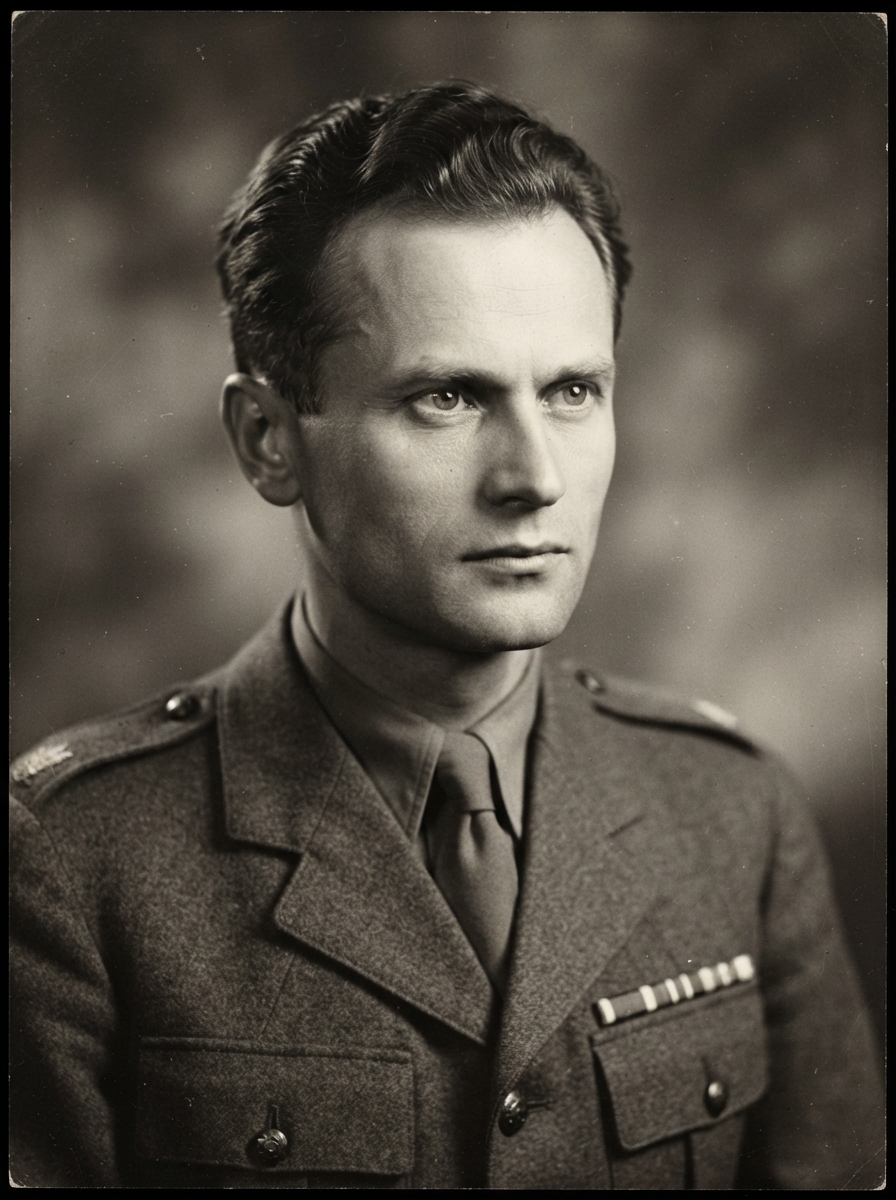
AI-assisted Portrait of Witold Pilecki
The Man Who Walked Into the Roundup on Purpose
On the morning of 19 September 1940, a German cordon closed on the Żoliborz district of Warsaw and swept up some two thousand men off the street. Among them was a thirty-nine-year-old cavalry officer carrying identity papers in the name of Tomasz Serafiński. He had walked into the cordon deliberately. Three days later he arrived at Auschwitz, was tattooed with the number 4859, and began the assignment he had proposed to his own underground command: find out what the Germans are actually doing in that camp, organize the prisoners, and report.
Witold Pilecki was born in 1901 in Olonets, in Russian Karelia, to a Polish family exiled after the January Uprising — a man raised inside a family memory of occupation and resistance. He fought the Bolsheviks as a teenager in 1919–20, farmed an estate at Sukurcze between the wars, painted competently, raised two children, commanded a cavalry unit in September 1939, and helped found the Secret Polish Army when the fighting ended. Nothing in that biography is exotic. It is the résumé of a conventional, orderly, dutiful Polish landowner-officer. That is precisely the point.
He spent nearly three years inside Auschwitz building a clandestine organization, the Związek Organizacji Wojskowej, cell by cell across the camp — placing his men in the hospital, the kitchens, the storerooms, the labor details, the office that kept the records. He fed reports out through escapees, laundry, and released prisoners. Those reports contained, as early as 1941, the news that a mass-extermination facility was operating at Oświęcim. The Allied governments received them. Almost nobody acted, and a good many did not believe them.
Pilecki is the extreme case of an ISTJ at war: dominant Si turned into a three-year act of eyewitness record-keeping inside the worst place on earth, because someone had to have the accurate figures.
The Witness as Instrument
Dominant introverted Sensing is a memory that stores the concrete world in exhaustive, verifiable detail and then measures everything against it. In ordinary lives it makes reliable men and dull dinner companions. Placed inside Auschwitz, it made Pilecki into an instrument no camera could have replaced. He counted. He dated. He recorded the introduction of Zyklon B in the autumn of 1941 and the first gassings of Soviet prisoners; he tracked the shift from a camp that killed Poles by labor and beating to an apparatus built to kill Jews on arrival at industrial scale; he registered the arrival of transports, the ratio of those selected, the construction at Birkenau. His reports are full of numbers because numbers were the only thing that would survive being disbelieved.
The same faculty is what let him survive at all. Si is expert at learning the texture of an environment — its rules, its rhythms, the exact tolerances of what a guard will overlook. Pilecki learned Auschwitz the way a man learns a machine he must operate without instruction: which kapo could be approached, which work detail killed you in a week and which one kept you alive, when a shift changed, where a body could go unnoticed. He caught pneumonia and typhus and came out the other side; he watched the men around him die in the thousands and kept filing.
And behind all of it sat the deeper Si engine: continuity with the past as an obligation. He came from a family that had lost its lands for a failed uprising and had gone on transmitting the memory of it anyway. Pilecki's instinct in catastrophe was not to escape it or to theorize it but to get it written down accurately, because a thing recorded is a thing that persists after the witnesses are killed. His entire war is one very long act of testimony.
Building an Army Inside the Camp
Auxiliary extraverted Thinking turned the observation into an organization. Within weeks of arrival Pilecki began recruiting in fives — small cells that did not know one another, each with its own commander, so that no interrogation could unravel the whole. He built it along military lines because he was a military officer and because a structure is what makes an underground survive its own casualties. By 1942 the network reached across the camp: men in the hospital who could falsify a diagnosis and keep a comrade off a death list, men in the storerooms who could divert food and clothing, men in the office who could alter records, men in the Bauleitung who knew what was being built and why.
Te also shows in what he did with the intelligence: he processed it into actionable proposals and pushed them up the chain. The reports smuggled out from 1941 onward — via escapees and released prisoners, ultimately reaching the Home Army in Warsaw and the Polish government-in-exile in London, and from there the British and Americans — did not merely describe atrocities. They argued a case. Pilecki proposed that the Home Army attack the camp from outside while his organization rose within, or failing that that the Allies bomb it, or at minimum airdrop weapons. He was told, repeatedly, that it could not be done. He kept submitting the plan.
In April 1943, having concluded that the rising would never be authorized and that his organization was being broken by transfers and executions, he made the decision himself: he arranged a night shift at the camp bakery outside the wire, forced the door, cut the phone line, and walked out with two others. It took days on foot to reach safety. He then wrote the long version of his findings, the document now called Witold's Report — one of the earliest comprehensive accounts of the Holocaust produced by anyone. He fought in the Warsaw Uprising in 1944 and held a barricaded strongpoint the insurgents called the Great Bastion. He finished the war in a German POW camp and joined the Polish II Corps in Italy.
The Private Reason He Never Explained
Tertiary introverted Feeling in an ISTJ is the quiet, unshowy core that decides what the duty is for — rarely spoken aloud, never negotiable. Pilecki volunteered for Auschwitz. No superior ordered it; he proposed it, and the proposal was accepted with the frankness that it was near-certain death. He left a wife and two small children to do it, told them nothing, and in his report offered almost no explanation of his motives beyond the fact that the work needed doing. There is no rhetoric anywhere in his writing about heroism.
What the Fi does produce is a persistent, almost unbearable attention to individuals. The report is not an abstraction; it is full of named men, their trades, how they died, who behaved well and who did not. He records his own failures of nerve and his shame at them. He describes helping a man and describes the men he could not help, and he does not let himself off. This is the moral register that the machinery of the camp was designed to abolish — the insistence that each number had been a person with a name and that the names go in the file.
It also explains what he did after the war, which by any prudent calculation was insane. Poland in 1945 was a Soviet client state; Pilecki, an officer of the London-loyal underground and a former inmate whose report indicted everyone, could have stayed in Italy. Instead he returned in December 1945 under a false name to gather intelligence on the communist takeover for the Polish government in exile — reporting on the security services, the show trials, the murder of Home Army veterans. He was ordered out in 1947 and refused to leave. He had accepted an assignment. He did not consider it finished.
The One Thing He Could Not Imagine
Inferior extraverted Intuition is a failure of alternative scenarios — an inability to model the world as it might unaccountably be, rather than as the evidence says it is. Pilecki's blind spot was not the camp; it was everyone outside it. He operated for three years on the working assumption that accurate information, delivered to legitimate authority, produces action. It is the most reasonable assumption a Si-Te mind can make, and in this case it was wrong in a way he seems never to have anticipated: London read the reports and largely could not process them, the Allies declined to bomb the camp, and no rising came.
He made the same error twice. Returning to Poland in 1945 to report on the communist regime, he behaved as though the truth would eventually matter to someone with the power to use it. He was arrested by the Ministry of Public Security in May 1947, held in Mokotów prison, and tortured over months so severely that he told his wife the camp had been, by comparison, easy. At the show trial in March 1948 he was convicted of espionage for a foreign government, and on 25 May 1948 he was shot in the back of the head in the prison courtyard. His grave has never been positively identified.
Where the inferior function surfaced usefully, it surfaced as the one wild, counterintuitive idea of his life — the notion that the way to learn what Auschwitz was would be to become a prisoner in it. That is a genuinely Ne inversion of the problem, and he had exactly one of them. Everything after it was Si and Te executing the plan with total rigor for three years. Inferior functions work like that: once, brilliantly, and then never again on demand.
Why ISTJ Over ISTP
Why not ISTP?
The ISTP case rests on the audacity: a man who walked into a roundup, survived by reading a lethal environment, and eventually broke out through a bakery door at night looks like a tactician operating on nerve. But the audacity was a single decision, and what followed it was the opposite of moment-to-moment improvisation — nearly three years of patient organizational construction, cells of five with compartmented command, placed agents in the hospital and storerooms and records office, and a reporting cadence maintained under conditions designed to destroy every form of continuity. Ti-Se solves the problem in front of it and moves on; Pilecki was executing a long-range brief he had accepted before he arrived, and he kept executing it after his network was gutted and after London had made clear that no relief was coming. His escape was not a tactical impulse either — it was a considered judgment that the intelligence had outgrown what could be smuggled out, followed by a written report. He kept filing right up to the trial that killed him.
The ISTJ verdict is also the only reading that makes his death legible. A tactical type would have stayed in Italy in 1946; the mission was over, the war was won, the risk was pointless. Pilecki went back because an assignment had not been formally closed and because he believed the record needed to be kept for whatever Poland eventually emerged. That is Si-Te fidelity carried past the point where it serves the man who holds it — the same fidelity that had already carried him through the gate at Auschwitz, and the same one that put him in a cell in Mokotów writing accurate accounts for interrogators who wanted none.
Connected Figures
Further Reading
- The Volunteer: One Man, an Underground Army, and the Secret Mission to Destroy Auschwitz — Jack FairweatherThe Costa-winning biography, built on Polish archives and family papers — the fullest reconstruction of the camp network and the fate of the reports.
- The Auschwitz Volunteer: Beyond Bravery (Witold's Report) — Witold PileckiHis own 1945 account, translated into English in 2012 — a primary document of the camp written by a trained observer who chose to be there.
- Auschwitz: A New History — Laurence ReesPlaces Pilecki's reports in the wider record of what the Allies knew, when they knew it, and why nothing followed.
- The Polish Underground State: A Guide to the Underground, 1939–1945 — Stefan KorbońskiThe organizational world Pilecki came from and reported to — the Home Army, its couriers, and its channel to the government in exile.
