 Historical Figure MBTI
#1017 · 7-28-26 · The Second World War
Anne Frank
The Diary of a Young Girl · Voice From the Annex · Hope Against the Evidence
1929 — 1945
10 min read
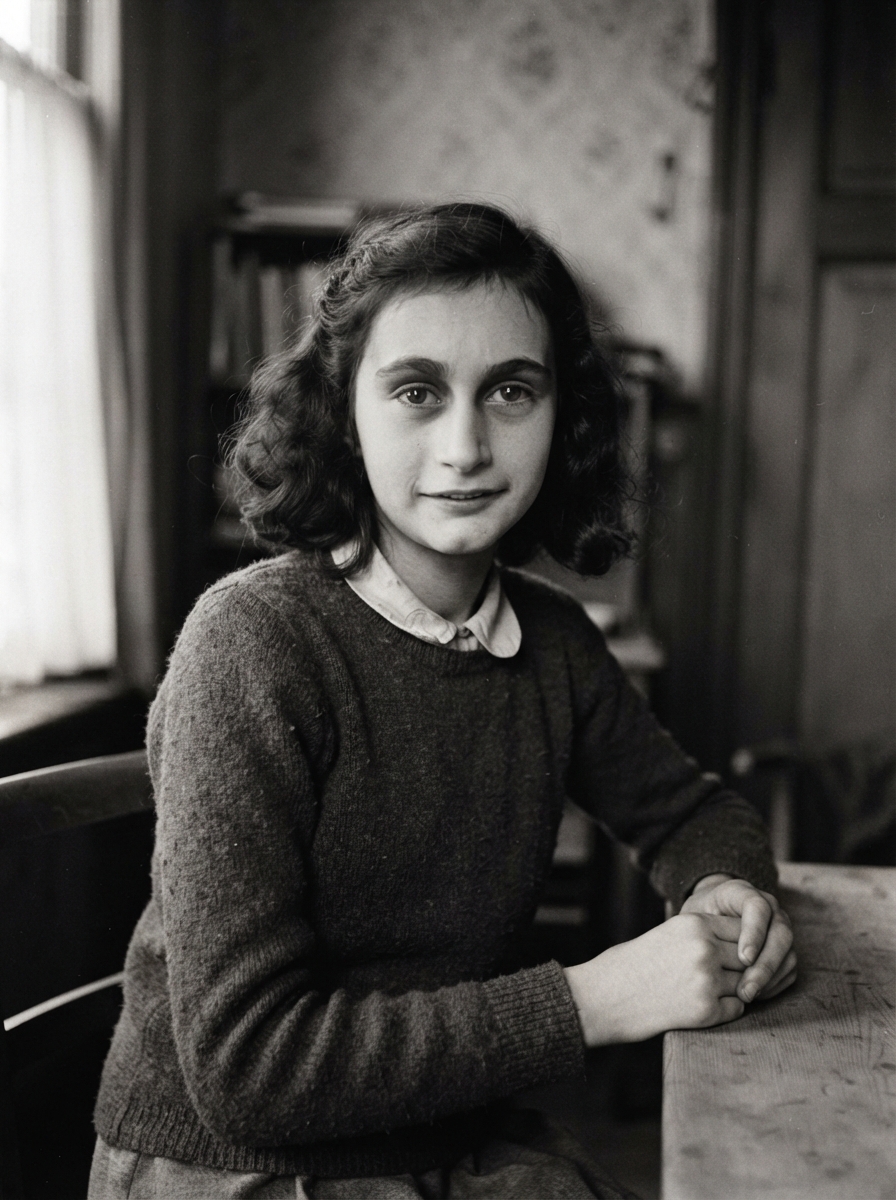
AI-assisted Portrait of Anne Frank
The Only Historical Figure Who Handed Us Her Own Interior
Almost every typing in this archive is an inference. We read what someone did, what they wrote for other people, what their enemies said about them, and we reason backwards toward a mind. Anne Frank is the exception. For twenty-five months she wrote, privately and at length, with no audience but a notebook she addressed as a friend, about exactly the thing a type is made of: what she valued, what she could not stand, who she was becoming, and how far the person she showed the world stood from the person she believed herself to be. The primary source for her psychology is not a battlefield report or a state paper. It is her own running commentary on her own inner life, kept up daily while the world outside was organising her death.
She was born in Frankfurt in 1929 and taken to Amsterdam in 1933, when her family joined the emigration out of a Germany that had just made Jews foreigners in their own country. The Netherlands held for seven years and then did not. In July 1942 the Franks moved into a concealed set of rooms behind a hinged bookcase above Otto Frank’s business on the Prinsengracht, joined by four others, and stayed there for two years and a month, dependent on a handful of employees who brought them food and news at risk of their own lives. In August 1944 they were betrayed and arrested. Anne died of typhus in Bergen-Belsen in early 1945, at fifteen, weeks before the camp was liberated. Otto, the only one of the eight to survive, published the diary in 1947.
What makes the book endure is not that it records the hiding. Very little happens in it. What makes it endure is that a girl locked in four rooms produced one of the most sustained pieces of self-examination in modern literature — quarrelling with her mother on the page, dissecting her own vanity, revising her judgements a month later, insisting on a self that the outside world had already classified as disposable. That is an INFP at work, under conditions that would have flattened the function in most people.
An INFP whose dominant Fi turned confinement into the most thoroughly documented interior life of the twentieth century — a self built and defended on paper against a world that had voted it out of existence.
The Self as the Subject Under Study
Dominant introverted feeling is not sentiment; it is a private, continuously maintained register of what matters and what is beneath one, consulted before any external standard. Anne’s diary is that register written out. She judges the seven other people in the annex against her own convictions rather than against convention — Mrs van Pels for smallness, Dussel for pettiness, her mother, repeatedly and cruelly, for a warmth Anne felt was performed rather than felt. Then she goes back over the judgements. The famous passages where she calls her own earlier entries unfair, and lets both versions stand, are the mechanism showing itself: measuring even her own verdicts against an internal standard she will not let herself off.
The same function produced her most-quoted line and the reason it is so often misread. “In spite of everything, I still believe that people are truly good at heart” was written in July 1944, three weeks before the arrest, by a girl who knew perfectly well what was happening to Jews in the east — the annex listened to the BBC, and she recorded what she heard. It is not innocence and it is not denial. Read the whole passage and she says plainly that she sees the world being turned into a wilderness, that she hears the approaching thunder that will destroy them too. The belief is held anyway. That is the signature move of dominant Fi: a value is not a conclusion drawn from evidence, so contrary evidence does not retire it. She holds the position because it is hers.
It also explains the second diary. In spring 1944 she heard a broadcast from the exiled Dutch government asking people to preserve wartime documents, and began rewriting her own entries into a version for publication — editing herself, cutting, renaming the household. Even the turn outward was routed through the private self first: she did not start a new public document, she went back and revised the interior record until it was true enough to show.
Range in a Room With the Curtains Nailed Shut
Auxiliary extraverted intuition should have been the first casualty of the annex. Ne feeds on new input, and Anne’s input for two years was seven other people, a bookcase, and the Westertoren bell. What she did instead was manufacture range out of nothing. She invented “Kitty” and wrote to her as a correspondent rather than keeping a log. She taught herself shorthand, French, and enough Dutch and English literature to fill a workbook of genealogies of the European royal houses. She wrote short stories and fairy tales alongside the diary. She ran hypotheticals about after — the year in Paris, the year in London, the career in journalism, the ambition, stated outright, to go on living after her death through what she wrote.
Ne also shows in the texture of her observation. She does not simply report that the adults argue; she models them, imagines their reasoning, tries out several readings of a single gesture, and frequently finds all of them plausible at once. Her account of falling for Peter van Pels is a study in that mode: over weeks she reinterprets him three or four different ways, is entirely aware she may be inventing a person out of proximity and boredom, and says so. Fifteen-year-olds are not usually able to watch themselves fall in love and narrate the mechanism at the same time.
And the humour is Ne humour — quick, associative, faintly absurd. The lavatory schedule, the potato-peeling rota, the burglary downstairs, the dentist’s visit, all rendered as comic set pieces. A diary written by a type without that function would have been a chronicle of privation. Hers is frequently, disconcertingly funny.
The Ledger of Small Things
Tertiary introverted sensing appears in the diary as an almost obsessive fidelity to detail: the exact contents of a food delivery, the precise sequence of who used which room at which hour, the weight lost, the ration of butter, the day the beans spilled down the stairs. This is the function most responsible for the diary’s value as a historical document. Anne was not trying to record the Holocaust; she was recording her days with a fussiness about particulars that happened to preserve, in fine grain, how eight people actually lived inside an occupied city’s hiding place.
Si also drives the diary’s ache for the past — the bicycle, the ice-cream shop, the classroom she was thrown out of, the friends she names and re-names, the world before 1942 remembered in specific sensory pieces rather than general nostalgia. Tertiary Si tends to idealise; hers does, and she catches it doing so, noting that the girl who was popular at the Jewish Lyceum is a person she is no longer certain she likes.
Then there is the physical grip of the notebooks themselves. The red-and-white checked autograph album given for her thirteenth birthday, the exercise books she moved to when it filled, the loose sheets of the rewrite: she kept them, guarded them, and was, by the accounts of the helpers, more anxious about the diary than about almost anything else in the annex. Miep Gies found the pages scattered on the floor after the arrest and put them in a drawer unread.
The Machinery She Could Not Reach
Inferior extraverted thinking is the weakest position in the stack, and in Anne’s case it was also the function the situation demanded and denied. Everything that determined whether she lived — the ration coupons, the false papers, the supply chain, the shipping lists, the bureaucratic apparatus of Adolf Eichmann’s transport office — was pure external system. She had no access to any of it. The organising was done by the helpers, and the organising against her was done by men who never saw her.
Where inferior Te does surface, it is in the strained, slightly grandiose planning voice of the late entries: the schedules she set for her own study, the resolutions to be more efficient, the sudden hard-edged pronouncements about what she would do with her life, delivered with the brittle over-certainty that marks a fourth function in use. She was aware of the strain. She writes about wanting to be taken seriously as competent, about being treated as the family lightweight while her sister Margot was the reliable one, and about the gap between the girl who talked too much and the one who wanted to be, in her own word, useful.
The revision project of 1944 is the closest she came to operating that function well: a deadline, a structure, an intended reader, a plan for a book. She had rewritten roughly two thirds of the diary when the Gestapo came up the stairs on 4 August 1944.
Why INFP Over INFJ
Why not INFJ?
The INFJ reading is tempting because of the moral seriousness and the eventual public reach of the book, but the reach was posthumous and her father’s doing. The writing itself is self-referential rather than audience-directed: she is working out her own feelings, her own relationships, and her own sense of self, on the page, for herself. An INFJ’s auxiliary Fe would show as a drive to harmonise the eight-person household, to manage the friction between the Franks and the van Pelses, to persuade. Anne does the opposite — she sharpens the disagreements in private, records exactly how little she thinks of several of the people she is trapped with, and treats her own inner consistency as the thing worth defending. Nor does she reason toward a single converging insight the way dominant Ni does; she opens possibilities, holds several readings at once, and lets contradictory versions of herself stand side by side.
This is, frankly, the least contested typing in the batch. Almost every judgement made about a historical figure is a reconstruction from behaviour, and reconstructions are where typing goes wrong. Here the evidence is direct, voluminous, and unperformed for the first two years of its existence. A dominant-Fi mind narrating itself for twenty-five months with restless imaginative range and almost no external material to work with — the diary does not merely support the reading, it is the reading.
Connected Figures
Further Reading
- The Diary of a Young Girl — Anne FrankThe primary source for everything here; the Definitive Edition restores passages Otto Frank cut in 1947.
- The Diary of Anne Frank: The Revised Critical Edition — Netherlands Institute for War DocumentationPrints versions A, B, and C in parallel, showing her own 1944 rewrite against the original entries.
- Anne Frank Remembered — Miep Gies with Alison Leslie GoldThe helper's account of the two years of supply runs, the arrest, and finding the pages on the floor.
- Anne Frank: The Biography — Melissa MüllerThe standard life, with the Frankfurt and Amsterdam years the diary itself does not cover.
- The Hidden Life of Otto Frank — Carol Ann LeeOn the father who survived, edited, and published — the reason any of it reached a reader.
