 Historical Figure MBTI
#1018 · 7-28-26 · The Second World War
Elie Wiesel
Witness to Night · Nobel Laureate for Memory · The Duty to Testify
1928 — 2016
7 min read
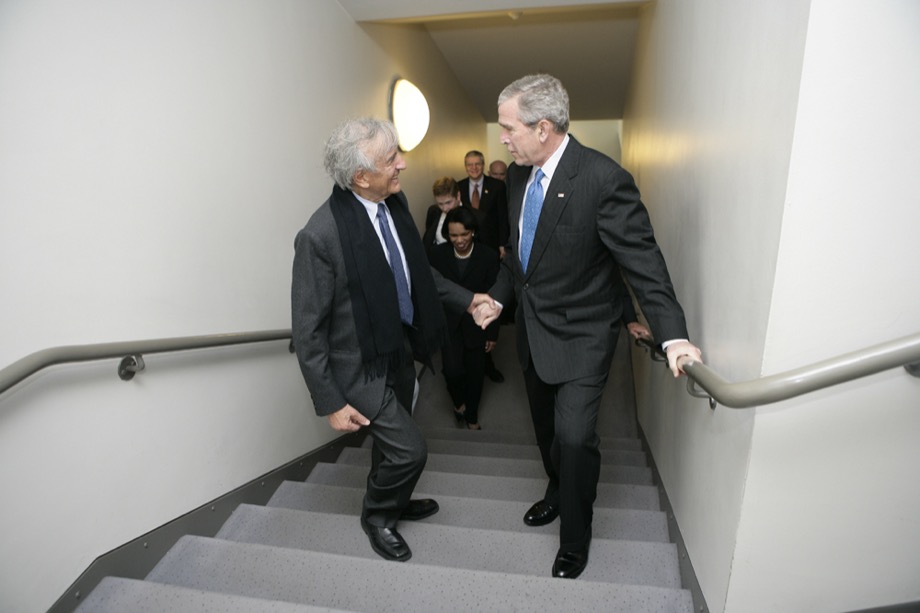
Portrait of Elie Wiesel
Ten Years of Silence, Then Fifty of Refusing to Be Quiet
He was fifteen when the trains came for Sighet. The Jews of that Transylvanian town — Hungarian since 1940, and until the spring of 1944 largely untouched — were ghettoised in April and deported in May, at the end of the war, when the machinery had already killed most of the people it would ever kill and had almost run out of time. Wiesel arrived at Auschwitz-Birkenau with his father, mother, and three sisters. His mother and youngest sister were selected and killed the same night. He and his father were marched to Buchenwald in January 1945; his father died there in late January, of dysentery and beating and exhaustion, some weeks before the Americans arrived in April.
He then said nothing about any of it for ten years. The silence was a vow, deliberate and explicit: he did not trust himself, or the language, to handle the material yet. When he broke it, the result was an 800-page Yiddish manuscript, cut to a 127-page French text and published in 1958 as La Nuit. The English Night followed in 1960, sold poorly for a decade, and then became one of the most widely read books of the century. He spent the remaining fifty-six years of his life converting that private catastrophe into public architecture: institutions, commissions, museums, lectures, campaigns, and the 1986 Nobel Peace Prize awarded to him as a “messenger to mankind.”
The pattern — long interior gestation, then a single unwavering line pursued outward for decades, aimed at changing what the world would feel and remember — is a INFJ pattern almost to the point of caricature.
An INFJ whose dominant Ni took ten years to convert Auschwitz into a single governing conviction, and then spent half a century building the institutions to enforce it on the world’s memory.
The Decade Underground
Dominant introverted intuition works by withholding. It refuses the first available account of an experience, sits with the material unresolved, and produces — eventually, and usually all at once — a single compressed reading that then governs everything after. Wiesel’s ten-year vow is the clearest documented instance of that process in this archive. He was a journalist in Paris and Tel Aviv through those years, perfectly capable of writing about the camps, and chose not to. The reason he gave was that he was waiting for the words to be adequate, which is Ni describing itself: the conviction that a premature articulation would be worse than none.
What came out was not a chronicle. Night is compressed to the point of severity — no dates for long stretches, no statistics, the whole thing organised around a handful of images that carry the argument: the flames, the hanging of the child, the son who outruns his father in the snow. He cut an 800-page manuscript to a seventh of its length because the meaning, once found, did not need the material. That is a distillation instinct, not a documentary one.
The single conviction the decade produced was that indifference, not hatred, is the enabling condition — that the opposite of love is not hate but apathy, and that the moral duty of a survivor is therefore not merely to grieve but to interrupt other people’s comfort. Every public act of his life after 1958 follows from that one line. Ni does not generate many theses. It generates one, and then holds it for fifty years.
Making the World Feel It
Auxiliary extraverted feeling is what turned a memoir into a mission. Wiesel did not stay a writer; he became an organiser of collective conscience. He chaired the President’s Commission on the Holocaust from 1978 and shaped what became the United States Holocaust Memorial Museum; he founded the Elie Wiesel Foundation for Humanity; he taught at Boston University for nearly forty years; he spoke and lobbied on Soviet Jewry, Cambodia, Bosnia, Rwanda, Darfur, and Argentina’s disappeared. The recurring form is the same — locate a public that is not feeling something it should, and apply pressure to it directly.
The Bitburg episode in 1985 is the sharpest example. Reagan had agreed to lay a wreath at a German military cemetery that held the graves of forty-nine Waffen-SS men. Wiesel, standing in the White House to receive the Congressional Gold Medal from Reagan’s own hands, said to his host’s face that that place was not his place, that his place was with the victims of the SS. He did it in public, in the president’s house, at a ceremony designed to honour him. Dominant-Ti types do not stage moments like that; they write a letter. This was Fe used as an instrument — the calculated deployment of a shared moral emotion at the exact point of maximum audience.
Fe also explains the register of the prose. Where the analytic survivor writes to be understood, Wiesel writes to be felt — cadenced, liturgical, borrowing the rhythms of the Hasidic storytelling he grew up inside. He wanted a response, and built the sentences to produce one.
The Argument With God
Tertiary introverted thinking shows in Wiesel as a persistent, unresolved theological logic. He had been a devout boy studying Talmud and Kabbalah in Sighet, and he never abandoned the framework — but he spent his life prosecuting it from the inside. His recurring device is the trial: God in the dock, the covenant treated as a contract with terms, the survivor as plaintiff. In The Trial of God he dramatises a rabbinical court convened to try the Almighty for the murder of his people, which ends with the judges finding the defendant guilty and then rising to pray.
That structure is Ti in a supporting role: rigorous enough to insist the contradiction is real and cannot be smoothed away, but subordinate to a value commitment that will not follow the argument to its exit. He would not become an atheist and he would not stop indicting. He held both, deliberately, and said so.
The Body That Would Not Be Written About
Inferior extraverted sensing surfaces in the way Night handles physical fact. The book is astonishingly sparse on the sensory particulars a documentary account would foreground — little on the food, the barracks routine, the work, the geography. When the body does appear it appears as shock: the mirror in the final line, in which he sees a corpse looking back at him. The physical world is not a field he inhabits comfortably; it arrives as an intrusion that overturns the interior one.
The pattern held afterward. He was a professor and a lecturer, a man of rooms and platforms, whose engagement with the physical world stayed thin. Where Primo Levi returned to a laboratory and worked with his hands for thirty years, Wiesel worked almost entirely in speech.
Why INFJ Over INFP
Why not INFP?
The INFP case rests on the interiority of Night and the decade of silence, and both are real — but look at what he did with the material once he had it. He did not stay in private expression. He built a commission, a museum, a foundation, a professorship, and a fifty-year campaign of speeches aimed at moving publics and pressuring governments. Dominant Fi defends the integrity of a personal value; auxiliary Fe organises other people around a shared one, and Wiesel spent his life doing the second — most visibly when he stood in the White House and told the President of the United States, in front of cameras, that Bitburg was not his place. That is not a private conviction being protected. It is a public conscience being managed.
The distinction matters for reading the triptych. Wiesel and Anne Frank are often placed together as the two great personal voices of the Holocaust, but their instruments are opposite. She wrote for herself and was published by someone else after her death; he wrote for the world and spent a lifetime making sure it listened. Same catastrophe, same literary stature, entirely different orientation of the feeling function.
Connected Figures
Further Reading
- Night — Elie WieselThe 1958 memoir, cut from an 800-page Yiddish manuscript; the primary source for everything here.
- All Rivers Run to the Sea — Elie WieselThe first volume of memoirs, covering Sighet, the camps, the decade of silence, and the writing of Night.
- Nobel Peace Prize Lecture, 1986 — Elie WieselThe clearest statement of the thesis: that neutrality helps the oppressor and memory is an obligation.
- The Trial of God — Elie WieselThe play in which a rabbinical court convicts the Almighty and then rises to pray — his theology in dramatic form.
- Elie Wiesel: Confronting the Silence — Joseph BergerA biographical account of the public career, the institutions, and the controversies.
