 Historical Figure MBTI
#1009 · 7-26-26 · The Second World War
Adolf Eichmann
The Bureaucrat of Genocide · Architect of Deportation · The Banality of Evil
1906 — 1962
9 min read
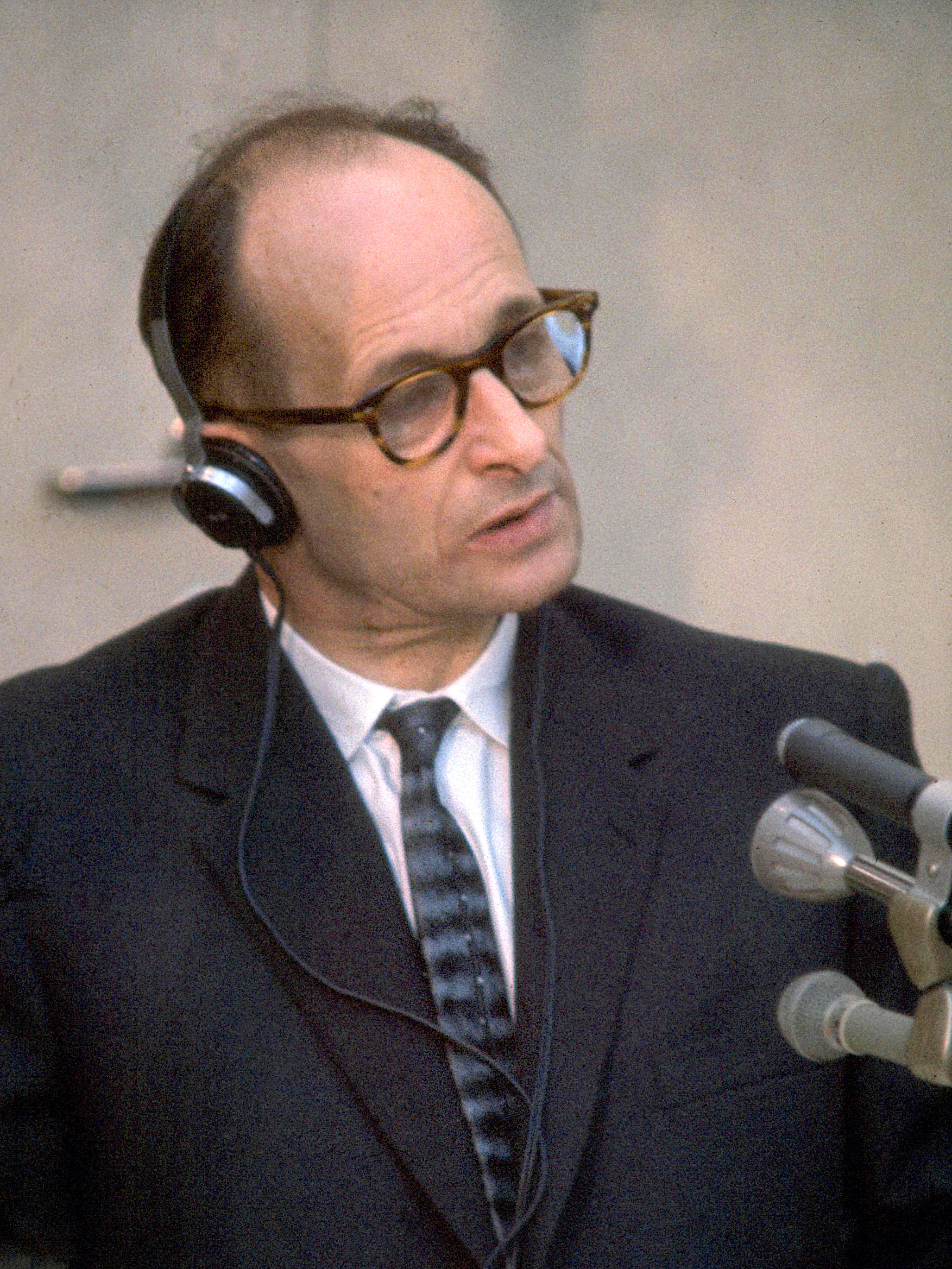
Portrait of Adolf Eichmann
The Man Who Ran the Timetables
Adolf Eichmann organized the deportation of millions of Jews from across Nazi-occupied Europe to ghettos, killing fields, and death camps. As head of Section IV B4 of the Reich Security Main Office — the Gestapo’s “Jewish desk” — he was the logistical architect of the Holocaust: the man who negotiated with railway ministries for rolling stock, who calculated how many human beings could be loaded into a freight car, who set quotas and chased them, who pushed the Hungarian deportations of 1944 at a rate of roughly twelve thousand people a day toward Auschwitz. He did not invent the extermination policy. He made it run on schedule.
He was present at the Wannsee Conference in January 1942, where the coordination of the “final solution to the Jewish question” across the German state apparatus was settled among officials over a working lunch; Eichmann took the minutes. The crimes he administered are not in dispute and were never seriously contested by him. What was contested — furiously, and for decades afterward — was what kind of man does this. The answer that emerged from his capture and trial was more disturbing than the one the world had prepared for.
Israeli Mossad agents seized him from a street in Buenos Aires in May 1960, after more than a decade living under a false name as a factory worker in Argentina. He was tried in Jerusalem in 1961 for crimes against humanity and against the Jewish people, convicted, and hanged in 1962 — the only civil execution ever carried out in the State of Israel. Sitting behind bulletproof glass in that courtroom, he did not perform the part of a demon. He complained about rank, insisted he had merely followed orders, spoke in worn official phrases, and corrected small procedural details with something close to professional pride. Hannah Arendt, covering the trial, found him not monstrous but appallingly ordinary — a functionary who had never once thought his way past his own paperwork.
Eichmann is the archive’s starkest ISTJ: a dominant-Si administrator who committed genocide the way another man commits to a filing system — by memorizing the procedure, optimizing the throughput, and never asking what was inside the crates.
The Procedure Was the Whole World
Introverted Sensing lives inside stored detail: precedent, routine, the remembered right way of doing a thing. In Eichmann it produced a mind that was encyclopedic about method and blank about meaning. He learned scraps of Hebrew and Yiddish, memorized the internal structures of Jewish community organizations, mastered the emigration paperwork he had first run in Vienna in 1938, and carried the whole apparatus in his head — transit routes, camp capacities, the difference between what the Reichsbahn would grant and what the Wehrmacht would concede. When postwar interrogators pushed him on ideology, he was vague. When they pushed him on train schedules, he was precise.
His authority came from that stored specificity. Other men in the SS held higher rank; Eichmann held the files. Because he alone knew the working detail of how deportation actually functioned — which local police could be relied on, which foreign ministry would object, how many days a convoy needed — he became indispensable to superiors who wanted results without the mechanics. Si turns accumulated procedure into power, and in a bureaucratic state that power is enormous.
It also insulated him. A man whose reality is the procedure experiences a violation of the procedure as the moral event, and the content of the procedure as a given. Eichmann was genuinely agitated by irregularities in his lane — an unauthorized transport, a missed quota, a colleague trespassing on his jurisdiction — and unmoved by the destination of the trains. That is not an excuse; it is the mechanism. Si supplied him with an inexhaustible sense of doing the job correctly, and correctness was allowed to substitute for conscience.
Efficiency as a Substitute for Thought
Extraverted Thinking measures the world in outputs, and Eichmann measured his in people moved per unit of time. His Vienna office in 1938 was celebrated inside the SS as an assembly line for forced emigration — a Jew entered with property and citizenship and left with an exit stamp and nothing else, in a single day. He was proud of that design. When policy shifted from expulsion to extermination, he applied the same optimization instinct to the new objective without visible friction: the metric changed, the method of thinking did not.
The Hungarian operation in 1944 is the clearest exhibit. With the war visibly lost and the German rail network under Allied bombardment, Eichmann arrived in Budapest with a small staff and, in under two months, organized the deportation of some four hundred thousand people. He negotiated, requisitioned, improvised, and delivered. Te does not require belief; it requires a target. Eichmann pursued his with the energy other men reserve for causes.
This is why the “just following orders” defense he offered in Jerusalem collapsed under examination and yet still described something real about him. He was not a passive conduit — he took initiative, expanded his remit, and pushed transports through resistance from other agencies. But the initiative was always in service of a goal handed down from above. Te executed magnificently within a frame it never questioned, and the frame was mass murder.
A Private Morality Made of Career
Tertiary Introverted Feeling in a man like this does not produce empathy; it produces a small, jealously guarded inner ledger of self-regard. Eichmann’s recorded distress is almost entirely about himself: that he was never promoted past Obersturmbannführer, that colleagues took credit for his work, that he was misunderstood, that he had been decent in his personal dealings. He told his Jerusalem interrogators that he had no hatred of Jews and had once been reprimanded for a Jewish acquaintance — offered as though it were exculpatory, in a life spent scheduling their annihilation.
He claimed, absurdly, to have lived by Kant’s categorical imperative, and when pressed produced a mangled version of it in which duty meant aligning one’s will with the will of the Führer. That is Fi in its most degraded form: an inward conviction of personal integrity that has taken its content entirely from outside, and then defends it with real feeling. He felt like a moral man. The feeling was attached to obedience rather than to anything he had actually examined.
Bettina Stangneth’s work on the Argentine tapes complicates the picture in an important way: in exile among fellow fugitives, Eichmann boasted, and spoke of regretting only that the job had not been finished. The Jerusalem meekness was partly a performance. But the underlying structure holds either way — a man whose sense of self ran on loyalty, grievance, and standing within a hierarchy, and who never located a value in himself that could stand against an order.
The Missing Imagination
Inferior Extraverted Intuition is the failure at the center of the case. Ne is the capacity to step outside the given frame and see alternatives — that things could be otherwise, that a rule could be refused, that the person on the other side of the transaction has an interior life. Eichmann had almost none of it, and Arendt said so bluntly: his was an inability to think, which she distinguished sharply from stupidity. He was not unintelligent. He was incapable of occupying any standpoint but his own official one.
It showed in his speech. Observers at the trial noted that he could barely produce a sentence that was not an official formula or a stock phrase, and that he repeated the same clichés under wholly different questions. Language that never leaves the groove is the audible symptom of a mind that never leaves it either. He could imagine a rescheduled convoy. He could not imagine the moral universe in which the convoy was a crime.
When inferior Ne did surface, it did so as unmoored fantasy rather than perspective: the grandiose Argentine talk, the invented self-image of a man of principle, the bizarre proposals for territorial “solutions” he had once entertained. Weak Ne does not make a person harmless. It makes them available — usable by any structure that supplies the frame they cannot generate for themselves. That is the specific danger this type carries into a criminal state, and it is why Eichmann matters far beyond his own biography.
Why ISTJ Over INTJ
Why not INTJ?
An INTJ reading would require dominant Introverted Intuition — an independent vision of the future that the person then builds toward. Eichmann had no vision. He generated no policy, proposed no doctrine, and produced not a single original idea in twenty years inside the apparatus; the extermination program was conceived above him and handed down. He was an executor whose entire competence lay in remembered procedure and measurable output, and whose defense — sincerely felt, if legally worthless — was that the ideas were somebody else’s. Ni architects. Si and Te optimize what the architects order.
The distinction is not academic. Placing Eichmann among the visionaries would make him a strategist of genocide and, perversely, a more comfortable figure — a monster of a recognizable kind, safely unlike the rest of us. The ISTJ reading is harder to live with, because it says the machinery of the Holocaust required, at its middle levels, exactly the traits a modern organization prizes: reliability, mastery of detail, respect for the chain of command, pride in hitting the number. Eichmann supplied all four. The catastrophe was not that he malfunctioned. It was that he worked perfectly inside a system built for murder, and never once asked what the system was for.
Connected Figures
Further Reading
- Eichmann in Jerusalem: A Report on the Banality of Evil — Hannah ArendtThe 1963 book that grew from her New Yorker trial coverage, and the origin of the phrase that defines him.
- Eichmann Before Jerusalem: The Unexamined Life of a Mass Murderer — Bettina StangnethUses the Argentine Sassen tapes to show how much of the meek functionary in the glass booth was a performance.
- Becoming Eichmann: Rethinking the Life, Crimes, and Trial of a 'Desk Murderer' — David CesaraniThe fullest biography, tracking how an unremarkable young man was made into the manager of deportation.
- The Destruction of the European Jews — Raul HilbergThe foundational study of the Holocaust as an administrative process, and the best context for what Eichmann's desk actually did.
