 Historical Figure MBTI
#1023 · 7-29-26 · The Second World War
Martin Bormann
The Secretary Who Ruled the Paper · Hitler's Shadow · Vanished Into Legend
1900 — 1945
7 min read
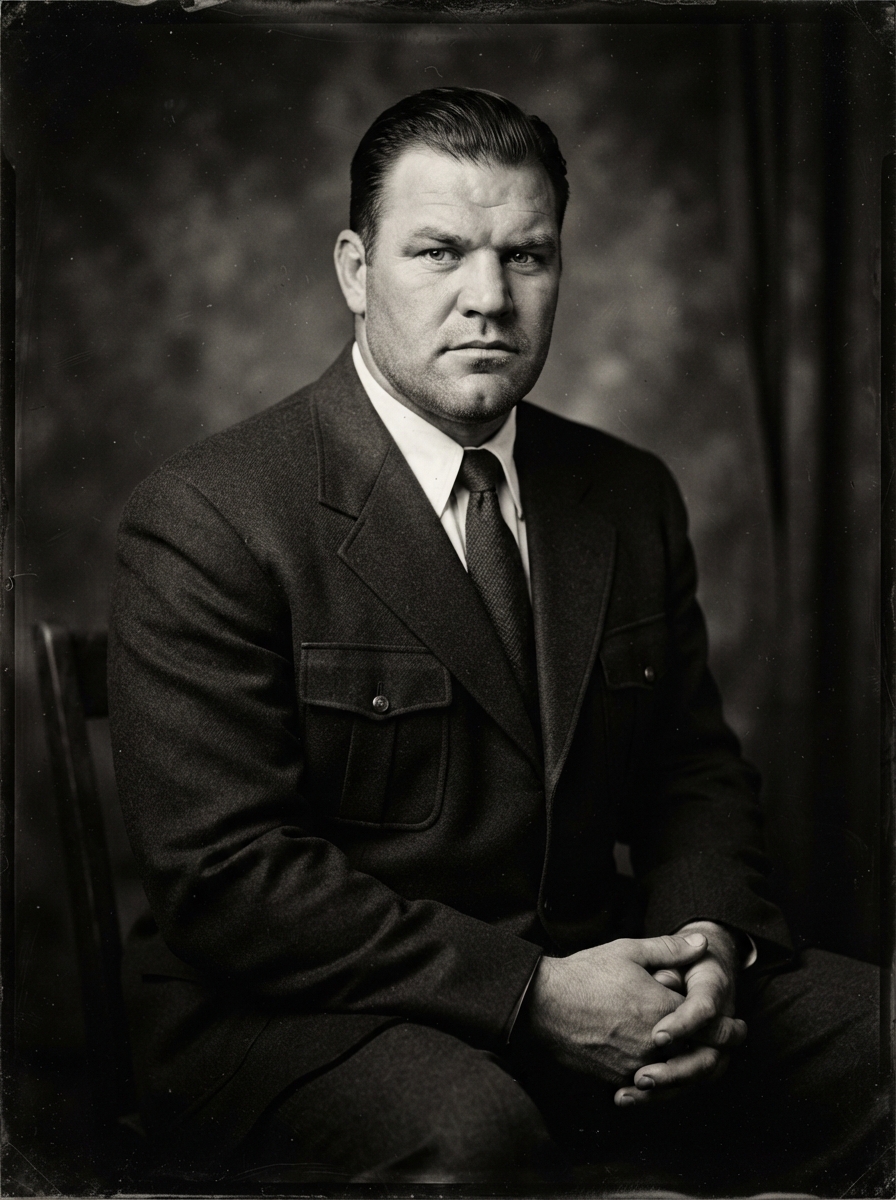
AI-assisted Portrait of Martin Bormann
The Man Who Controlled the In-Tray
Martin Bormann was head of the Nazi Party Chancellery and Adolf Hitler’s private secretary, and he was a direct, willing instrument of the regime’s crimes. He administered the confiscated property of deported and murdered Jews and enriched himself personally from it. He signed and circulated the decrees that stripped Jews of legal protection, handed the “final settlement” of the Jewish question to the SS, let the lynching of downed Allied airmen go unpunished, and authorized brutal treatment of Slavs in the occupied East. He oversaw the exploitation of slave labor in party-controlled enterprises. At Nuremberg he was tried in his absence, convicted of war crimes and crimes against humanity, and sentenced to hang. Nothing below is a mitigation. He was a mass criminal who worked through a filing system.
What sets him apart is that almost no German could have picked him out of a crowd. Hermann Göring was a celebrity, Joseph Goebbels a voice on every radio, Heinrich Himmler a face on newsreels. Bormann stood at the edge of photographs holding a folder. Born in 1900, a Freikorps thug convicted in 1924 as an accomplice in a political murder, he rose not through the street or the podium but through the party’s accounts — Party Chancellery chief in 1941, secretary to the Führer in 1943.
By 1944 virtually every document reaching Hitler’s desk passed through his hands first, and every request to see Hitler through his diary; orders issued over the Führer’s name had been drafted and quietly slanted by him. He became the second most powerful man in the Reich — without a doctrine, a following, or a public.
Bormann is the archive’s purest case of ISTJ dominant Introverted Sensing weaponized as proximity: a man who acquired absolute power by knowing every file, remembering every detail, and standing closer to the source of authority, every day, for longer, than anyone else was willing to stand.
Power Accumulated One Document at a Time
Dominant Introverted Sensing lives in retained, concrete particulars: what was said, what was signed, where the paper went. It is the faculty of the archivist and the steward, and in Bormann it was formidable. His first foothold was administering Hitler’s private finances and the Obersalzberg estate — buying up neighbors’ land parcel by parcel, handling the royalties from Mein Kampf and the industrial endowment fund he had created.
That was the foundation of everything. Knowing where the money was and which favor had been promised made him indispensable to a dictator who despised detail. Hitler kept irregular hours, refused to read long papers and governed by monologue; Bormann stayed awake for the small-hours rambling, took down the remarks, and by morning had converted them into written directives circulated as the Führer’s will — a memory-and-paperwork machine installed between one man and a state.
Si also explains his method, which was simply never to leave. Göring had Karinhall, Himmler the SS, Goebbels Berlin — every hour they spent on those empires was an hour Bormann spent in the anteroom, learning Hitler’s habits the way a steward learns a household: which mood at which hour, which visitor to announce and which to lose in the schedule. Applied here, Si’s familiarity and presence amounted to a stranglehold.
The Gatekeeper’s Arithmetic
Auxiliary Extraverted Thinking systematizes the world into offices, jurisdictions and measurable control. Bormann used it to turn a clerical role into a constitutional one. From 1941 he insisted that all party business — and anything touching party interests, which in that regime meant nearly everything — be routed through his office. He fought the ministries for competencies, won the right to be consulted on legislation and senior appointments, and issued circulars carrying the force of Hitler’s own word.
His weapon against rivals was never argument but procedure: he outlasted them at the door and ensured their proposals arrived in the framing he chose, if at all. When Rudolf Hess flew to Scotland in 1941 he inherited the Deputy Führer’s apparatus and enlarged it; when Speer tried to rationalize war production he found the Gauleiters — Bormann’s clients — obstructing him at every turn.
The same instrumental coldness runs through the crimes. His directives on the Jews, on Polish and Soviet labor, on church property read as housekeeping: categories, jurisdictions, disposal of assets, allocation of workers. The property of the murdered was an accounting entry, some of it moved into his own hands. Te without a developed feeling function needs no cruelty as a motive — only a task, an authority, and a form to file.
Loyalty as the Only Conviction
Tertiary Introverted Feeling gives an ISTJ a private, unargued core of value, held silently and defended without explanation. Bormann’s had one article: Hitler. He was no believer in Nazi ideology as a body of ideas — he wrote no theory and showed no interest in the racial mysticism Himmler adored or the aesthetic politics that animated Goebbels. What he had was an almost feudal attachment to one man’s person, and a readiness to treat anyone competing for that man’s attention as an enemy.
The one cause he pursued with feeling was the campaign against the churches — monasteries closed, clergy harassed, pressed harder than Hitler thought wise — and even that reads less as philosophy than as a jealous clearing of ground.
Undeveloped Fi shows too in a private life squalid in an orderly way: ten children with his wife Gerda, an affair with an actress, and letters proposing a household in which both women bore his children by rotation — to which Gerda, raised in the same ideology, agreed. He was crude, bullying and universally disliked; Eva Braun loathed him and called him a pig. He did not care. Tertiary Fi answers only to itself, and Bormann’s answered to the anteroom.
A Man With No Second Plan
Inferior Extraverted Intuition shows up as blindness to alternatives: the mind extrapolates the known forward but cannot picture a world organized differently. Bormann’s power was parasitic on one body remaining alive in one building. He never built an organization loyal to himself as Himmler built the SS, never cultivated the Wehrmacht, never developed a fallback. His office was a corridor, and the corridor ended at a door.
So when the door closed he had nothing. He was in the Führerbunker to the end, countersigning the political testament that named Karl Dönitz President and himself Party Minister — an office of a party that had ceased to exist, in a state that had ceased to exist. Even then the Si-Te reflex held: get the succession documented, the titles right, the paper signed. He radioed Dönitz about protocol while Berlin burned.
His end was the inferior function in its most literal form. On the night of 1–2 May 1945 he joined a breakout group trying to cross Soviet lines near the Lehrter station, followed a tank until it was hit, and died a few hundred yards from the bunker, almost certainly by his own cyanide. He had no plan for a world without Hitler because he could not imagine one.
Why ISTJ Over INTJ
Why not INTJ?
The scale of his power invites an Ni reading — the schemer with a long game — but Bormann produced no vision of his own. Introverted Intuition conceives a future and bends institutions toward it; Bormann conceived memoranda. He authored no doctrine and never tried to redirect the regime toward an end that was his rather than Hitler’s. His method was gatekeeping and the hoarding of access around an existing center of power — implementation, not invention. An INTJ would also have built an exit; Bormann built none, and died in the street outside the only building his power had ever occupied.
Set beside Himmler — the other great desk-murderer of the regime, and another ISTJ — the reading sharpens. Himmler had a creed, a crackpot racial mysticism with castles and rituals. Bormann had a doorway. Both converted paperwork into mass death, but Himmler wanted to build something and Bormann only wanted to be the one holding the folder. That is Si-Te at its most concentrated and least imaginative: the world reduced to what crosses the desk, and total authority extracted from the fact that everything did.
Connected Figures
Further Reading
- Martin Bormann — James McGovernThe first serious English-language biography, written while the manhunt was still live.
- Martin Bormann: The Man Who Manipulated Hitler — Jochen von LangThe standard study of how the Party Chancellery converted clerical control into political power.
- Trial of the Major War Criminals Before the International Military Tribunal — International Military Tribunal, NurembergThe official record of the case tried in his absence, including his own circulars entered as evidence.
- The Bormann Letters — ed. H. R. Trevor-RoperThe 1943–45 correspondence with Gerda Bormann — the private man in his own words.
- Hitler, 1936–1945: Nemesis — Ian KershawPlaces Bormann precisely within the court politics of the later Reich.
- The Third Reich in Power / The Third Reich at War — Richard J. EvansAuthoritative context on party-state rivalry, plunder, and forced labor.
