 Historical Figure MBTI
#1029 · 7-31-26 · The Second World War
George F. Kennan
Author of the Long Telegram · Father of Containment · The Diplomat Who Saw It Coming
1904 — 2005
9 min read
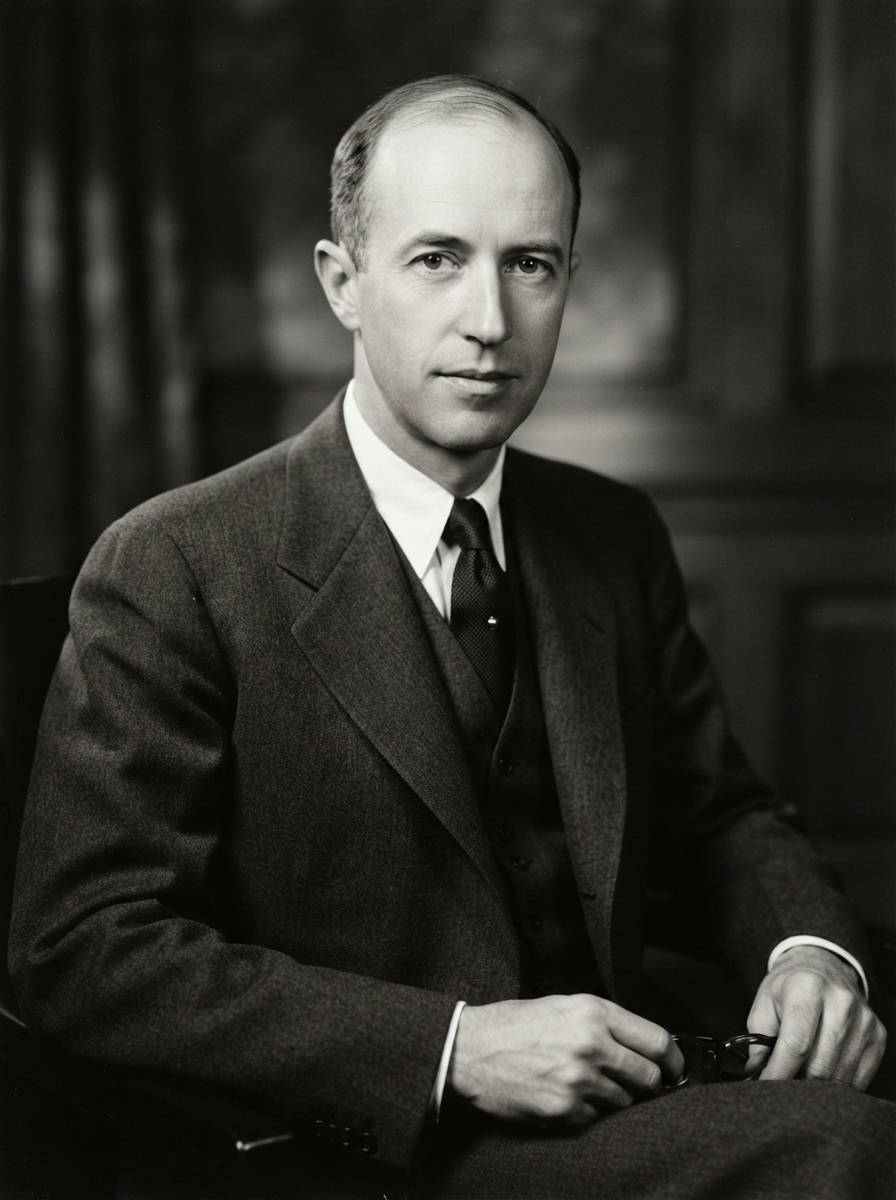
AI-assisted Portrait of George F. Kennan
Eight Thousand Words from a Sickbed
In February 1946 the second-ranking officer at the American embassy in Moscow was ill, irritable, and — by his own account — tired of being ignored. For years George Frost Kennan had sent Washington careful readings of Soviet conduct, and for years Washington had filed them somewhere between the weather reports and the trade statistics. Then the Treasury Department, baffled that Stalin's government would not join the World Bank, cabled the embassy to ask why. Kennan, propped up with fever and sinus trouble, dictated his answer in five parts. It ran to roughly eight thousand words — the longest telegram in the history of the State Department, and it set the shape of the next forty years.
What made the Long Telegram extraordinary was not that it warned of Soviet hostility — plenty of men were doing that by 1946. It was that Kennan refused to explain that hostility by grievance, misunderstanding, or the personality of a single dictator. Russian insecurity, he argued, was ancient and structural: a vast, flat, indefensible country ruled by men who had learned that unlimited authority was the only answer to unlimited exposure, and who had now acquired in Marxism a universal justification for it. The Soviet Union would press outward wherever it met no resistance — not on a schedule of conquest, but because pressing outward was what such a system did. From that diagnosis followed a prescription with the elegance of a proof: resist patiently, at every point, without war, and the thing would exhaust itself from within.
Eighteen months later the argument reappeared in Foreign Affairs, signed only "X," and the word it contained — containment — became the organizing idea of American grand strategy. Kennan was forty-three. He would spend the remaining fifty-eight years of his life arguing, with increasing bitterness, that almost everyone had misread him.
Kennan was an INTJ: a dominant Ni that saw the whole system before it could prove any part of it, and a Te that would not rest until the vision had been written down as policy.
Ni — The Shape Beneath the Events
Every diplomat in Moscow read the same newspapers and attended the same receptions. What separated Kennan was that he was never really analyzing events at all — he was analyzing the machine that produced them. He had spent the 1930s learning Russian well enough to read nineteenth-century novels for pleasure, and he treated Chekhov and Gibbon as legitimate sources on Soviet behavior, because what he wanted was not information but pattern.
This is the signature of dominant introverted intuition: the conclusion presents itself whole, and the argument is assembled afterward to carry it. The Long Telegram does not build inductively from incidents toward a cautious generalization. It opens with the structure — Soviet perception of the outside world, the sources of that perception, its projection onto official policy and then onto the unofficial "subterranean" level of front organizations, and finally what all of it means for the United States. The facts are hung on the frame; the frame came first. And it proved right in a way ordinary forecasting never is, because it predicted not moves but a disposition.
Ni also explains the most-quoted line in the X Article, the one about Soviet power carrying "within it the seeds of its own decay." In 1947 this was an extravagant claim about a state that had just crushed the Wehrmacht. Kennan was not forecasting from data. He was reading the internal logic of a system and following it to its end, and he had the temperamental confidence to publish that reading as though it were established fact. The Soviet Union dissolved in 1991. He was still alive to see it, and characteristically unsatisfied with how it had happened.
Te — Analysis Converted to Doctrine
A vision that stays in the head is a private conviction. Kennan's did not stay there. The telegram was organized like an engineering report — numbered parts, headed subsections, a closing set of practical recommendations addressed to what Washington should do on Monday morning. He had chosen his moment: Stalin's February 1946 election speech had just landed, James F. Byrnes was under pressure to define a policy, and the Treasury's dull procedural question was the opening Kennan needed to answer a much larger one nobody had asked him.
The payoff was immediate and institutional. Navy Secretary James Forrestal had the telegram reproduced and made required reading across the government, and in 1947 George Marshall installed Kennan as the first director of the State Department's Policy Planning Staff — a body created, essentially, to give one man's structural thinking a permanent bureaucratic address. From that chair he did the concrete work: a principal architect of the Marshall Plan, arguing that Western Europe's industrial recovery would hold the line better than any garrison, and pushing to rebuild strength at the handful of centers — Britain, the Rhine valley, Japan — that actually mattered.
That is the distinction worth holding onto. Kennan did not merely observe that the Soviets would probe; he specified where to stand, at what cost, with what instruments, and he fought inside the machine until the specification became policy. The Truman administration's whole postwar posture ran on his framework. Few analysts in any century have converted a private reading of the world into operational doctrine so completely, and fewer still within eighteen months of writing it down.
Fi — The Wound of Being Misunderstood
Almost as soon as containment became national policy, Kennan began to disown the version of it being practiced. He had meant political and economic counter-pressure applied at a few decisive points; what emerged was a global military commitment, an arms race, a doctrine of universal resistance stretching eventually to Vietnam. He blamed his own prose for some of it — the X Article's talk of "unalterable counter-force" had been, he later wrote, dangerously vague — but the deeper injury was that the world had taken his idea, used it wrongly, and would not give it back.
This is tertiary Fi in a man whose surface was pure cool analysis: a private, unarguable standard of what was right, held with an intensity no institution could accommodate. He left Policy Planning within three years, drifted out of the Foreign Service, and spent the rest of his life at the Institute for Advanced Study in Princeton — an insider by every credential who chose, again and again, the dissenting outsider's position. He opposed NATO's formation. He opposed the hydrogen bomb. He opposed nuclear buildup so publicly in his eighties that he became, absurdly, a hero to the disarmament movement of the 1980s.
The diaries — kept for eight decades, unsparing, frequently gloomy about America itself — show how much feeling ran beneath the analytical register. He wrote as a man who loved a country he thought vulgar, served a government he thought careless, and had been made famous by a document he wished he had written more precisely.
Se — A Stranger in the Present
Kennan was physically fragile and easily overwhelmed by the immediate. Ulcers, fevers, exhaustion, long spells of what he called nervous collapse — the Long Telegram itself was dictated from a sickbed, and the body gave out repeatedly at moments of pressure. He disliked crowds, press conferences, and the rough sensory business of politics. Ambassadorial life in Moscow, hemmed in by surveillance and cut off from the city he had spent his life studying, made him miserable within months.
Inferior Se shows most clearly in how badly he handled unscripted contact with the present tense. In 1952, waiting on a plane at Tempelhof airport in Berlin, a reporter asked him what life was like in Moscow, and Kennan — the most careful writer in American diplomacy — blurted a comparison between his confinement and his internment by the Nazis in 1941. Stalin's government expelled him within days. A career built on penetrating the Soviet mind was ended by a single unguarded sentence spoken aloud, off the page, in a hurry.
The lifelong preference ran the other way: toward the farmhouse in Pennsylvania, the archive, the long historical volume written slowly. He produced a two-volume study of Soviet-American relations that won both a Pulitzer and a National Book Award, and lived to 101 — an intuitive happiest at the greatest possible remove from the room he was actually in.
Why INTJ Over INTP
Why not INTP?
The scholarly temperament, the fifty years at Princeton, and the taste for revising his own conclusions all point toward INTP — but the shape of Kennan's thinking is wrong for it. He did not open questions; he closed them. The Long Telegram is not an exploration of possible Soviet motives but a single unified explanation delivered with total confidence, and its author then spent three years inside the State Department turning it into budget lines, staffing decisions, and the Marshall Plan. An INTP's Ti would have kept refining the model for its own coherence; Kennan's Te wanted the model implemented, and pushed until it was. Even his later dissent was not open-ended doubt — it was the same fixed vision, insisting that the world had executed it incorrectly.
The distinction matters because Kennan is so often filed as an intellectual who wandered into government by accident. He did not. He engineered his own influence: he chose the moment, wrote to the audience, took the institutional post when it was offered, and used it to build the machinery Europe was rebuilt with. That the doctrine outgrew him is the standard fate of an INTJ's framework once it leaves his hands. The vision was singular and total; its implementation was never going to be.
Connected Figures
Further Reading
- Memoirs, 1925–1950 — George F. KennanHis own account of the Moscow years and the telegram — the primary source for how he understood himself.
- George F. Kennan: An American Life — John Lewis GaddisThe authorized biography, thirty years in the making; Pulitzer Prize, 2012.
- The Long Telegram (Moscow Embassy Cable 511, 22 February 1946) — George F. KennanThe document itself — five numbered parts, declassified and widely reprinted.
- The Sources of Soviet Conduct — "X" (George F. Kennan), Foreign Affairs, July 1947The anonymous article that gave containment its name and its most-quoted phrases.
- American Diplomacy, 1900–1950 — George F. KennanHis realist critique of moralism in US foreign policy, delivered as lectures in 1950.
- The Cold War: A New History — John Lewis GaddisPlaces containment in the arc of the whole conflict Kennan lived to see end.
