 Historical Figure MBTI
#1003 · 7-24-26 · The Second World War
Leslie Groves
The General Who Built the Bomb · Manhattan Project Director · Logistics as Destiny
1896 — 1970
7 min read
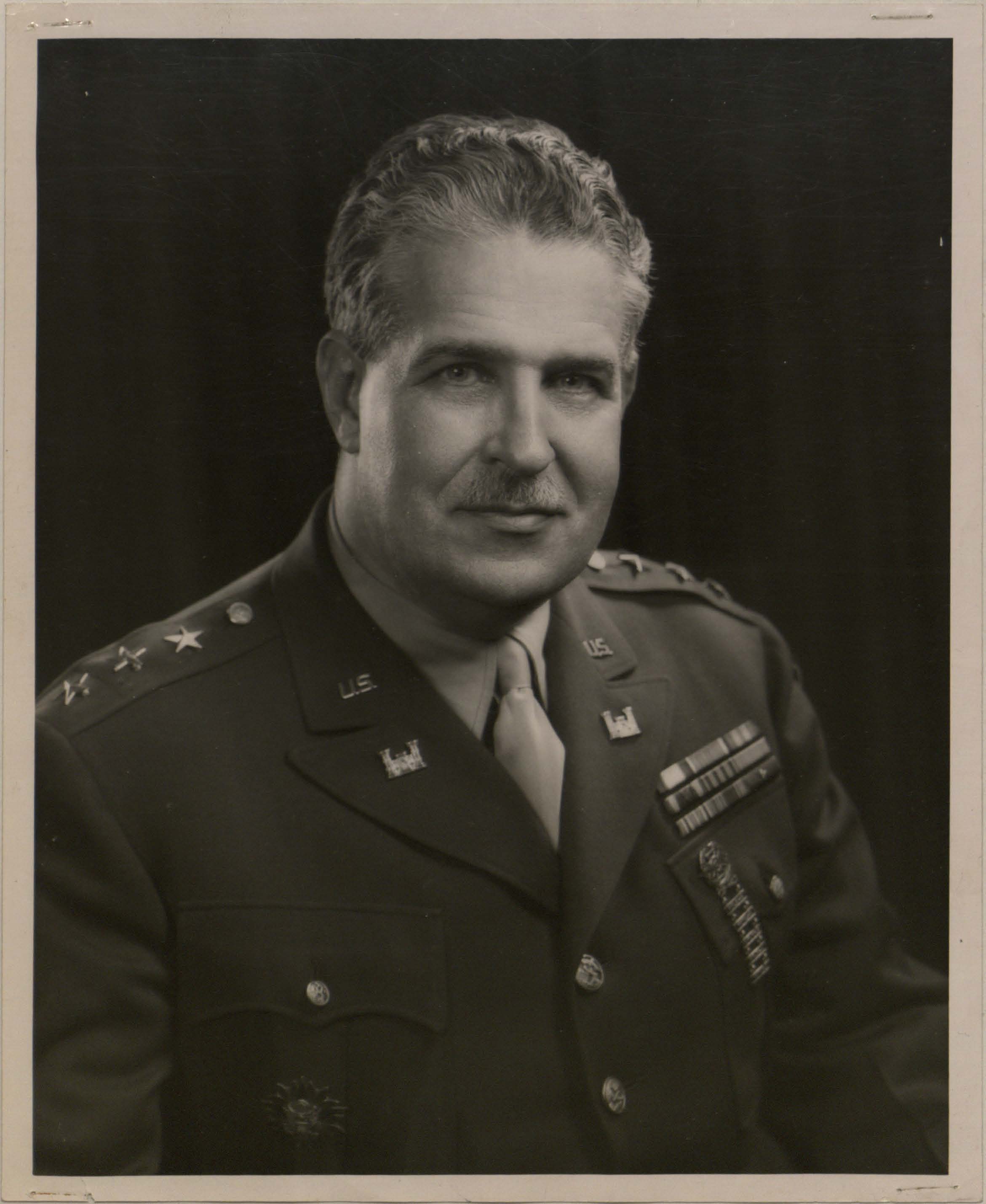
Portrait of Leslie Groves
The Least Charming Man in the Twentieth Century
In September 1942 a colonel in the Army Corps of Engineers was told he would not be going overseas. He was furious. He had just delivered the Pentagon — the largest office building on earth, built in sixteen months — and wanted a combat command, not another construction job. The new job was the atomic bomb. He took it, was made a brigadier general so the scientists would take him seriously, and inside three years had spent two billion dollars, built three secret cities, employed over 130,000 people, and produced a weapon that ended a war — without the secret leaking to the press, the Congress funding it blindly, or the vice president who would inherit it.
Leslie Groves was, by near-unanimous testimony, an unpleasant man: overbearing, contemptuous of expertise he did not share, obsessed with security to the point of paranoia, and physically enormous in a way he used. One Los Alamos physicist called him the biggest sonovabitch he had ever met. Groves knew, and did not care. He had a theory of himself, and it was correct: someone had to be the immovable object, and it was not going to be a scientist.
He is the archive’s cleanest ESTJ — not a visionary, not an innovator, but the man who converted an idea into concrete, schedules, and rail sidings by brute application of procedure and will. Nothing about the Manhattan Project’s organisation was conceptually new. All of it was executed faster and at greater scale than anyone had done it before.
An ESTJ whose dominant Te turned an unproven physics paper into an industrial empire — built on schedule, in secret, by a man who never once needed to understand the physics to run it.
Two Billion Dollars, No Delays
His first act in the job, on his second day, was to buy the Belgian Congo uranium ore already sitting in drums on Staten Island — more than a thousand tons of it — because the supply question would eventually become the binding constraint and he preferred to solve it before it existed. His second was to secure AAA procurement priority by walking into the War Production Board and refusing to leave without it. Te does not deliberate about sequence; it identifies the chain of dependencies and starts removing them from the front.
What followed was the largest industrial improvisation in American history, and its defining feature was a refusal to wait for certainty. At Oak Ridge he built two entirely different, mutually redundant uranium-enrichment plants — electromagnetic and gaseous diffusion — because nobody could tell him which would work, and a redundant plant was cheaper than a lost year. At Hanford he authorised full-scale plutonium reactors before Fermi’s Chicago pile had proved a chain reaction possible at all. When the B Reactor poisoned itself in 1944, the extra tubes DuPont’s engineers had insisted on over the physicists’ objections — a margin Groves backed — saved the schedule.
He ran all of it personally, from a modest office in Washington: read everything, decided fast, rarely revisited. His memoir is titled Now It Can Be Told, and its most revealing quality is how little wonder there is in it. To Groves the bomb was a construction project with an unusual specification.
Compartments, Procedure, and the Army Way
Groves was an army officer’s son who had grown up on posts, taken his commission from West Point, and finished fourth in the class of 1918. Everything he built at Oak Ridge, Hanford, and Los Alamos was built out of institutional forms he already knew: engineer districts, fixed-fee contracts with firms like DuPont and Stone & Webster, military security procedure, chain of command. The Manhattan Engineer District was named after a district office in New York because that is how the Corps of Engineers names things.
His signature policy — compartmentalisation — is Si taken to its extreme. Each worker was to know only their own task; the tens of thousands at Oak Ridge mostly had no idea what they were making. It was a spectacular security success: the program held for three years in a democracy with a free press. It was also the source of his permanent war with the scientists, who argued that a physicist who cannot see the adjacent problem cannot solve his own. He conceded the weekly Los Alamos colloquium to Oppenheimer and never stopped resenting it.
The One Unaccountable Hunch
Tertiary Ne in an ESTJ is narrow but occasionally decisive: an unexpected lateral association that the dominant function then enforces with total conviction. Groves used his exactly once, on the largest personnel question of the war. Every reasonable candidate to run the weapons laboratory was a Nobel laureate with administrative experience. Groves chose J. Robert Oppenheimer — no prize, no management record, a security file thick with communist associations, a theorist who had never run anything. The Military Policy Committee objected. Groves overrode them, and later said simply that Oppenheimer was the only man he met who understood the whole problem and desperately wanted the job.
He also created the Alsos Mission, sending scientific-intelligence teams into Europe behind the advancing armies to seize German nuclear documents and physicists — an invention with no precedent in army practice. And when copper for the separation plant’s magnet windings proved unobtainable, he borrowed some fourteen thousand tons of silver from the United States Treasury and wound them with that instead.
But it is worth being precise about the limits. These were tactical improvisations inside a fixed objective handed to him by others. Groves never asked what the weapon would mean, what should follow it, or whether the enterprise should exist. The frame was given; he filled it faster than anyone thought possible.
The Loyalty He Could Not Explain
Inferior Fi surfaces as a small number of private, non-negotiable commitments that the person cannot justify in their own operating language — and Groves’s was Oppenheimer. For three years he personally overrode his own security officers, who wanted the man removed, and in July 1943 signed a written directive ordering that Oppenheimer be cleared irrespective of the information in his file, because he was absolutely essential to the project. That is an emotional judgement dressed in administrative clothing, and Groves never gave a better account of it than that.
It also failed at the moment it was tested. Called before the 1954 security board, Groves defended Oppenheimer’s wartime loyalty warmly and then, asked whether he would clear him under the current criteria, said he would not. The answer was honest by his own procedural lights — the rules had changed, and Groves followed rules — and it was devastating. Loyalty, for an ESTJ, lives downstream of the standing regulation.
The unprocessed feeling more often came out sideways, as contempt for scientists as a class: undisciplined, self-important, forever talking about political consequences that were not their business. He put counter-intelligence agents on Niels Bohr and lectured him about keeping his mouth shut. It cost him nothing during the war and most of his reputation afterwards.
Why ESTJ Over ENTJ
Why not ENTJ?
The scale invites it — two billion dollars and three cities look like the work of a strategic architect. But an ENTJ’s Ni builds a new frame; Groves worked entirely inside an old one. Every instrument he used was standard Corps of Engineers practice: engineer districts, fee contracts, compartmented security, rank. He did not design the atomic age or think about what came after it — he was handed a specification and met it. And the abrasiveness cuts the same way: an ENTJ typically manages upward and outward with some strategic charm, while Groves was notoriously undiplomatic with the very scientists he depended on, because procedure, not persuasion, was his native register.
The Groves–Oppenheimer pairing is one of the great functional inversions in the archive, and it is why both men are legible only next to each other. Oppenheimer’s Ni saw the shape of the whole undertaking and could not have poured a foundation; Groves’s Te poured foundations at industrial scale and never once asked what the shape meant. Neither could have run Los Alamos alone. The mesa held because a man who thought in concrete decided, on an instinct he could not articulate, to protect a man who thought in visions — and because the man who thought in visions accepted the fence.
Connected Figures
Further Reading
- Now It Can Be Told: The Story of the Manhattan Project — Leslie R. GrovesHis own 1962 account — flat, procedural, unromantic, and the single best window into how he saw the job.
- The Making of the Atomic Bomb — Richard RhodesThe standard narrative history; unusually fair to Groves at a time when most accounts were not.
- Racing for the Bomb: General Leslie R. Groves, the Manhattan Project's Indispensable Man — Robert S. NorrisThe full-length biography, strong on the Pentagon years and the engineering culture he came out of.
- American Prometheus — Kai Bird & Martin J. SherwinEssential for the other half of the partnership, including Groves's 1943 clearance directive and his 1954 testimony.
