 Historical Figure MBTI
#1212 · 9-5-26 · The Mughal Empire
Faizi
Poet Laureate · Scholar · Translator
1547–1595
6 min read
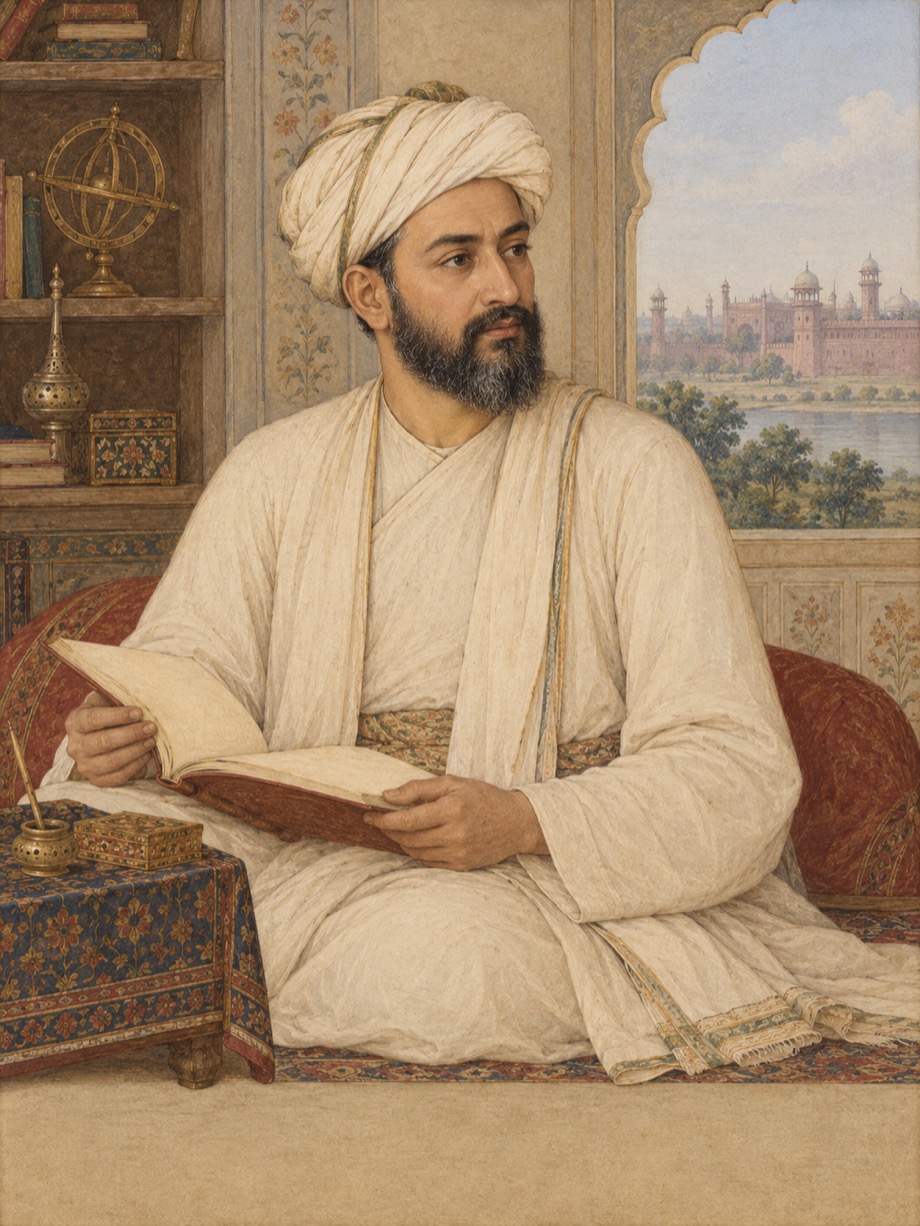
AI-assisted Portrait of Faizi
The poem with a scholar inside it
Faizi could write an elegy and translate a mathematical treatise. He could praise Akbar in verse and undertake a commentary constrained by the letters it was permitted to use. These were not separate identities competing for his attention. They belonged to a learned world in which verbal ingenuity, philosophical reflection, religious interpretation, and numerical knowledge could test the same cultivated mind.
The proposed INTP reading begins with his interest in how a problem can be reformulated and worked through. Poetry does not establish a feeling preference; mathematics does not establish a thinking preference. What makes the hypothesis worth considering is the range of formal and conceptual tasks he pursued, together with an intellectual independence visible within a court that paid for much of the work.
Born in 1547 and educated by his father, Shaikh Mubarak, he was the elder brother of Abu’l-Fazl. He entered imperial service before his brother, became tutor to Akbar’s sons, and received the title of poet laureate in 1589. The office supplied an audience and obligations. It did not confine his learning to celebratory verse.
Faizi tentatively reads as an INTP led by dominant introverted thinking: he makes language, inherited forms, and unfamiliar knowledge answer to a carefully worked problem.
Meaning under a chosen constraint
Faizi’s commentary Sawati al-Ilham was composed without dotted letters. A reader unfamiliar with Arabic-script writing can miss the severity of that choice: dots distinguish many ordinary letters, so excluding them removes much of the writer’s normal vocabulary. The problem is not simply to make the page look unusual. An extended argument must continue to function while the available means of expression have been deliberately narrowed.
Dominant introverted thinking is tentatively suggested by this willingness to pursue internal coherence under a stringent rule. The constraint creates an intellectual object whose success can be tested on its own terms. It also displays virtuosity to a learned audience. We cannot determine which satisfaction mattered more to Faizi, and such exercises had a history beyond his individual preferences. His achievement nevertheless makes the technical demands of language central to the portrait.
The mathematical translation raises a related question from the opposite direction. At Akbar’s request Faizi rendered Bhaskara’s Lilavati into Persian. He had to carry rules, problems, and explanations across linguistic and scholarly contexts. Modern analysis of the translation identifies omissions and changes rather than a transparent reproduction. The case for intellectual engagement survives those limitations. A translation that alters the order or fullness of explanation still asks what a new audience needs in order to understand an operation. This does not establish that Faizi independently mastered Sanskrit. Court translations frequently involved interpreters and intermediate explanations. The finished Persian text is evidence of an intellectual production, with several kinds of expertise behind the name on its title page.
The answer may live in another tradition
Faizi’s Nal o Daman drew on the story of Nala and Damayanti from the Mahabharata while entering the world of Persian narrative poetry. The project was neither a simple transcription nor a rejection of Persian literary inheritance. It placed an Indian narrative within a form readers could approach through familiar poetic expectations. The new work depended on perceiving an opportunity between traditions, then making something inside that space.
His intended sequence of five poems followed the example of Nizami’s Khamsa. Only two were completed. An unfinished project does not prove a personality preference, especially when death intervenes. The ambition does show that Faizi considered inherited forms extensible. They could host another story, another subject, another set of moral and philosophical associations. The model supplied a structure without deciding every possible use of it.
Auxiliary extraverted intuition offers a lens on this movement among alternatives: commentary, mathematics, narrative, and lyrical expression become connected fields of exploration. The proposed pattern is broader than a claim that he disliked boundaries. He often chose demanding boundaries and then looked for possibilities within them. His court position helped make the experiments available, while collaborators and learned interlocutors supplied knowledge he should not be credited with acquiring entirely alone.
Innovation with an old library behind it
Faizi’s learning was substantial before his official success. His father taught him within the established curriculum of a learned household, and his writing retained Persian forms rather than inventing a private literary language. His collected poetry included odes, lyrics, and elegies. Formal memory was a resource for invention: readers recognized the shape of a work and could appreciate what its author had changed.
His library, described after his death as containing several thousand volumes, ranged across literature, religion, philosophy, science, and medicine. The reported totals differ and should remain approximate. Its transfer to the imperial collection joined a personal accumulation of learning to a larger courtly institution. The books were not merely symbols of refinement. They supplied examples, authorities, and problems that could be revisited in another composition or inquiry.
Tertiary introverted sensing is a tentative interpretation of that retained store. It cannot be proved by owning books, and a scholar’s training explains much of the same behavior. The useful point is the interaction between recall and possibility. Faizi’s innovations were made with materials he had absorbed and forms he knew how to manipulate. Intellectual independence here means working upon an inheritance rather than having no inheritance.
An argument was not the whole person
Faizi interceded when Badauni incurred the emperor’s displeasure, despite the historian’s hostility toward him. The reported intervention complicates a picture made exclusively from intellectual conflict. Disagreeing with a man’s judgment did not require letting him suffer every consequence of displeasing a sovereign. Court access could be used for another person as well as for oneself.
Inferior extraverted feeling is the least secure part of the suggested stack. His tutoring, companionship, and intercession show participation in relationships, not their psychological inferiority. He also wrote moving elegies for his mother and a young son. Those losses should not become evidence for or against a thinking type. They demonstrate the limits of any portrait that lets formal ingenuity stand for the whole human being. His death in 1595 left his brother to help gather work that remained unfinished.
Why INTP Over INFP
Why not INFP?
INFP is a credible alternative given his personal lyrics, elegies, and independent spiritual interests. None of those activities establishes the priority of private values, just as the Lilavati translation cannot by itself establish analytical thinking. INTP receives a cautious preference because the surviving range of work repeatedly foregrounds formal manipulation and conceptual exploration. The choice remains uncertain without closer access to his ordinary decisions and to the full texture of his writing.
The hypothesis should illuminate the scholar inside the poet without making either identity a psychological category. His learning could serve curiosity, patronage, devotion, technical display, and grief in different works. A single public career accommodates several motives, and the accounts of admirers and hostile observers do not allow them to be cleanly separated.
Connected Figures
Further Reading
- Fayzi, Abu’l-Fayz — Munibur Rahman; Encyclopaedia IranicaAn overview of the poet’s career, extant works, and literary forms.
- On the Persian Translation of Bhaskara’s Lilavati by Abu’l Faiz Faizi at the Court of Akbar — Sreeramula Rajeswara Sarma and Maryam ZamaniA close analysis of what the mathematical translation preserves, changes, and omits.
- The Ain-i-Akbari — Abu’l-Fazl; translated by H. Blochmann and H. S. JarrettA detailed account of imperial institutions, learning, and the court’s view of its own order.
- Nal o Daman — FaiziThe narrative poem that brings an Indian story into a Persian literary project.
