 Historical Figure MBTI
#389 · 4-4-26 · Elizabethan England
Sir Francis Drake
Sea Dog · Circumnavigator · Scourge of the Armada
c. 1540 — 1596
9 min read
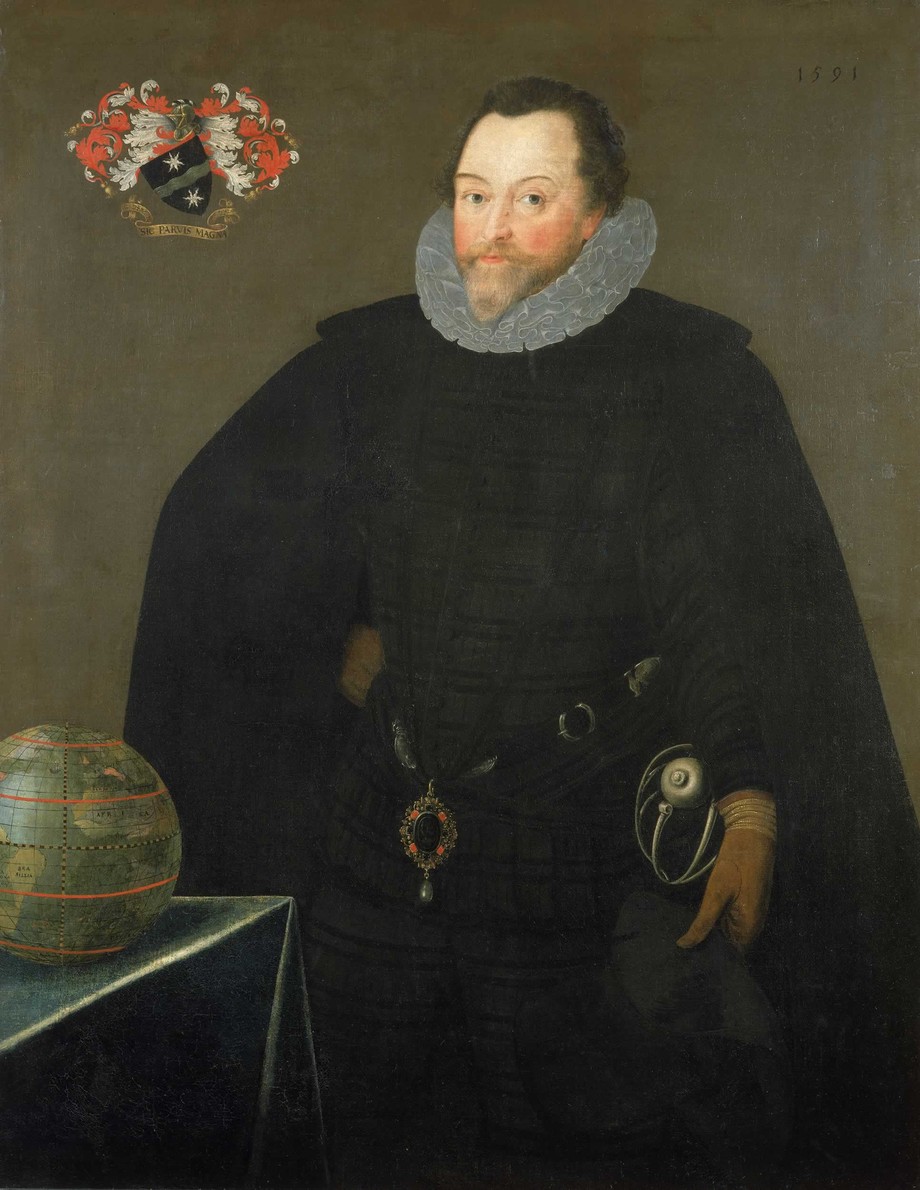
Portrait of Sir Francis Drake
The Farmer's Son Who Made Spain Tremble
He was born around 1540 in Devon, the eldest of a yeoman farmer's many sons, with no fortune, no title, and no claim on the world except the sea. He died fifty-six years later off the coast of Panama—an admiral and a knight, the most feared Englishman alive, with a price on his head in Spanish gold and a nickname the enemy spoke like a curse: El Draque, the Dragon. Sir Francis Drake did not inherit his place in history. He boarded it, cutlass in hand, and took it.
Between 1577 and 1580 he became the first Englishman to sail around the world, threading the Strait of Magellan and harrying the undefended Pacific coast of the Americas, returning in the Golden Hind so laden with plundered bullion that the voyage repaid investors forty-seven times over. Elizabeth I knighted him on the deck of his own ship. In 1587 he stormed Cádiz and burned the fleet Philip II was assembling—“singeing the King of Spain's beard”—then the following year helped break the Armada in the Channel. He was also a harder man than the legend allows: his first deep-sea voyages were in the slave trade with his kinsman John Hawkins, and on the circumnavigation he had a rival, Thomas Doughty, tried and beheaded on a Patagonian shore. He is a textbook ESTP—dominant Se that seized wind and wave and enemy in the live moment; auxiliary Ti that made the daring technically lethal; tertiary Fe that made men follow him to the ends of the earth; and inferior Ni that left him with no design larger than the next bold raid.
Drake was the ESTP buccaneer at full sail—a dominant Se that lived in the live moment of wind and wave and enemy, a cool Ti that turned daring into seamanship, and the swaggering confidence of a man who never met a situation he could not read and seize before anyone else had finished thinking.
The Master of the Living Moment
Se — dominant
Dominant extraverted sensing is total immersion in the physical present—the hand that knows exactly how much sail a rising wind will take, the eye that sees the gap in an enemy line a heartbeat before it opens. There has rarely been a purer demonstration than Drake at sea. Contemporaries who otherwise loathed him agreed: as a seaman he was without equal. He could hold a course through the murderous weather of the Strait of Magellan, navigate a Pacific coastline no Englishman had charted, judge a swell or a current by feel. The sea punishes hesitation and rewards the man who reads it moment to moment—and Drake was utterly at home in it.
His appetite for action was always pointed at something tangible: treasure, ships, ports, gold one could weigh in the hand. The raids on the Spanish Main were Se in its rawest form—not a strategy of conquest but a series of brilliant opportunistic strikes. At Cádiz in 1587 he sailed straight into a fortified enemy harbour, destroyed dozens of Spanish ships before the defenders could respond, and slipped out intact. During the Armada campaign he abandoned his station to chase the damaged Spanish flagship Rosario—indiscipline by any rule, but a perfect expression of the Se instinct that sees a prize and cannot let it pass. The legend of the interrupted game of bowls is a fable about this temperament: the man so completely the master of the present crisis that he could afford to finish his game first. It endured because everyone who knew him recognized the truth in it.
The Navigator's Cold Precision
Ti — auxiliary
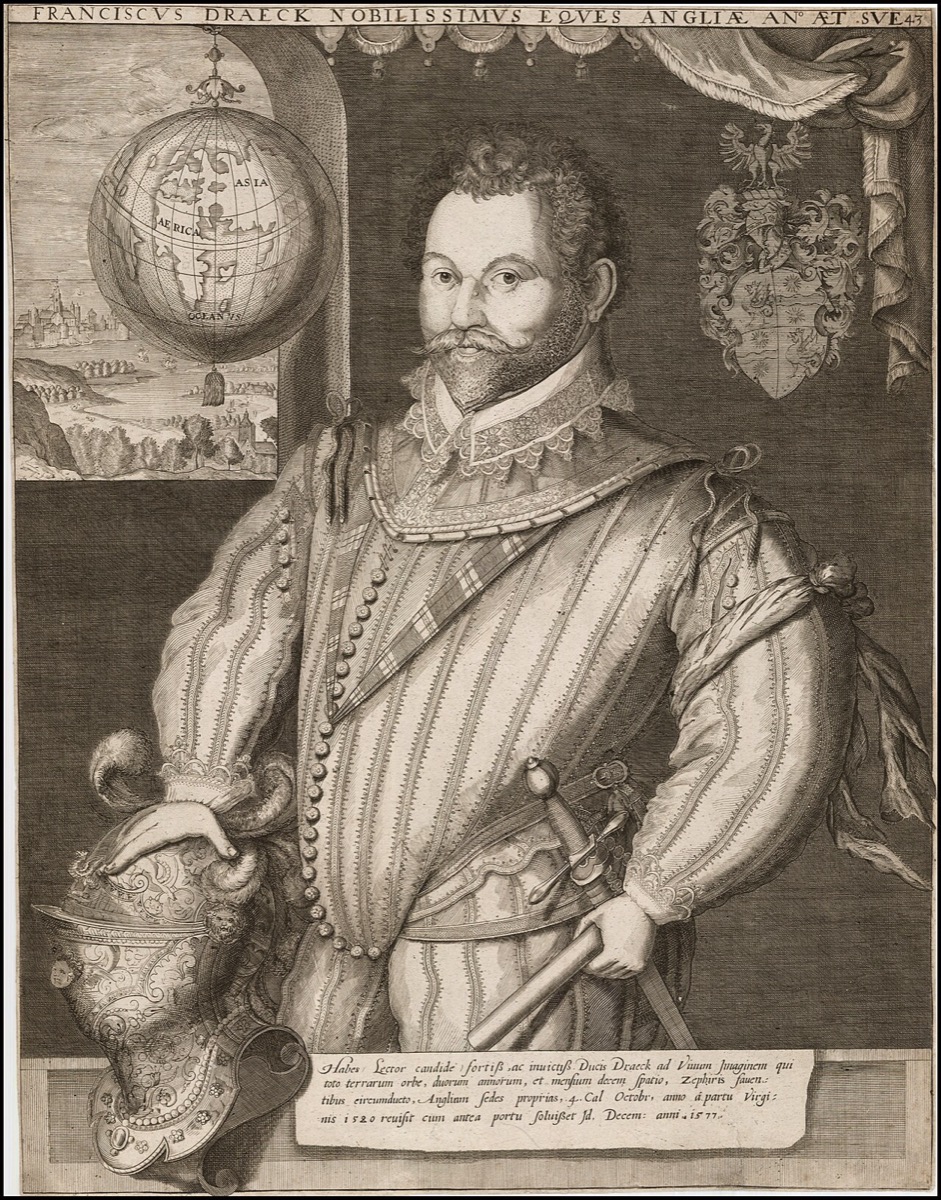
Auxiliary Ti is the craft that kept the boldness from being mere recklessness. Drake kept meticulous charts and journals, studied captured Spanish pilots' sailing directions, and absorbed the technical knowledge of oceans no Englishman had crossed. The circumnavigation was not only a feat of nerve; it was a feat of navigation. His tactical sense against the Armada was sharper still: Spain still thought of a naval battle as soldiers fighting on floating platforms—close, grapple, board. Drake and his fellow English captains understood that a faster, weatherly ship armed with long guns could stand off and pound from a distance, refusing the close fight entirely. That coldly logical reading of what the new ships could actually do is auxiliary Ti at work: not theory, but the practical analysis of a system in order to win with it.
Ti also explains the harder edges. The trial and execution of Thomas Doughty on the Patagonian coast was an act of brutal logic: a divided command on a voyage of that length could not survive, and Drake reasoned that a rival who questioned his authority had to be removed, gentleman or not. He dined with Doughty, took the sacrament with him, and had him beheaded—the same Ti capacity that let him weigh wind and gun and prize with complete detachment, turned to a darker use. Auxiliary Ti serves dominant Se; it does not soften it.
The Swagger That Men Would Follow
Fe — tertiary
Tertiary Fe in an ESTP is not empathy; it is charisma, showmanship, the instinct for the mood of a crowd and the gift of bending it. Drake commanded crews on voyages of years, into oceans no Englishman had sailed, against odds that should have produced mutiny ten times over—and they followed him, because he made them believe the impossible was merely the next thing they would do. He dined off silver plate to music in his cabin and let the crew see the style of the enterprise they had joined. The swagger was leadership.
The same Fe instinct made him a superb reader of a larger audience. When he returned in the Golden Hind he grasped the theatrical value of having Elizabeth I knight him on his own deck; he coined the phrase about singeing the King of Spain's beard because he knew it would be repeated. He was a self-mythologizer of genius, and the myth was a tool: it raised money, frightened the enemy, and bound the public to him. But tertiary Fe has limits—it did not extend to the Africans he helped transport in chains, nor to Doughty, nor to the Spanish townsfolk whose ports he sacked. It is the warmth of the showman, deployed in service of the self, not a settled concern for anyone beyond the footlights.
No Plan Beyond the Next Raid
Ni — inferior
Inferior Ni is the ESTP's blind spot: the long-range vision, the patient design that sees where a course must end years before it gets there. Drake had none. He raided because there was treasure to raid. The circumnavigation, which posterity remembers as a planned epic, was in execution a string of opportunistic strikes whose route was improvised around weather, plunder, and the need to escape the Spanish ships hunting him. He did not set out to map an empire or open a trade. He set out to take Spanish gold, and the voyage around the world was, in a sense, the shape that taking it happened to make.
Where sustained strategic vision was required, Drake fell short. The 1589 Counter Armada against Portugal dissolved into a series of local plundering actions; he was distracted toward prizes, objectives blurred, and the expedition limped home having achieved little. His death in 1596 is the inferior function's final word. His great years behind him, his luck running thin, he set out on one more Caribbean raid. The Spanish, who had had decades to learn from him, were ready; the ports fortified, the easy prizes gone. He succumbed to dysentery off Panama in January 1596. He had no second act, no larger design to retire into—nothing beyond the next raid. The man who lived entirely in the seized moment had, in the end, nowhere else to go.
Why ESTP Over ISTP
Why not ISTP?
The ISTP shares Drake's Se-Ti spine—cool technical mastery, a gift for reading a physical situation and acting on it. But the ISTP is the quiet, self-contained technician drawn to the problem rather than the crowd. Drake was the opposite: a bold, swaggering, crowd-leading commander who needed an audience and a deck full of men to lead, who mythologized himself for the nation and dined to music while he plundered. His Fe was loud and load-bearing where the ISTP's is buried. That hunger for the stage is the ESTP tell.
The ISTP would have done the seamanship and skipped the show. Drake could not skip the show; the show was how he led, how he raised his fleets, how he became El Draque. He read the live situation and seized it in front of his men, and the seizing was half performance. He was an extravert in the deepest sense—a man who became fully himself only in action, with an audience, in command. ESTP, not ISTP.
Connected Figures
Further Reading
- Sir Francis Drake — John SugdenThe fullest modern biography, drawing on Spanish as well as English sources.
- The Pirate Queen: Queen Elizabeth I, Her Pirate Adventurers, and the Dawn of Empire — Susan RonaldPuts Drake within the broader context of Elizabethan privateering and the undeclared war with Spain.
- The Elizabethan Renaissance: The Life of the Society — A. L. RowseRich background on the social and maritime world that produced Drake and his contemporaries.
- The Defeat of the Spanish Armada — Garrett MattinglyClassic narrative of the 1588 campaign in which Drake served as vice-admiral.
