 Historical Figure MBTI
#566 · 4-29-26 · The Ottoman Zenith
Giovanni Giustiniani Longo
Genoese Condottiere · Defender of the Walls · Captain of the Last Siege
c. 1418 — 1453
5 min read
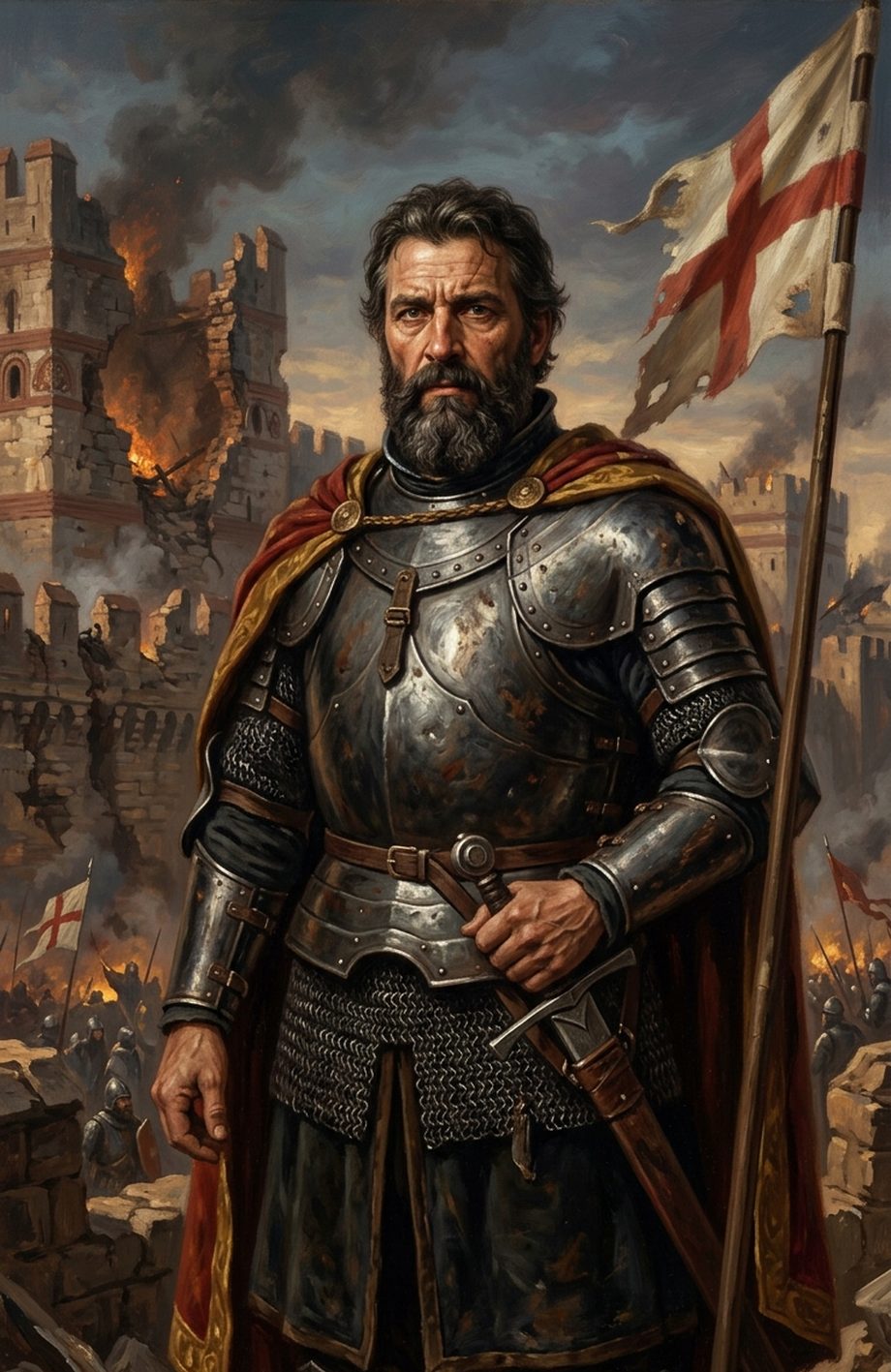
AI-assisted Portrait of Giovanni Giustiniani Longo
The Man Who Held the Wall
He was a soldier for hire who sailed toward a hopeless fight. In January 1453, as the Ottoman noose tightened on Constantinople, Giovanni Giustiniani Longo — a Genoese nobleman and one of the most celebrated siege captains of his age — ran two ships into the Golden Horn carrying seven hundred well-armed men he had equipped at his own expense. He came not because the cause was safe but because it was the biggest siege in the world, and he belonged at the center of one.
Constantine XI, the last emperor of the Romans, gave him command of the land walls — the stretch where Mehmed II would throw everything he had — and for seven weeks the condottiere held the most vulnerable ground in the city against the largest army in the world. He is the ESTP in his native element: the fighting man at his best in the thick of a fight.
Giustiniani is the ESTP soldier of fortune distilled: dominant Se reading the assault breach by breach and repairing the walls under fire, wedded to a Ti master's command of stone, timber, and the mechanics of a wall that holds or fails.
The Breach and the Stockade
Se — dominant
Dominant Se acts on the immediate physical world without hesitation, and Giustiniani's whole war was fought in the present tense. He posted himself at the Mesoteichion, the low stretch of wall where the ground was worst and Mehmed had trained his enormous cannon, and read the assault as it came — where the bombardment was biting, which tower was about to go — shifting his men to meet it in real time, commanding from the parapet itself rather than a map behind the lines.
His signature act was the nightly repair. When Mehmed's great gun smashed a section of ancient stone by day, his crews swarmed the gap after dark and threw up an outer stockade of earth, rubble, and timber — a rough, springy rampart that absorbed the cannonballs better than the masonry it replaced. Every morning the wall broken by day was whole again by dawn: Se remaking the defense faster than it could be destroyed.
The Mechanics of a Wall
Ti — auxiliary
What made Giustiniani worth an emperor's trust was that his boldness was married to expertise. Auxiliary Ti gave the ESTP's energy a technician's precision: he understood walls the way a master understands his craft — how a stockade should be angled to deflect a ball, why yielding earth defeated a cannon that shattered rigid stone. It is why the earthwork held where masonry failed, seven weeks against the most advanced artillery on earth. This is the Se-Ti pairing that produces the great tactical soldier: the nerve to stand in the gap, and the intelligence to know how to fill it.
The Voice on the Wall
Fe — tertiary
The defense was a brawl among strangers — Greeks, Genoese, and Venetians who mostly distrusted one another, thrown together on the same doomed rampart. What welded them was Giustiniani himself — his mere arrival a jolt of morale the chroniclers remembered for decades. Tertiary Fe let the fighting captain rally men out loud, in the open, directing the whole multinational defense by force of presence and coaxing bitter rivals to hold the same line.
This is the hinge of his type: Giustiniani did not fight as a solitary technician but led, visibly and audibly, and the men took their heart from watching him stand there — a courage tuned to one man's bearing that would, in the end, prove the fatal fact of the siege.
The Wound and the Gate
Ni — inferior
The end came where the ESTP's blind spot lives. Before dawn on 29 May 1453, at the climax of the final assault, Giustiniani was struck down — grapeshot or an arrow through his armor at close range. In agony, with the enemy pouring against the stockade he had held for weeks, he made a decision fixed entirely on the pain in his body: he ordered his men to carry him back through the gate to a ship. Constantine begged him to stay, knowing what his leaving would do. Giustiniani went anyway.
Inferior Ni is the failure to hold the long consequence in view when the immediate demand overwhelms. The sight of their commander borne off the wall broke the defenders' nerve; the line dissolved, the Ottomans surged through, and within hours the thousand-year city had fallen. The man who had read every hour of the siege so brilliantly could not, in his last hour, see past his wound to the catastrophe his exit would trigger. He died days later at sea near Chios.
Why ESTP Over ISTP
Why not ISTP?
The pull toward ISTP is genuine: both are Se-Ti tacticians, and Giustiniani's mastery of the stockade could belong to a quiet craftsman of war. But the ISTP is a lone technician who solves the problem in front of him and lets his work speak. Giustiniani did the opposite — he rallied and directed an entire fractious, multinational garrison out loud, in the open, and the defense held because men took heart from watching him. That is an extraverted commander of others, not an introverted master of his own craft.
The tell is the tragedy itself. The ISTP's Se turns inward onto the object; Giustiniani's turned outward onto the whole garrison at once. A lone craftsman's wound costs one soldier, but Giustiniani was so much the engine of the defense that the moment he left the wall, the wall fell — only an extravert's exit brings down an army.
Connected Figures
Further Reading
- The Fall of Constantinople 1453 — Steven RuncimanThe classic scholarly narrative of the siege — measured, authoritative, and still the standard account of Giustiniani's defense and its collapse.
- 1453: The Holy War for Constantinople and the Clash of Islam and the West — Roger CrowleyA vivid, fast-moving modern retelling — especially strong on the artillery, the day-by-day fighting at the walls, and the drama of Giustiniani's wounding.
- History of Mehmed the Conqueror — Kritovoulos (Michael Critobulus)A contemporary Greek account written for the victorious sultan — a near-firsthand source for the siege, seen from the Ottoman side.
