 Historical Figure MBTI
#564 · 4-29-26 · The Ottoman Zenith
Mehmed II
Sultan of the Ottoman Empire · Conqueror of Constantinople · Caesar of Rome
1432 — 1481
13 min read
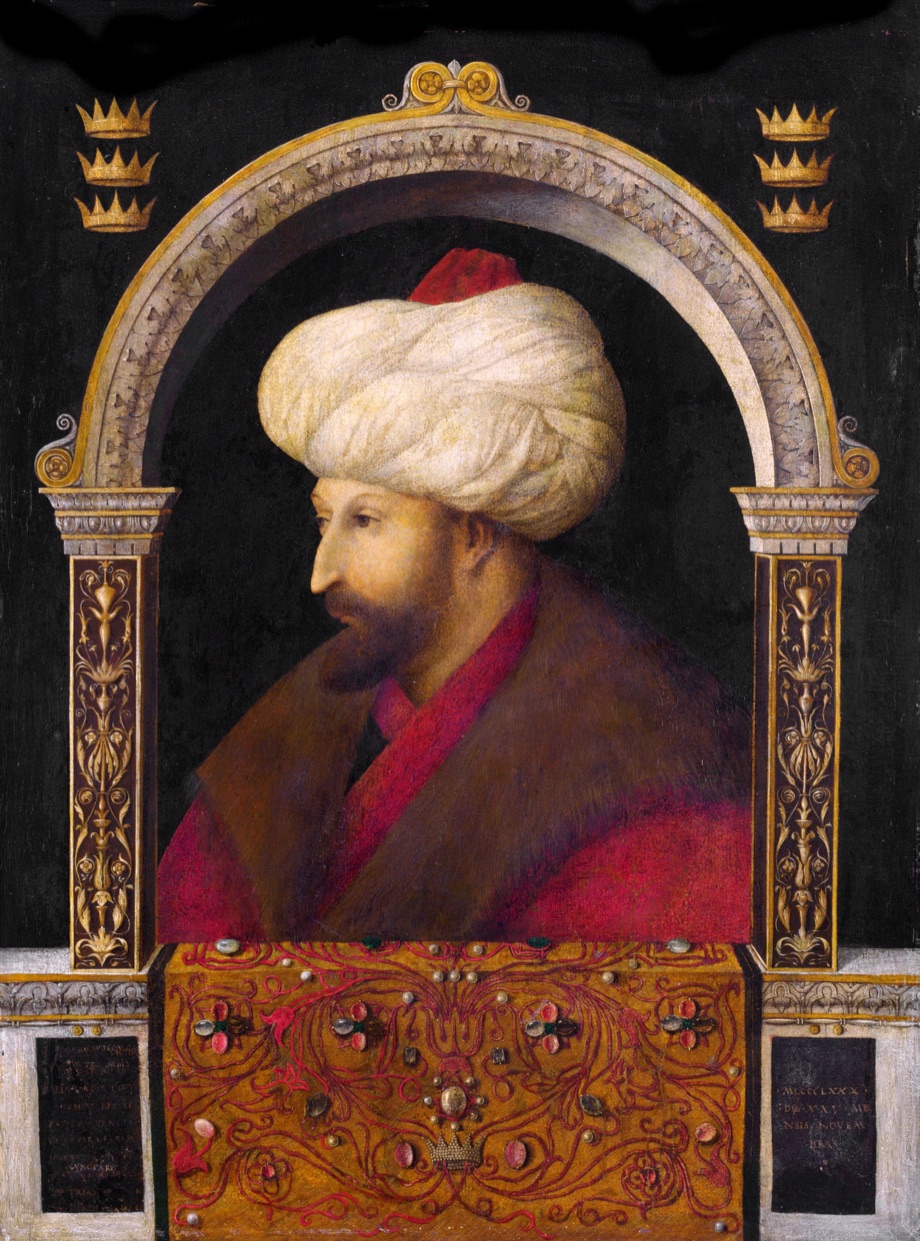
Portrait of Mehmed II
The Boy Who Would Not Tell His Beard
“If a hair of my beard knew my thoughts,” he is said to have told his intimates, “I would pluck it out.” It is the truest sentence anyone ever spoke about Mehmed II, and he spoke it about himself. Here was a sultan who ruled an empire, led its armies in person, and codified its law — and who kept his real intentions so completely sealed that even the men closest to him learned his plans only when they had already become facts. He was not secretive out of cunning alone. He was secretive because the vision that drove him lived entirely inside his own skull, a single fixed image of the future that he had carried since boyhood and would spend his whole life dragging into reality: the walls of Constantinople breached, the last Caesar dead, and himself enthroned as the new Roman emperor of a reunited world.
Born in 1432, the son of Murad II, he was made sultan as a boy of twelve, found wanting, and set aside — a humiliation he never forgot — before returning to the throne in 1451 at nineteen. Within two years he did the thing that Islam had dreamed of for eight centuries and that every previous besieger had failed to do. On 29 May 1453, at the age of twenty-one, he took Constantinople. The thousand-year-old Theodosian walls fell to his cannon; the last emperor, Constantine XI, vanished fighting in the breach; and Mehmed rode his horse into Hagia Sophia and made the greatest church in Christendom a mosque. He was not yet finished. For the next twenty-eight years he pursued the rest of the dream with the same cold method — Serbia, the Morea, Trebizond, Bosnia, sixteen years of war with Venice — styling himself Kayser-i Rûm, Caesar of Rome, and dying in 1481 with his army pointed at Italy and the city of Rome itself.
The archive is full of conquerors, and it is easy to file Mehmed among them as one more commanding general. That is a mistake. His power was not the extraverted battlefield charisma of a Genghis Khan; it was inward, cerebral, and patient — the power of a man who saw one future with unbearable clarity and bent every resource of an empire toward it for thirty years. He is the rare thing: a Ni-dominant conqueror, an INTJ on a throne.
Mehmed is the INTJ in imperial form: a mind ruled by Ni's single, secret vision of the future — the new Rome — executed through Te's tireless machinery of cannon, law, and administration. Not a general who happened to conquer, but a strategist for whom conquest was the disciplined output of an idea he had held since he was a boy.
The Single Secret Vision
Ni — dominant
Dominant Ni is the mind that fixes on one future and cannot let it go — a private, convergent certainty about how things must end, held so tightly that the present becomes merely the raw material to be shaped toward it. Everything about Mehmed points back to a single such image: Constantinople taken, and himself as the heir of Caesar. He did not improvise his way to it. Contemporaries recorded that as a young man he would trace the city's walls on paper and interrogate anyone who had seen them; that he studied the failed sieges of the past to learn why they had failed. When he returned to the throne in 1451, his first great act was not a battle but a wall of his own — the fortress of Rumeli Hisarı, thrown up on the European shore of the Bosphorus in a single summer to strangle the City's sea lifeline. He was building the conclusion before he had fought the war.
The secrecy that so unnerved his court was Ni's natural mode: a vision fully formed inside cannot be shared, only executed. His own vow — that he would pluck out a hair of his beard that knew his thoughts — was not a boast but an accurate description of how the function works. His cautious grand vizier, Çandarlı Halil Pasha, argued against the siege as reckless and unwinnable; Mehmed simply proceeded, having already seen the outcome others could not. When the walls finally fell, he had the vizier executed. It reads as ingratitude only until you understand that Halil had doubted the vision, and to the Ni mind a doubter of the vision is a permanent structural risk.
What separates Mehmed from an ordinary strategist is that the vision did not stop at the City. Constantinople was the keystone of a larger idea: the reunification of the Roman Empire under a new Caesar. He took the title Kayser-i Rûm in deadly earnest and spent the rest of his life executing its logic — mopping up the last Byzantine successor state at Trebizond in 1461, absorbing the Balkans, checking the eastern rival Uzun Hasan at Otlukbeli in 1473, reducing the Crimean Khanate to a vassal, and finally, in 1480, landing an army at Otranto in the heel of Italy with Rome itself in his sights. Only his death in 1481 halted the march. The through-line across four decades is not opportunity seized but a single foreseen end, patiently approached.
Cannon, Code, and the Order of the World
Te — auxiliary
Auxiliary Te is the arm of the INTJ: the systematizing, engineering, institution-building power that converts an inner vision into working machinery. Mehmed's Te is written first in metal. The Theodosian walls had turned back besiegers for a thousand years, so Mehmed did not besiege them conventionally — he re-engineered the problem. He hired the Hungarian founder Orban, whom the Byzantines could not afford to keep, and commissioned him to cast the largest bombard the world had seen, the monstrous “Basilica” that hurled stone balls the weight of a man and had to be dragged to the walls by teams of oxen. When the great boom-chain across the Golden Horn kept his fleet out of the harbor, he refused to accept the obstacle on its own terms: he had scores of ships hauled overland on greased log rollers, across a hill and behind the enemy's defenses, appearing in the harbor overnight. This is Te at its purest — not the reckless improviser but the engineer who redefines the constraint until it yields.
The same faculty ran the peace. A lesser conqueror sacks a city and moves on; Mehmed took a ruin and rebuilt it into the capital of a world empire. He repopulated depopulated Constantinople by decree, resettling peoples from across his domains; he built Topkapı Palace and the Grand Bazaar; he laid the administrative and commercial bones of the city that became Istanbul. And he governed with a chilling systematic tolerance that was itself a Te calculation: rather than expel the conquered Greeks, he reinstalled a Greek Orthodox Patriarch, Gennadios, and protected Christians and Jews as taxpaying subjects under his law. Faith was a variable in a functioning system, and a productive tax base was worth more to the order of the empire than the satisfaction of persecution.
Nowhere is his Te colder or clearer than in the law. Mehmed codified the secular statutes of the empire in the Kanunname, and in it legalized royal fratricide — the sultan's right, on accession, to execute his own brothers to forestall civil war. He justified it not with cruelty but with a phrase of terrible administrative logic: it was permissible “for the order of the world.” That sentence is the signature of the type. The end — a stable, unchallenged succession — justified a means most men could not stomach, and Mehmed wrote it into permanent law with the dispassion of a man balancing an equation.
The Private Renaissance
Fi — tertiary
Tertiary Fi is the INTJ's interior life — a private world of taste, conviction, and personal identity, kept largely hidden and answerable to no one but the self. In most conquerors it barely registers. In Mehmed it produced one of the strangest and most human things about him: a ferocious, genuinely private intellectual appetite that had nothing to do with statecraft and everything to do with who he believed himself to be. He read and spoke Greek, Latin, Persian, Arabic, and Hebrew. He studied Ptolemy's geography and had a world map prepared. He collected Greek manuscripts and Western art, and he kept scholars and theologians at his court to debate before him — not for policy, but for the sheer pleasure of the argument.
The revealing detail is that this appetite reached across the very civilization he was at war with. In 1480, at the height of his campaigns against Venice, Mehmed asked the Venetian Republic to send him a painter, and it sent Gentile Bellini, who spent more than a year at the Ottoman court and painted the famous portrait of the sultan — a spare, thoughtful, unmistakably Renaissance face beneath the turban. That a Muslim conqueror styling himself Caesar of Rome should want a Venetian master to fix his likeness in the Western manner is pure tertiary Fi: a private, idiosyncratic sense of self that overrode every ideological boundary because it answered only to his own conviction of what he was.
The man who made Hagia Sophia a mosque also sat for a Venetian painter and collected the manuscripts of the empire he had destroyed. The conquest was Ni and Te; the collector was Fi — a self so privately certain it saw no contradiction in inheriting the enemy's civilization even as he ended it.
This is why he identified so completely as heir of Rome rather than merely its destroyer. He did not see himself as ending the classical world but as continuing it under a new master. The Fi conviction — I am the legitimate successor of the Caesars — was intensely personal, unprovable, and, for Mehmed, absolutely settled. It was the private faith beneath the public machinery, and it explains a life that mixed devastation and connoisseurship in a single unblinking person.
The Fleet Over the Hill
Se — inferior
Inferior Se is the INTJ's capacity for sudden, decisive engagement with the physical present — usually the least developed function, but capable, under the direction of the dominant vision, of astonishing bursts of concrete boldness. Mehmed led sieges in person; he was on the field, in the danger, at Constantinople and after. And his war is remembered for exactly the kind of audacious physical stroke that looks, at first glance, like the work of a pure sensor: the ships dragged overland into the Golden Horn, the giant cannon, the storming of the greatest walls in the world.
But the tell is that every one of these flourishes served the decades-long plan. Hauling the fleet across a hill was not the improvisation of a tactician exploiting a fleeting opening; it was the solution to a specific obstacle blocking a foreseen objective he had been approaching for years. The Se was harnessed — a tool the strategist reached for when the vision required a physical act no plan could accomplish on paper. It never ran him. He did not fight for the thrill of the fight, and he did not chase the momentary advantage for its own sake; he applied overwhelming physical force at the precise point his long calculation had identified.
Where inferior Se shows its underside is in his relationship to the present as such. Mehmed could not simply stop and enjoy a won position; the vision always pulled him toward the next objective. There was no natural resting point — Serbia, the Morea, Trebizond, Bosnia, Venice, Otranto — because a man ruled by the future is never fully in the present he has secured. The same faculty that let him haul a fleet over a hill in a single night left him unable ever to sit still inside his own conquests. He died in the saddle, marching, at forty-nine.
Why INTJ Over ENTJ or ESTP
Why not ENTJ?
He led armies in person, so the commanding-general reading is tempting — and this archive is full of ENTJ conquerors: Genghis Khan, Kublai Khan, Baibars. But the ENTJ's power is extraverted: field-presence, force of command, the charisma that organizes people in the room. Mehmed's power was the opposite. It was inward and secret — “if a hair of my beard knew my thoughts” — and it flowed from private vision and calculation, not from the ability to fill a tent with his personality. He was feared for what he had already decided, not for how he dominated a conversation. That is Ni leading Te, not Te leading Ni.
Why not ESTP?
The audacious set pieces — the fleet hauled over the hill, the monstrous cannon, the storming of the walls — look like ESTP tactical genius, the opportunist seizing the live moment. But the ESTP reads the present and strikes; Mehmed served a plan he had carried since boyhood. Every flourish was subordinate to a foreseen end decades in the making — the reunification of Rome under a new Caesar. The dragging of the ships was not improvisation but the engineered solution to a known obstacle blocking a fixed objective. Se was his tool, not his master.
The distinction is one of direction, not degree. Mehmed had the ENTJ's command and the ESTP's nerve, and used both — but they were instruments of something that neither type leads with: a single interior image of the future so complete that a man would keep it secret from his own beard and spend thirty years, an empire, and a thousand-year city making it true. The conqueror in the room was real. The conqueror who mattered was the one nobody could see — the strategist inside, running the whole long calculation alone.
Connected Figures
Further Reading
- Mehmed the Conqueror and His Time — Franz BabingerThe classic scholarly biography — exhaustive, still the foundational modern study of the life and the reign.
- 1453: The Holy War for Constantinople and the Clash of Islam and the West — Roger CrowleyThe most vivid modern narrative of the siege — gripping on the cannon, the boom-chain, and the fleet dragged overland.
- The Fall of Constantinople 1453 — Steven RuncimanThe elegant, authoritative account of the siege from the Byzantine side — the standard work for a generation.
- The Ottoman Empire: The Classical Age, 1300–1600 — Halil İnalcıkThe definitive institutional history — essential for understanding the Kanunname, the devshirme system, and Mehmed's statecraft.
- The Grand Turk: Sultan Mehmet II — Conqueror of Constantinople — John FreelyA readable single-volume life of the Conqueror, strong on the Renaissance mind — the Bellini portrait and his intellectual court.
