 Historical Figure MBTI
#546 · 4-26-26 · The Mamluk Sultanate
Baibars
Sultan of Egypt · Victor of Ain Jalut · The Slave Who Broke Two Empires
c. 1223 — 1277
9 min read
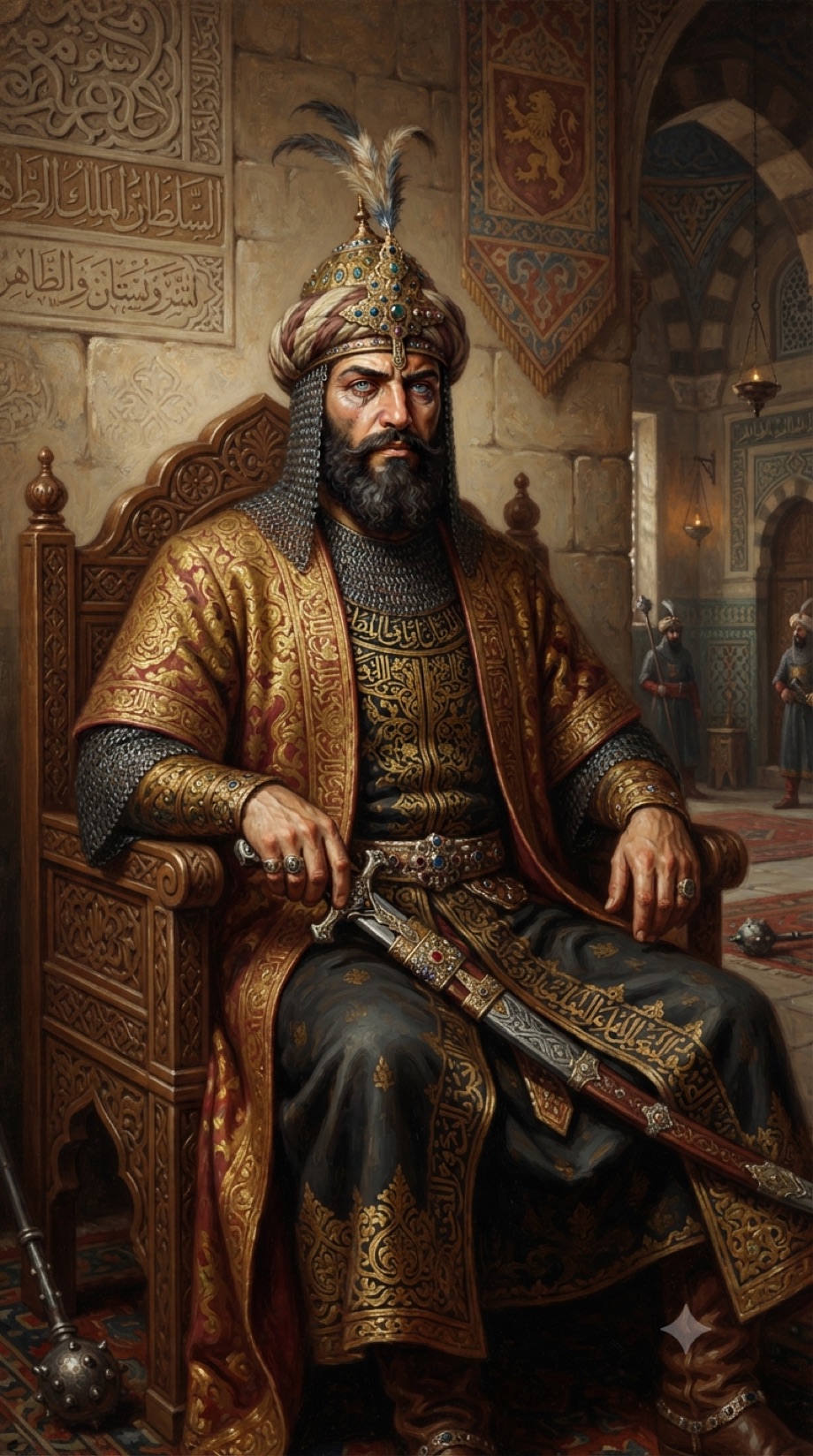
AI-assisted Portrait of Baibars
The Slave Who Built a State
He was sold twice. A Kipchak boy of the steppe north of the Black Sea, swept up in the same Mongol upheavals that would define his life, Baibars was carried into the slave markets of the Near East and priced like livestock — tall, powerful, blue-eyed, but with a flaw in one eye that lowered his value, so that a first buyer looked him over and sent him back. Half a century later that returned merchandise would command the richest throne in the Islamic world, install and depose caliphs, and hand the Mongol Empire the first strategic defeat in its history. Few lives so completely refuse the station they begin in.
Baibars — al-Malik al-Zahir Rukn al-Din Baybars al-Bunduqdari (c. 1223–1277) — rose through the Bahriyya, the elite slave-soldier regiment of the last Ayyubid sultans, and made his name in two of the pivotal battles of the thirteenth century. At Mansura in 1250 he devised the ambush that annihilated the crusader vanguard of Louis IX in the streets of the town. At Ain Jalut in 1260 he commanded the vanguard that broke the seemingly invincible Mongols. Both were feats of live-moment battlefield genius. But the reason to remember Baibars is not how he fought. It is what he built on top of the fighting: a centralized, disciplined war-state, welded to a manufactured legitimacy, engineered to outlast him — and it did, by roughly two and a half centuries.
That is the tell. The tactician who wins and then drifts is one kind of man. The tactician who converts every victory into an institution — a caliphate, a postal system, a dynasty, a doctrine of holy war — is another. Baibars is the second kind, which is why the sharp, present-tense brilliance on the battlefield is the least interesting thing about him.
Baibars is the ENTJ in its most formidable form: a Te commander who read the whole geopolitical board years ahead and bent it to a single Ni vision — a Sunni war-state at the center of the Islamic world, with himself, a sold slave, as its indispensable architect.
The Machinery of Rule
Te — dominant
Dominant Te builds systems that produce a result, and Baibars built the most efficient war-state of his century. The signature achievement is the barid — a lightning postal-relay network of horse stations and carrier pigeons that could carry an order or an intelligence report from Cairo to Damascus in roughly four days. It was not a convenience; it was a nervous system. It meant a sultan in Egypt could feel a Mongol probe on the Euphrates within the week and move against it, that no province could revolt faster than Cairo could learn of it. Baibars grasped that an empire is only as fast as its information, and he made his the fastest in the region. That is Te at its purest: effectiveness as the highest value, infrastructure as the real weapon.
Everything around the barid was cut from the same cloth. He rebuilt fortresses razed by the Mongols and garrisoned the frontier; dug canals and sank wells; secured the pilgrimage roads to Mecca so that the caravans moved under his protection and his prestige; raised the great Mosque of Baybars in Cairo. He centralized the administration and disciplined the army until the Mamluk military machine was the terror of the eastern Mediterranean. He was ferocious to his enemies and exacting with his own officials — a man who measured a reign by what it could reliably do, not by what it felt. The crusader states learned this by attrition: Caesarea and Arsuf in 1265, Safed, the great walled city of Antioch in 1268, the Hospitaller stronghold of Krak des Chevaliers in 1271, each reduction a methodical subtraction from a map he intended to clear.
The deepest Te signature is durability. A warlord wins battles; an administrator builds something that keeps working after he is gone. The apparatus Baibars assembled — the bureaucracy, the caliphal legitimacy, the frontier defenses, the disciplined slave-army that recruited and reproduced itself — outlived him by some two hundred and fifty years, carrying the Mamluk Sultanate down to the sixteenth century. He did not merely seize a state. He engineered one to run without him.
Reading the Whole Board
Ni — auxiliary
Auxiliary Ni gives Te its horizon — a single convergent picture of how the world will fall out, years ahead, toward which all the maneuvering bends. Baibars' masterstroke was not a battle but an alliance. The Mongols were not one thing; they were a house dividing against itself. When Hulagu, the Ilkhan who had sacked Baghdad and menaced Syria, fell into enmity with his cousin Berke Khan — the Muslim convert who ruled the Golden Horde — Baibars saw the fracture and drove a wedge into it. He courted Berke, made common cause with one branch of the Mongol world against another, and manufactured a structural advantage that no single victory could have bought: an enemy permanently distracted at his own back. That is Ni–Te working in concert — not reacting to the Mongols in front of him, but reading the entire geopolitical field and engineering the terms of the whole contest.
The same long vision produced his most audacious act of statecraft. When Hulagu destroyed the Abbasid Caliphate at Baghdad in 1258, he did not merely kill a caliph; he decapitated the symbolic center of Sunni Islam. Baibars understood the vacancy as an opportunity most men would not even have recognized. In 1261 he tracked down a fugitive of the Abbasid house, installed him in Cairo as caliph, and had himself invested by the man's authority. He did not want the caliph — he kept him powerless, a ceremonial fixture. He wanted the institution. By transplanting the caliphate to Cairo, Baibars crowned his sultanate as the legitimate heart of the Sunni world and turned a parvenu slave-dynasty into the sanctioned defender of the faith. It was legitimacy engineering of the first order: a symbol acquired not for its power but for what it made possible.
The ESTP reading dazzles at Ain Jalut and misses the caliph in Cairo. Anyone can want a throne; Baibars wanted the machinery of legitimacy that would make his throne unassailable for two centuries — and he saw, years before it mattered, exactly which fugitive to crown to get it.
The Feigned Retreat
Se — tertiary
Tertiary Se gives the ENTJ strategist a gift for decisive action in the live moment — the ability to read a physical situation as it unfolds and strike at the exact instant it breaks open. In Baibars it was spectacular. At Mansura in 1250, he lured the crusader vanguard — Templars and the rash Robert of Artois, brother of Louis IX — into the narrow streets of the town and closed the trap, annihilating them where their cavalry could not maneuver. It shattered the Seventh Crusade. His trademark was the feigned retreat: the calculated show of weakness that draws an overconfident enemy onto prepared ground, then turns and destroys him.
Ain Jalut in 1260 was the same instrument used against a far greater foe. Commanding the vanguard under Sultan Qutuz, Baibars is credited with the feint that sprang the trap on the Mongol army of Kitbuqa in the hills of Galilee. The Mamluks broke the Mongols, took Kitbuqa, and executed him — and the aura of Mongol invincibility, unbroken from China to the gates of Egypt, died in an afternoon. This is the bodily, present-tense mastery that makes the ESTP reading so tempting: a man visibly at home in the chaos of the field, seizing the decisive moment with perfect timing and nerve.
But in Baibars the Se is tertiary — a weapon in the service of the plan, not the engine of the man. The feigned retreat is itself the giveaway. It is not the impulse of a thrill-seeker; it is a disciplined deception that only works if the commander has already mapped the whole engagement and can hold his nerve while pretending to lose. The tactics were dazzling. They were also entirely instrumental. Every ambush served an end that reached far past the battlefield.
The Knife and the Cup
Fi — inferior
Inferior Fi is the ENTJ's thin and buried interior — a private register of loyalty and grievance that the instrumental mind overrides almost completely, surfacing mostly as raw personal feeling under the pressure of ambition. Baibars rose by the knife, and the pattern is unsettlingly consistent. He was among the murderers of the last Ayyubid, Turanshah, in 1250. Ten years later, weeks after the shared triumph at Ain Jalut, he murdered his own sultan Qutuz on the march home — reportedly because Qutuz had reneged on a promised reward, the governorship of Aleppo — and was acclaimed sultan over the still-warm body. The feeling that moved him was not conscience but the sharp, personal sting of a debt unpaid.
What little the interior showed, it showed in service of the objective. He held loyalty to the Bahriyya that had made him — he had once fled into years of Syrian exile after Sultan Aybak murdered the Bahri leader Aqtay — and his relentless holy war against the crusaders carried a genuine ideological charge, a sincerity about defending Islam that the caliphal theater both exploited and, in some measure, expressed. But the Fi never governed. It colored a life otherwise ruled by cold calculation; it did not soften it.
The end has the shape of a moral that his own age could not resist drawing. By tradition, Baibars died in Damascus in 1277 from poisoned kumiss — fermented mare's milk he had himself prepared for another man, an Ayyubid prince he meant to remove, and drank by mistake. Whether or not it is literally true, the story fixed itself to him because it fit: the man who rose by the knife and the cup was undone by his own poisoned cup. The inferior function's ledger, closed at last by the very instrument he had raised it with.
Why ENTJ Over ESTP or INTJ
Why not ESTP?
The case for ESTP is seductive, and it rests on real evidence: the feigned retreats, the street ambush at Mansura, the perfectly timed feint at Ain Jalut are Se tactical genius of the highest order. But that is how Baibars fought, and tactics are not a personality type. The ESTP is an opportunist of the moment who wins the fight in front of him and then drifts; Baibars won the fight and then built a caliphate, a postal empire, a doctrine of holy war, and a dynasty that outlasted him by two and a half centuries. He allied with Berke Khan against Hulagu by reading the whole board years ahead. That is Te–Ni playing the entire game, not Se seizing the hand it is dealt.
Why not INTJ?
The strategic depth might suggest an Ni-dominant planner working behind the scenes. But Baibars was overwhelmingly extraverted and hands-on — front-line at Mansura and Ain Jalut, personally leading raids and sieges, personally wielding the knife against Turanshah and Qutuz, personally driving a bureaucracy and a frontier and an army. The INTJ engineers from a remove; Baibars engineered by commanding, in the field and at the center, every day. His dominant function reaches outward into the world of action and organization — that is Te leading, with Ni as its instrument, not the other way round.
The precedent in this archive is exact. Robert the Bruce is typed ENTJ against the same "why not ESTP?" objection — the same guerrilla-tactician surface stretched over state-founder substance — and, tellingly, both men climbed to their thrones over a body: Bruce stabbed Comyn before the altar at Greyfriars, Baibars helped kill Turanshah and then murdered Qutuz. The battlefield brilliance is the foil, not the answer. Where the ESTP wins the battle and the INTJ maps the war from the shadows, the ENTJ does what Baibars did: wins the battle, installs the caliph, builds the postal roads, writes the legitimacy, and founds the state — commanding the whole of it in person, and arranging it to run long after he is gone.
Connected Figures
Further Reading
- The Lion of Egypt: Sultan Baybars I and the Near East in the Thirteenth Century — Peter ThorauThe standard scholarly biography — the fullest and most authoritative account of the life and reign.
- Mongols and Mamluks: The Mamluk-Ilkhanid War, 1260–1281 — Reuven Amitai-PreissThe definitive study of the struggle with Hulagu's Ilkhanate — essential on Ain Jalut, the Berke alliance, and the wider strategy.
- The Middle East in the Middle Ages: The Early Mamluk Sultanate, 1250–1382 — Robert IrwinThe best single-volume history of the sultanate Baibars consolidated — the state, the army, and the institutions behind the wars.
- The Age of the Crusades: The Near East from the Eleventh Century to 1517 — P. M. HoltPlaces Baibars within the long arc of the crusader states and their destruction — strong on the diplomacy and the caliphal restoration.
- The Knights of Islam: The Wars of the Mamluks — James WatersonA vivid military history of the Mamluk war-machine — the tactics, the slave-soldier system, and the campaigns against Mongols and crusaders.
- Sirat al-Zahir Baybars — Anonymous (medieval Arabic folk epic)The vast popular romance that turned Baibars into a legend — the folkloric source that made him a hero on the scale of Arthur or Robin Hood.
